

By Bjorn Fehrm • Aerospace Analyst
October 2, 2026
We started looking at thermoplastic composites last week. The thermoplastic matrix behaves like the plastics we use every day; it melts when heated. The plastics used for aeronautical thermoplastic composites have a very high melt processing point: 380°C to 400 °C for the PEEK variant and over 305 °C for LMPEAK (Low Melt PEAK).
The melted viscosity is thick like honey, so dry fiber infusion is not a viable manufacturing method. Instead, different variants use heated closed molds, bringing heat to the matrix and forcing the composite into shape.
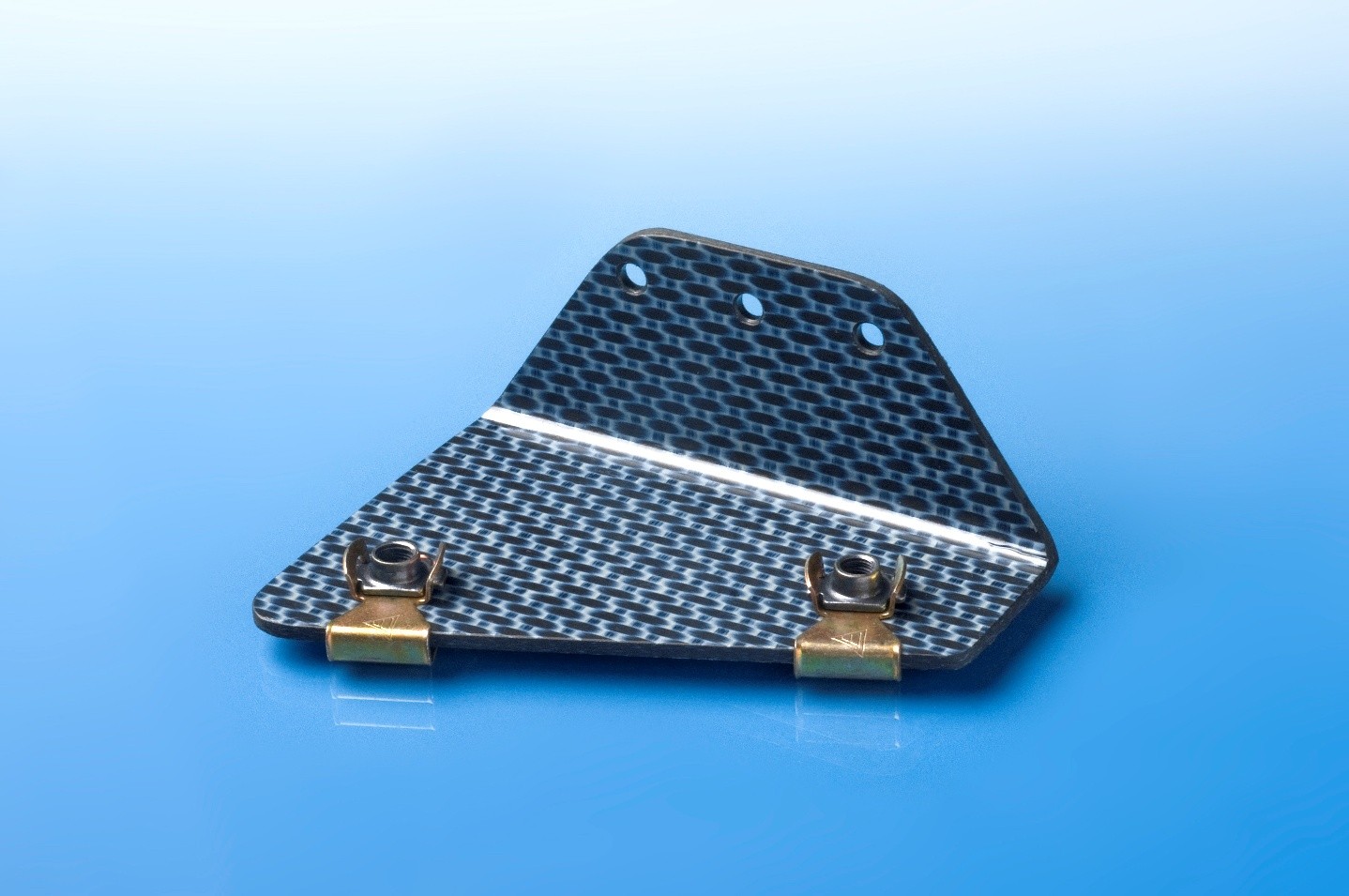
The matrix and reinforcing fibers are often combined into a preform before introduction to the tool, which then forms the final shape. This method has been used in aeronautics to create small items like clips and brackets for the last 20 years. Figure 1 shows a fuselage bracket produced for the A350-900. The method is fast and economical for smaller items.

Figure 1: An A350 bracket to attach items to the fuselage structure. Photo credit: Airbus
Aeronautical Thermoplastic Composite Manufacturing
The manufacturing setup for the bracket in Figure 1 can look something like Figure 2. It’s a thermoforming cell with a closed, heated forming tool (to the right) and a picking robot that introduces the flat preform and removes the finished bracket, clip, or cleat.
The production rate is very high, which is necessary as an A350 fuselage contains 8,000 such details. The manufacturing cell is at Airbus Premium Aerotec Bremen. By changing the robot program and forming tool, the cell can produce different small parts at a high rate.

Figure 2: The bracket/clip/cleat manufacturing cell at Airbus Premium Aerotec Bremen. Picture credit: Airbus
We can divide this type of dual-sided mold-processing into three categories:
Thermo-Stamping and Press Molding (Hot Pressing)
This high-rate production method involves taking pre-consolidated flat sheets, heating them rapidly in an infrared oven above their melting point, and mechanically stamping them in a hydraulic press mold.
The bracket we see in Figure 1 is made with this method. Before stamping, the polymer matrix and reinforcing fibers must be intimately mixed. We described a suitable method for such preforms last week: mixing alternating layers of dry fiber fabric and thermoplastic film, then placing them in a press where high heat and pressure force the molten polymer film through the thickness of the fabric layers.
Continuous Compression Molding (CCM)
CCM is a highly efficient, continuous process used to fabricate long, uniform structural profiles (such as C-channels, hat-stiffeners, and flat sheets) by pulling carbon fiber UD tapes through a series of heated and cooled compaction zones.
The U.S. company ATC uses this technique to produce larger parts, such as fuselage frames. It creates a preform either by pressing thermoplastic film and fiber fabric, as before, or by using prepreg thermoplastic tape and AFP layup. The long preform is then rapidly heated above the polymer’s melting point and transferred into an in-house-designed hydraulic shuttle press. The press stamps the molten blank into the required curved geometries (such as Z-frames or C-frames) under a controlled thermal cycle (Figure 3).

Figure 3: The continuous compression molding of a U-shaped profile. Photo credit: ATC
The forming operation is fast, taking minutes instead of the hours needed for thermoset polymerization. Depending on the thermoplastic used, the result is used in aeronautical production (PEEK/LMPEAK) or other industries, then using a lower-strength and lower-cost PPS plastic.
Hybrid Overmolding
This technique bridges continuous fiber-reinforced composites with injection molding. A continuous fiber PEEK or LM-PAEK composite shell is thermo-stamped, placed into an injection molding machine, and an unreinforced or short-fiber polymer compound is injected over it to create complex features like internal ribs or bosses.
Figure 4 shows such a part, made from an LMPAEK flat sheet placed in an injection mould, with PEEK stiffening ribs added on top of the laminate through injection molding of the plastic on top of the sheet.

Figure 4: A flat LMPAEK laminate overmolded with PEEK plastic ribs. Photo credit: TPRC Enschede, NL
The surface of the LMPAEK composite sheet is heated by the injected molten PEEK in the mold, creating a thermoplastic join.
Large Parts
We have described several thermoplastic manufacturing methods that use heat, pressure, and closed tools to give the thermoplastic composite its final form and control heat increases and decreases.
For large parts, like the skins of an aircraft fuselage, a closed tool is not preferred because of its high cost and energy requirements if the whole tool surface must be heat-cycled.
We are then forced to use the fourth method, AFP prepreg tape placement with spot-heated laydown of the tape into the layup on the single-sided mould. This process is called In-situ consolidation. This method is still in development, as in-situ consolidation is very difficult to make work. We look at this method in next week’s Corner.
Related