

By Howard Hardee • Editor
October 1
Boeing’s management team is surely breathing a sigh of relief after avoiding a potentially costly and disruptive strike of its union-represented engineers and technicians.
Both groups represented by the Society of Professional Engineering Employees in Aerospace (SPEEA) voted on October 1 to approve new four-year contracts, with the current contracts set to expire in a matter of days. If the union had not approved the new contracts by October 6, thousands of workers—most based in the Puget Sound area—would have been free to strike. A work stoppage would have further delayed Boeing’s aircraft certification programs and likely hurt 737 Max production, as well.
The contracts were approved with 68% of the professional unit and 54% of the technical unit voting in favor.

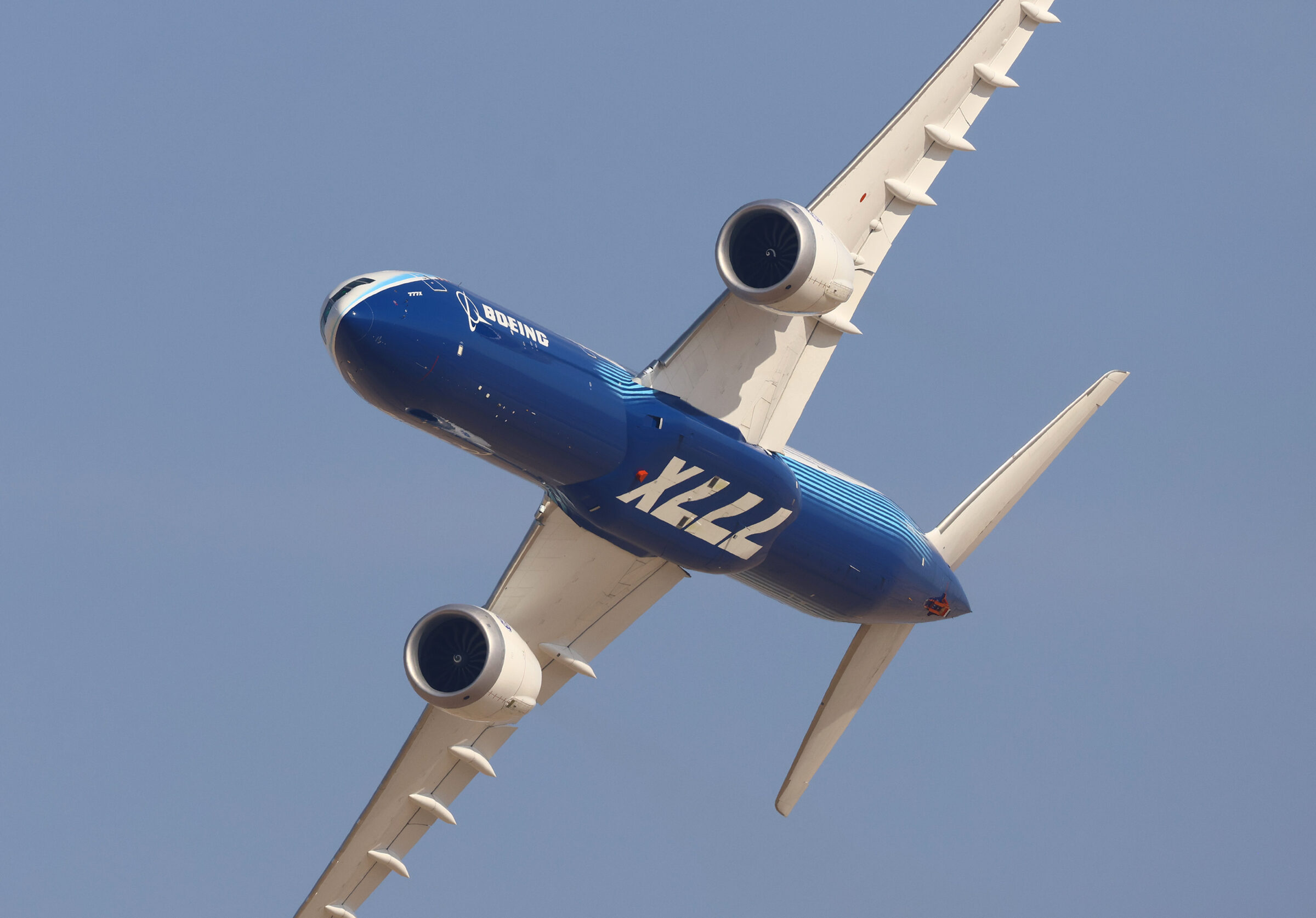
Certification of the 777-9, already badly delayed, likely would have suffered further from a SPEEA strike—which has now been avoided. Photo credit: David McIntosh/AIN
While SPEEA’s negotiation team hailed the contract approvals as “victories that some thought were completely out of reach when this negotiation cycle started,” it acknowledges ongoing work to re-establish “trust with the membership that has eroded over the past decades.”
Lingering distaste from previous negotiation cycles—during eras when management was openly hostile toward organized labor—still rankles many rank-and-file engineers and technicians.
“Without trust, Boeing and SPEEA will likely find ourselves right back where we were when we started this contract negotiation cycle,” the negotiation team said. “As we work to restore aerospace professionals and technicians to the center of Boeing’s universe, we must continue to build our union strength and our networks so that when called upon again, we are ready.”
The new four-year contracts provide a 10% wage increase, effective October 2, for all SPEEA-represented workers in Washington, Oregon, California and Utah. Workers will receive another 4% wage increase in March.
The union estimates that the average salary for a SPEEA-represented engineer will rise to $208,000 from $152,000, while average tech salaries will increase to $163,000 from $119,000.
Ben Nimmergut, Boeing’s functional chief engineer for production engineering, said the airframer is “pleased with the outcome of the vote.”
“We look forward to working with our team to support our company’s continued recovery and meeting our customer commitments now and in the future,” he said.
Quagmire Avoided
Union members were considering Boeing’s second offer. The first tentative agreement approved by SPEEA’s negotiation team rejected by both groups on August 21.
A walk-off would be poorly timed for Boeing Commercial Airplanes (BCA), which is focused on ramping 737 Max production and certifying the 737 Max 10 and 777-9.
Last month, CEO Kelly Ortberg acknowledged that certification activity would all but cease if SPEEA-represented workers went on strike, and that a work stoppage would reverberate into the airframer’s production systems.
“Let me be clear—we’re working very hard to try to avoid any kind of a work stoppage,” Ortberg said. “That’s our key priority because the impact would be significant. Essentially, the 777 certification program shuts down until we get the engineers back, and it would have a ripple effect into our production.”
He added that BCA would not be able to sustain current rates of 737 Max production in the event of a lengthy SPEEA strike, let alone hit still-elusive monthly production ramp targets.
“One of the things we did is we agreed with the union to start negotiations early,” Ortberg said. “I think that was wise because we got through this first round and we found out that the agreement that we had with the bargaining unit negotiating team wasn’t what the union wanted.”
Boeing’s C-suite certainly did not want a repeat of the massively disruptive IAM 751 strike in the summer of 2024, which saw the company’s Puget Sound-based production activities come to a near-standstill for several weeks.
Concerns of the Workforce
If the union had not approved Boeing’s contract offers on October 1, there would have been scarce time to re-organize and vote on a third offer prior to the October 6 deadline. If a strike had ensued, Boeing’s efforts to ramp up 737 Max production in Renton and Everett would likely have been hindered.
Online chatter had focused to a great degree on the shifting composition of Boeing’s engineering workforce, with the technicians’ bargaining unit shrinking relative to the professional unit.
“Tech jobs have been on a decline for some time now,” one Redditor commented in the r/SPEEA thread. “I don’t have a clear idea of the exact timeline, but I know it to be true based on the ratio of tech/prof jobs at Boeing and how it’s changed over the years. This contract is potentially one of the last few nails in that coffin for tech employees at Boeing. I say ‘last few’ because I can see it taking another 10 years to really be all profs.”
Employees were also concerned about outsourcing tasks to other, non-unionized Boeing sites and to countries such as Brazil and India.
One commenter urging a “no” vote wrote on Reddit: “I believe engineers and profs deserve more than what Boeing is offering. Yes, this contract is ‘OK.’ But we shouldn’t settle for that. Remember every company wants to pay you as little as possible to line their own pockets a little more. That extra in their pockets should be going to us.”
Broadly speaking, many union employees—most of whom do not identify their affiliation on social media—believe that the last contract did not keep pace with inflation over the past four years. Though SPEEA-represented employees are white-collar workers who tend to make well above the national median income, cost-of-living issues are especially prevalent in the Puget Sound area.
Related