

by Jeff Steinberg-
With the signing of the Treaty of Paris in 1783 formally securing the independence of the United States, the Continental Army, along with the espionage networks that played such a vital role in winning the war, was dismantled.
With the Treaty signing and the withdrawal of the last British troops from New York City in November 1783, George Washington formally stepped down as Commander-in-Chief of the Continental Army and returned to his beloved Mount Vernon. What was left of the Continental Army were two garrisons at Fort Pitt and West Point comprising a total of 80 officers and soldiers.
Little was it known as the military was being decommissioned that the new nation would, within a generation, be engaged in another war—the war of 1812—with the British Empire, its former ruler. Nor was it generally thought that within a few years, it would be necessary to forge a new Constitution that would define a unified republic, as opposed to a confederation of former colonies who sometimes bitterly opposed each other over local interests.
Without a formal Army or intelligence agencies, the task would fall to private individuals – visionaries – who continued the revolution as loyal Americans and filled the gaps to defend the new nation.
Many of these visionaries are best remembered, not for the crucial contributions they made to the defense of the Republic, but as inventors, writers, artists, farmers, and political philosophers.
The fight for liberty by citizen patriots before the Revolutionary War showed what could be accomplished through private networks such as the Committees of Correspondence. Here, we will see that this tradition continued in some of the most unexpected ways.
A Vacuum Filled
Even after the War of 1812, which was largely fought by state militias (the peak wartime size of the US Army was 36,000), Presidents Thomas Jefferson and James Madison remained skeptical about maintaining a standing army, viewing it as an instrument of monarchic tyranny. This rejection of standing armies and secret police was at the heart of the American commitment to popular sovereignty, the repudiation of European colonialism and tyranny, and the belief that the “common defense” was the mission of the entire people.
At the same time, the War of 1812 was a clear reminder that the British and other European powers continued to plot against the new United States.
As a result of the ongoing climate of threat to the Republic during the extended period between the War of 1812 and the start of the Civil War, the defense of the Republic was taken up largely by a network of private citizen patriots, who conducted intelligence and counterintelligence against the European powers seeking to break up the United States, while building an independent, unique American culture. During this period, two private networks emerged, conducting proactive intelligence. Their efforts overlapped.
The Society of the Cincinnati
Just prior to Washington’s retirement as Commander-in-Chief of the Continental Army, a group of officers gathered at the Verplanck House in Fishkill, New York in the Hudson River Valley. The meeting was chaired by Baron von Steuben, and the major speech was delivered by Alexander Hamilton. The group endorsed a proposal drafted by Henry Knox, Edward Hand, Jedediah Huntington, and Samuel Shaw to found the Society of the Cincinnati. The Society was to be a hereditary association comprised of officers who had served in the Continental Army throughout the War for Independence and their successive generations. Living relatives of those officers who died in combat fighting for independence were included among those qualified for membership.
The Society was named after the Roman General Lucius Quinctius Cincinnatus (519-430 BC), who saved the Roman Republic, rejected the offer to be dictator, and instead returned to his farm. He epitomized the citizen soldier. The motto of the Society was: “He relinquished everything to serve the Republic.”
The Society’s Mission Statement was simple:
- Preserve the rights so dearly won;
- Promote the continuing union of the states;
- Assist members in need, their widows, and their orphans.
On July 4, 1784, French King Louis XVI formally ordained a French branch of the Society of the Cincinnati, with the Marquis de Lafayette as its first President General.
Within a year, the American branch had established chapters in every state. Of the 5.500 men eligible to join, 2,150 became members in the first year. George Washington was elected as the first President General, serving in that role until his death in 1799, when he was replaced by Alexander Hamilton.
Their common bond of wartime service in the Continental Army had produced not only a sense of comradery; they knew the dangers inherent in the weak Articles of Confederation, the lack of a central Federal government, and the lack of resources that had plagued the war effort.
The Society constituted a core of the Federalist faction that fought to replace the Articles of Confederation with a stronger Federal system with a powerful central government under a system of checks and balances that would be a barrier against degeneration into monarchy. Society founder Alexander Hamilton collaborated with James Madison to draft the Annapolis Convention plan of 1786, which formed the basis of the Virginia Plan that was taken up a year later in Philadelphia.
The Society of the Cincinnati convened its second national meeting in Philadelphia on May 14, 1787. Twenty-three Society members were among the 55 delegates to the Constitutional Convention, which also convened in Philadelphia in May 1787. Among the Cincinnati convention delegates were George Washington, Alexander Hamilton, Rufus King, Gouverneur Morris, and John Dickinson (Dickinson had served with Benjamin Franklin and John Jay on the Committee of Secret Correspondence, which conducted espionage and counterespionage during the Revolution).
Morris would serve on the Committee of Style that drafted the Constitution and was its primary author, and Washington would serve as the President of the Constitutional Convention.
While it would be incorrect to characterize the Society members attending the Constitutional Convention as a voting bloc, the members were engaged in constant interaction and collectively played a significant role in securing a strong Federal Constitution. The larger Society membership played an equally important, albeit informal role in the ratification debates that took place in all 13 states.
Three Society members served in the first Administration: President George Washington, Treasury Secretary Alexander Hamilton, and Secretary of War Henry Knox.
In the aftermath of ratification, the Society performed a critical role as a source of revolutionary pride and preservation of the core Republican values. While individual members played significant roles in the early decades of the Constitutional Republic, the organization shunned any overt political role, particularly during the Jeffersonian period. George Washington’s role as the personification of the citizen-soldier during his two presidential terms did much to silence Society critics who objected to any hereditary organization as a form of aristocracy.
The War of 1812 was a reminder of the sacrifices of the Revolutionary generation and the patriotic battle against the British Empire; and the Society went through a postwar popular rebirth.
That rebirth peaked during the 1824-1825 tour of the United States by Lafayette. Lafayette was the last living General of the Continental Army and was the President General of the French Society of the Cincinnati. Every state chapter held parades, banquets and other celebrations during Lafayette’s tour. It was a period of reflection and celebration of the nation’s birth and the values embedded in the Constitution.

Lafayette also came to the United States with a mission.
The Bread and Cheese Club
In 1821, James Fenimore Cooper published his first popular novel, The Spy: A Tale of the Neutral Ground. It was the first published account of the actual espionage networks in Connecticut, Westchester County, and New York City that played a pivotal role in the victory in the American Revolution, albeit in the form of historical fiction.

Cooper got much of the material for The Spy from John Jay, a family friend and close Federalist collaborator of Cooper’s father William Cooper. Fenimore Cooper’s father was a frontier land developer, founder of Cooperstown, New York, and a two-term US Congressman from the area. Jay had been director of counterintelligence in New York during the Revolution and headed the Committee for the Detection and Defeat of Conspiracies, which ran some of the spy networks for Washington. James Fenimore Cooper visited Jay at his Bedford, New York retirement home and drew out detailed accounts of the wartime spy operations in the “neutral ground,” a part of New York which was held by neither the patriots nor the British.
Cooper’s novels were more than popular fiction. He and a group of other republican intellectuals consciously aimed to create a unique American literary culture, promoting principles that stood in stark contrast with the European empires and their literary glorification of a caste aristocracy and feudalism. Sir Walter Scott was the epitome of that English style of contemporary literature.
American writers and painters were intimately connected with the Society of the Cincinnati and viewed the organization as a model for the values they sought to promote through their literary and artistic output: revolutionary nationalism, elite civic duty, and the unique circumstances of American life. Cooper’s most famous historical novels, including The Last of the Mohicans, The Pioneers, and The Spy were built around characters modeled on Cincinnati members.
In 1823, Cooper founded the Bread and Cheese Club, a regular gathering of 35 leading American writers, painters, editors, scientists, and public scholars. Among the members of the Club were several individuals who were also members or close associates of the Society of the Cincinnati. These included:
- Gulian Verplanck, whose grandfather Samuel Verplanck was an officer in the Continental Army and a Society member. Gulian inherited his grandfather’s membership in the Society. It was the Verplanck home in Fishkill, New York that hosted the founding meeting of the Society.
- Charles King, son of Revolutionary War officer and Cincinnati member Rufus King. Charles was editor of the New York American and later President of Columbia College.
- Samuel F.B. Morse, leading American portrait painter and the son of Reverend Jedidiah Morse, who was the popular historian of the Society of the Cincinnati.
- Philip Hone, a leading affiliate and promoter of the Society’s New York chapter, civic leader, and Mayor of New York City.
America’s most prominent artists and publicists formed the core membership of Cooper’s Bread and Cheese Club. William Cullen Bryant was one of the country’s most popular poets, editor of the New York Evening Post, and the founder of the Metropolitan Museum of Art and the sponsor of Central Park. He was one of Cooper’s closest friends and Club associates.
Samuel F.B. Morse, later known for his invention of the telegraph and Morse Code, was one of the most prominent portrait painters in the United States, and a student of Benjamin West. Morse and Cooper were the closest of friends. Along with Asher Durand and Thomas Cole, Morse was a leader of the Hudson River School that created a uniquely American school of landscape and portrait painting.
Washington Irving was the honorary chairman of the Bread and Cheese Club, although he spent much of the period of the Club’s activities living abroad as a US diplomat. Irving’s stories and biographies were crucial to the emergence of a unique American literature. He wrote a multi-volume biography of George Washington and a history of New York City (The Knickerbocker Tales), as well as an account of Moorish Spain (Tales of the Alhambra). Cooper considered Irving the “intellectual godfather” of American literature and saw the Bread and Cheese Club as an extension of Irving’s work in establishing a unique American culture.
The Lafayette Tour and Its Aftermath
The Marquis de Lafayette arrived in the United States in 1824, convinced that France and other European countries were ripe for republican revolution. After his own failure to preempt the Jacobin Terror soon after his first return from America as an acknowledged hero of the American Revolution, he was committed to not repeating those mistakes. He sought to recruit some prominent American republicans to return with him to France to aid in the efforts.
Lafayette’s tour under the Cincinnati sponsorship facilitated that agenda.
The New York Committee hosting Lafayette included Bread and Cheese Club members and Cincinnatus affiliates Philip Hone, Gulian Verplanck, Samuel Morse, and William Cullen Bryan.
Cooper was introduced to Lafayette by these close colleagues and attended the New York Cincinnati Society banquets for the French visitor. Lafayette visited the Bread and Cheese Club. Lafayette had read The Spy and considered it the finest account of the spirit of the American Revolution. He asked Cooper to write an account of his American tour for a European audience. Cooper agreed and ultimately published Notions of the Americans (1828) as a fictional account of the tour incorporating many of Lafayette’s observations about American life. The book strongly promoted America’s republican virtues and the difference between meritocracy and aristocracy.
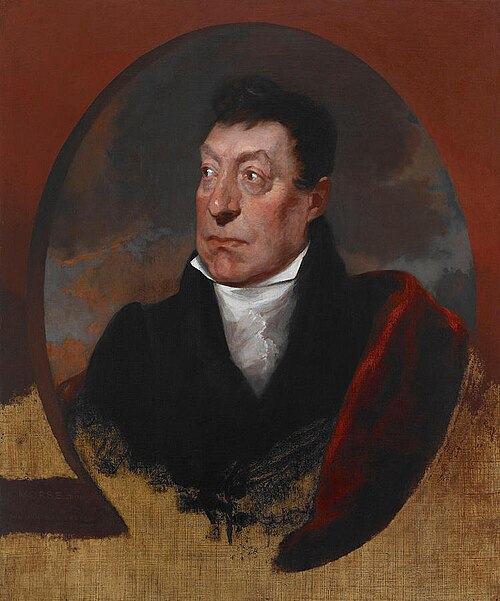
Lafayette also established ties with the painter Samuel Morse. To commemorate the Frenchman’s visit to New York City, a contest was held with the winner commissioned to paint the official City Hall portrait of Lafayette. Morse won the competition against other major American painters including Charles Wilson Peale, Thomas Sully, and John Wesley Jarvis. Morse did the sketches of Lafayette for the official portrait while Lafayette was staying at the White House with the newly elected President John Quincy Adams. Lafayette had been a personal friend of Morse’s father Jedidiah during the Revolution.

When Lafayette returned to France in late 1825, James Fenimore Cooper and family followed in early 1826, taking up residence in Paris. Soon afterwards, Samuel Morse joined his close friend in France, where he extended his studies of painting and explored Europe’s Renaissance galleries and museums. For two years, Morse was a daily fixture at the Louvre. One of his most famous paintings, Gallery of the Louvre, which took him 14 months to complete, was a composite of his favorite works of art from the museum. The large canvas also featured Cooper and American sculptor Horatio Greenough observing Morse painting. Greenough was a member of the National Academy of Design, which was founded by Morse before his departure for France, and aligned with the Bread and Cheese Club’s commitment to create a sovereign American culture.

As two of America’s most popular artists, Cooper and Morse had an open door to Europe’s aristocratic circles. Morse was in constant demand to do portraits of prominent Europeans, and he used the sittings as opportunities to gather intelligence on the many European machinations and plots against the United States. He kept a running diary of this intelligence, which he shared with Cooper.
Cooper was a frequent visitor to Lafayette’s estate La Grange on the outskirts of Paris. He became a leading figure within the liberal salon circles of Paris. Those circles included revolutionaries from every part of Europe, as well as others in the growing American community.
One of those traveling Americans and close colleagues of Cooper, Morse, and Lafayette was a recent graduate of Goettingen University named George Bancroft, who become America’s most prominent 19th century historian and a future US Ambassador to the United Kingdom and Prussia/German Empire. Along with another American scholar, John Lothrop Motley, Bancroft would become close friends and informal advisor to Otto von Bismark during the founding of modern Germany in 1871.
Revolutionary Europe
Lafayette was correct that Europe was ripe for revolution in 1830. The Second French Revolution (1830-1831) overthrew the post-Napoleon Bourbon restoration under Charles X, replacing him with a constitutional monarchy under Louis-Philippe of the House of Orleans. Lafayette was named head of the National Guard and was the public face of the reform movement.
Cooper chronicled the Revolution, writing detailed accounts of the July events to his political circles back in the United States.
In 1829, during a visit to Rome, Cooper met the Polish revolutionary Adam Mickiewicz. A poet, dramatist and founding leader of the Polish independence group The Philomath Society, Mickiewicz had been arrested by the Russians in 1823, jailed and later exiled to St. Petersburg and Moscow, where he became a close intellectual collaborator of Alexander Pushkin, despite the competing national patriotic outlooks they expressed in their writings.
Mickiewicz was part of the Decembrist circles that launched a failed uprising in Poland in December 1825.
In November 1830, Polish military cadets launched a second revolt to overthrow the Russian occupation. They seized the palace and arsenal in Warsaw. Mickiewicz was the intellectual leader of the revolt. Following two years of war, the Russians recaptured Warsaw and Mickiewicz, along with many other Polish revolutionaries went into exile in Paris.
Cooper had been a financier of the Polish uprising. He and Morse formed the American Committee for Polish Independence in Paris, at the same time Lafayette was heading the French Committee for Polish Independence.
Both Cooper and Morse would describe these experiences as profoundly important in advancing their own republican outlooks. They were eyewitnesses and participants in the revolutions in France and Poland.
Throughout his nearly decade of travel around Europe, Cooper was constantly conducting political intelligence, focused on European elite attitudes toward the United States, developing detailed evidence of the corruption and cruelty concealed beneath Europe’s physical beauty. He wrote a series of novels which were in-depth profiles of leading European oligarchical factions. Cooper was aware that there was a romanticism among many Americans, who believed that republicanism was flourishing across Europe. His writings aimed to disabuse that naivety.
Between 1831 and 1833, Cooper produced a trilogy of novels exposing European despotism.
- The Bravo (1831) exposed Venice as a “beautiful façade” hiding “political rot.” In a non-fiction introduction to the novel, he warned American readers that the Venetian system of was a “masked despotism” and a “theater of deception.”
- The Heidenmauer (1832) was set in the Rhineland during the Reformation, when aristocracy and Church conspired to suppress any reforms.
- The Headsman (1833) tore the mask off Switzerland’s nominal republic, revealing a repressive caste system.
In addition to the trilogy, Cooper wrote a running series of political dispatches throughout his travels, describing the worsening social conditions and political repression, the hatred for American democracy among the elites, and the dangers embedded in all systems of monarchy and oligarchy.
While these reports were full of detailed profiles of the leading European schemers against America, Cooper couched his political intelligence and counterintelligence in travelogues.
Upon his return to the United States, Cooper’s dispatches were published as a series of five books, collectively called Gleanings from Europe. They were published by Carey and Lea, America’s leading publishing house based in Philadelphia, co-founded by Henry Carey. Carey and Lea also published his trilogy. The Gleanings covered England, France, Italy, Switzerland, and Germany in separate volumes; and were released between 1837-1838.
It is impossible today to adequately assess the impact the intelligence and counterintelligence work of Cooper and Morse had during the 1820s and 30s. What is clear is that they were operating as a patriotic network of activists dedicated to securing the Republic during a period when no other formal security institutions were on guard. Even today, the insights provided by Cooper’s novels and travelogues and the intrigues that were ferreted out by Morse’s penetration of leading European oligarchical circles, enshrined in his diaries and his reports to Cooper that were incorporated in his writings, stand out as examples of high-quality strategic intelligence work.
In the next part of this series, another of the Society of Cincinnati/Bread and Cheese Club “unofficial” intelligence officers will be revealed.
(Note: this is part four of an ongoing series on the history of American intelligence services, by Jeff Steinberg.)


Related Posts