Chicago History Museum Reveals Final “US at 250: Civic Action in Chicago” Installation

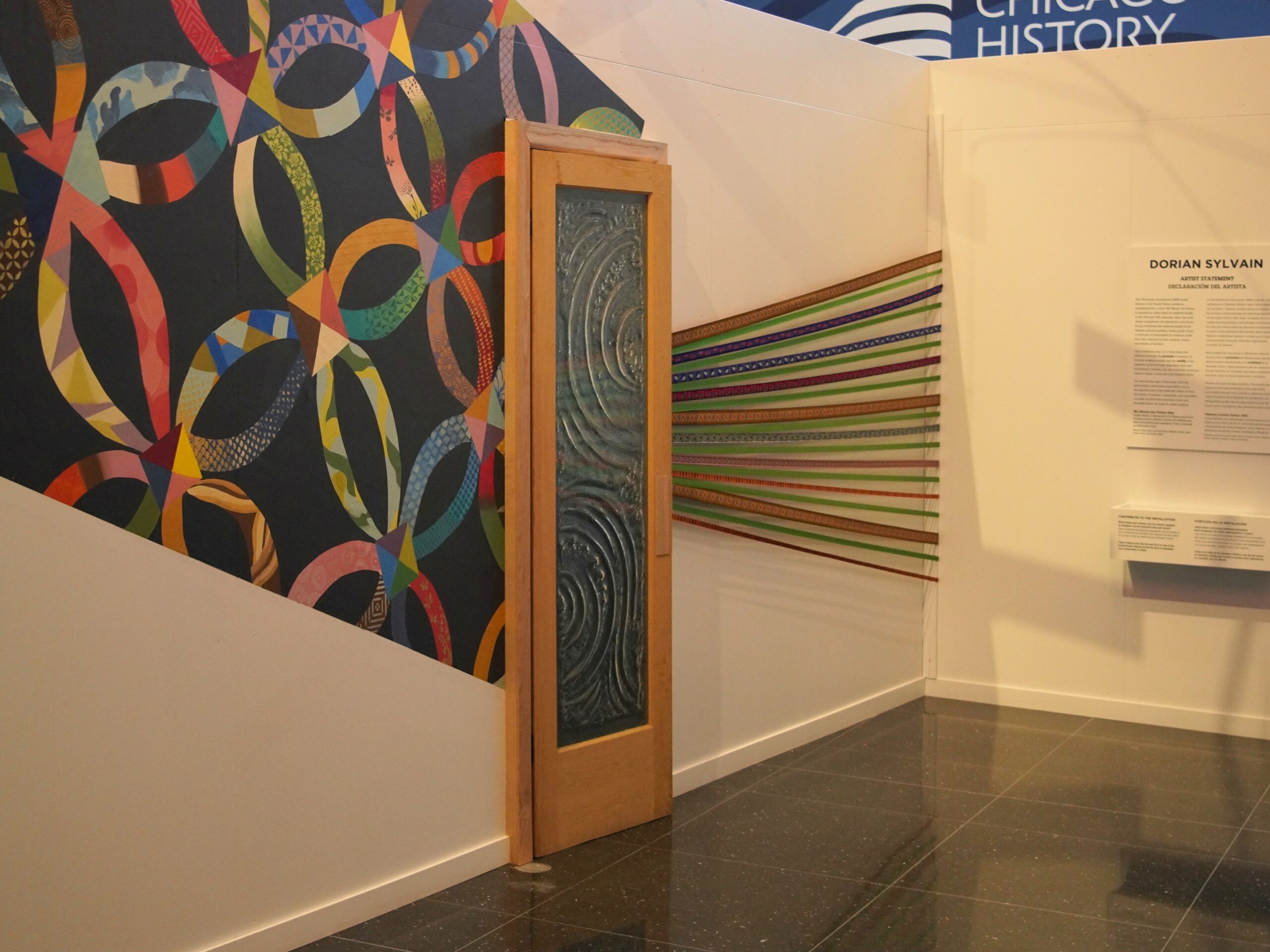
The final installation of a four-part artistic exploration of America’s founding documents, Dorian Sylvain’s artwork serves as a response to the 13th Amendment
CHICAGO (October 6, 2026) – As part of its year-long “US at 250: Civic Action in Chicago” initiative, the Chicago History Museum unveiled the final of four rotating contemporary art installations responding to four important documents from U.S. history in the Museum’s collection: the Declaration of Independence, Northwest Ordinance, U.S. Constitution and the 13th Amendment.
The latest installation, Dorian Sylvain’s “We Weave Our Future,” explores the complex legacy of the 13th Amendment, which formally ended slavery outside prisons in 1865 and helped establish mass incarceration. Visitors will see patterns inspired by quilts made by enslaved people in the 18th and 19th centuries and be invited to contribute to the installation. The symbols on one quilt pattern represent hope and freedom, while the symbols on the other quilt pattern symbolize the chaos and uncertainty of the nation’s carceral state.
Sylvain’s artwork was co-designed by U.S. History and Civics students at Art in Motion Creative Arts Middle and High School and is paired with materials that show the history and impact of the John Howard Association, Illinois’s only independent citizen correctional oversight organization. In 1901, Illinois-based prison reformer Reverend Frank Emory Lyon founded the John Howard Association to support the state’s growing prison population, and today, it continues to monitor and report on prison conditions and treatment.
Completing the four-part artistic exploration of America’s founding documents and how they connect with Chicago’s long history of civic action, Sylvain’s work is on view in the Museum’s first-floor lobby now through January 3, 2027.
“This important national anniversary is a time for us to question, converse and connect about how we came to be where we are today as a country,” said Chicago History Museum Curator of Civic Engagement & Social Justice Elena Gonzales. “What systems affect our everyday lives? Are they working for all of us, and, if not, what can we do about that? The best celebration we can imagine at the 250th is the collaborative improvement of our imperfect democracy.”
“US at 250” is anchored in the Chicago History Museum’s collection materials relating to the United States’ founding and Chicago’s civic legacies. The project centers the city as a place of participatory action and the Museum as a space for making connections between past, present and future. It highlights stories of people coming together to fight for equality, inclusion and a voice in decisions that affect their lives.
As part of the “US at 250” initiative, these art installations explore the ongoing work of democracy throughout the nation’s complex history through letterpress prints, murals, altar monuments and interactive experiences. Each work is on display in the Museum’s lobby for three months.
“When art and history meet at the Museum, visitors see history differently and make connections to the present,” said Erica Griffin-Fabicon, Elizabeth F. Cheney Director of Education at the Chicago History Museum. This final installation moves visitors from observers into participants responding to history and sharing their capacity for civic involvement today.
The first installation, “Self-Evident: A Letterpress Exploration of the Declaration of Independence,” on view from January to March 2026, featured artist Vida Sačić, whose work explored the language and legacy of the nation’s founding ideals, inviting visitors to consider how the promises of the Declaration of Independence continue to resonate and be contested today.
From April to June 2026, artists Carlos Flores and Deon Reed presented “Porta(til),” a collaborative installation inspired by the Northwest Ordinance. Their work highlighted the Northwest Ordinance’s promises of freedom for formerly enslaved African Americans and land rights for Indigenous peoples, and reimagined its expansionist legacy through participatory, community-driven action.
Prior to this final installation, “The People, We Are: A Living Reflection on the U.S. Constitution,” by Barrett Keithley was on display from July to September 2026. Keithley, a local multi-disciplinary artist, cultural strategist and creative entrepreneur, created a mixed-media mural that visually and emotionally explored the impact of the U.S. Constitution and invited visitors to reflect on the living document that continues to shape and be shaped by the people it serves.
In addition to the responses by local artists, the broader “US at 250: Civic Action in Chicago” initiative includes updated stories and objects in the “Facing Freedom” exhibition, which reopened July 4, public and community engagement within and outside the Museum’s walls, Civic Circle discussions for teens and young adults, resources for grades 6–12 students and teachers, and conservation work and an exhibition, “Threads of a Nation: Preserving Presidential Clothing.”
Featuring an array of artifacts related to U.S. history, “Threads of a Nation” will open to the public on Saturday, October 24, 2026. The exhibition offers a glimpse into the conservation process of garments and accessories associated with several presidential figures, including John Adams, George and Martha Washington and Abraham and Mary Lincoln, alongside rare objects and documents that provide historical context.
For more information about “US at 250: Civic Action in Chicago,” visit chicagohistory.org/USat250 or contact Emily Miller, Public Communications Manager, at [email protected] or (312) 799-2161.
###
ABOUT THE CHICAGO HISTORY MUSEUM
The Chicago History Museum is situated on ancestral homelands of the Potawatomi people, who cared for the land until forced out by non-Native settlers. Established in 1856, the Museum is located at 1601 N. Clark Street in Lincoln Park, its third location. A major museum and research center for Chicago and U.S. history, the Chicago History Museum strives to be a destination for learning, inspiration, and civic engagement. Through dynamic exhibitions, tours, publications, special events and programming, the Museum connects people to Chicago’s history and to each other. The Museum collects and preserves millions of artifacts, documents, and images to assist in sharing Chicago stories. The Museum gratefully acknowledges the support of the Chicago Park District on behalf of the people of Chicago.