

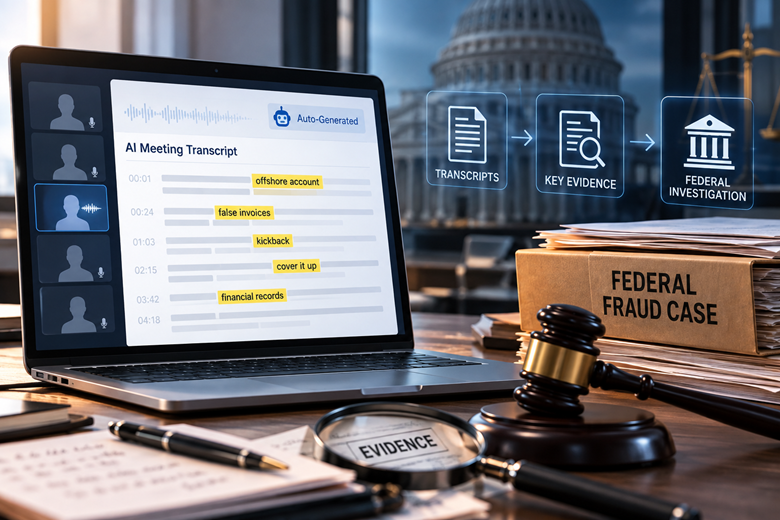

Silently present at last Tuesday’s strategy session is a bot himself. It documents (reorts) what was spoken and by whom and when, more or less.
It stores that record on an account in the cloud that someone set up and later forgot. That record is typically among the first things investigators in a federal fraud investigation want and is often the subject of a subpoena.
In the past few years, AI note-takers have breathed new life into the mundane task of taking notes.In the past few years, AI note takers have found their right footing in the world of office equipment. They are riding in meetings off invite calendars, transcribing during the meeting, creating action items, distributing an edited meeting summary to all before coffee cools down.
Often, companies have not considered what that means when something comes along like a grand jury subpoena.
The Bot in the Meeting Is Making Business Records
All of those auto-generated transcripts are documents. It’s stored on a server, includes a time stamp, is associated with a known username and can be exported. The working definition is that this information falls into two categories: E-mail or any machine-produced transcript of the package or a signed Memo, and courts have had none of this.
In fact, according to a law firm analysis on these tools, if a company captures AI transcript and summaries are captured during normal business operations, they will be discoverable in the same manner as is any other document, rendering privileged strategy discussions, deal terms, and company disagreement a potentially discoverable product of the AI tool.
The volume is most underestimated part by executives. In one quarter, a mid-sized organization with note taking employees in sales, finance, HR and the C-suite can produce thousands of hours of valuable searchable transcript.
Investigators love “searchable.” Ten years ago, they had to depose people about what was said in a meeting. Now they can grep for the phrase.
Fraud Cases Live and Die on What People Said in the Room
Federal fraud charges almost always turn on intent. Prosecutors have to show that the defendant knew the billing was wrong, knew the numbers were inflated, knew the disclosure was misleading. That is a hard case to build from spreadsheets alone.
It gets much easier when there is a transcript of the CFO saying, on a Tuesday morning call, that the aggressive revenue recognition approach is probably not going to survive an audit. The DOJ has publicly told line prosecutors how to weigh what a company knew and when. Its Justice Manual chapter on charging business organizations directs prosecutors to look hard at the quality of a company’s compliance program and its willingness to hand over non-privileged records. Auto-generated meeting transcripts are exactly the kind of non-privileged record that ends up on the table in that conversation.
Deleting the Transcript After the Subpoena Is a Separate Crime
After it is discovered that the bot has recorded all of the leadership meetings over the past two years, the instinct is to cleanse. This instinct is very harmful. The duty to preserve also kicks in when litigation is reasonably expected or a federal investigation has begun, with the obligation to preserve starting at the same time as the obligation to preserve begins with emails, namely, at the time of the commencement of the litigation or reasonably expected commencement of a federal investigation.
In Rule 37 (e), a court may hit a party with the toughest possible sanctions such as instructing the jury they should believe that the destroyed information was bad for that party or granting the plaintiff a default judgment upon showing destruction with an intentional attempt to hide it from the other party. There’s the possibility of adding obstruction of justice charges to the mix, too. Account’s note taking function has been altered after receipt of a preservation letter to such an extent that it has brought to an end careers.
What a Careful Company Should Actually Do
Nobody needs to rip the tools out. They are genuinely useful. The point is to treat them like the records systems they are, not like a convenience app somebody installed for the sales team.
- Inventory the bots. Identify all AI note-takers, even those users have signed up for on their own user accounts. Even if you don’t know how to look after something, you won’t.
- Write a retention rule. Design a retention policy. Determine the length of time and location of transcripts and who may remove them. Then, stick to that rule. It is in spoliation cases that selective deletion is born.
- Keep the bot out of privileged calls. Do not use a third-party service to transcribe meeting(s) with counsel. A Recording of a Privileged Conversation is a Privilege Waiver in Waiting, sitting on a Vendor’s Server!
- Train the people running meetings. Executives should know when the bot is in the room, how to remove it, and what disclosures the tool is making to other attendees.
- Get counsel involved early. When a subpoena or a preservation letter arrives, the transcript archive is one of the first things an experienced federal fraud defense team will want to inventory and lock down before anyone touches a retention setting.
The Quiet Witness Is Not Going Away
AI note-takers are only going to get more capable and more embedded. The transcripts they generate will keep getting longer, more accurate in some places and more confidently wrong in others, and more central to how federal investigators reconstruct what a company knew. The companies that handle this well will not be the ones who tried to make the records disappear. They will be the ones who decided, before anything went wrong, what the bot was allowed to hear and how long it was allowed to remember.