
Women Without Men by Shahrnush Parsipur, translated by Faridoun Farrokh, follows five women in Tehran in the summer of 1953, as the CIA and MI6-backed coup to reinstate the Shah unfolds. Originally published in 1989 but banned in Iran ever since, the novella weaves Islamic mysticism and magical realism together to explore the intimate theatre of power that uses the female body as a site of state control. Mapping the machinery of state violence via political fiction, this novella clearly and deftly renders gender policing and systemic oppression, writes Khushali Mahajan.
The lives of women in Coup-era Iran
There is a line near the opening of Women Without Men that functions almost as a quiet warning: “It is always the heart’s desire that drives one insane”. Shahrnush Parsipur’s novella, first published in Persian in 1989 and banned in Iran ever since, is a book exactly about that. In a tale woven with Islamic mysticism and macabre magical realism, Parsipur explores what happens to women whose desires, however modest and human, cannot be accommodated by the world they inhabit. The answer, in her telling, is transformation, both metaphorical and literal.

The arrival of this new edition in the Penguin International Writers series, in a fresh translation by Faridoun Farrokh, feels both overdue and entirely necessary. Previous English translations have existed, one by Farrokh himself in 2011, yet the latest version is considered to more faithfully transmit the feminist force of the original, whereas earlier translators were criticised for softening the language and violence. The difference matters as this is not a book that should be softened.
Controlling women’s bodies
The novella follows five women in Tehran in the summer of 1953, as the CIA and MI6-backed coup overthrows the democracy and reinstates the Shah. That political earthquake rumbles in the background throughout, but Parsipur’s eye is trained on a more intimate theatre of power that controls the home, the body and the marital bed. Each of her five women carries a different wound inflicted by the same system that is manically obsessed with the female body to the point of despising it yet displaying no scientific curiosity.
Each of her five women carries a different wound inflicted by the same system that is manically obsessed with the female body to the point of despising it yet displaying no scientific curiosity.
The obsession with virginity is the loudest, despite the dialogue surrounding sexuality existing only in whispers, while women’s desires are disciplined, controlled and punished. The punishment comes in the form of insults, rape and murder, by strangers, brothers and husbands, all aimed to remind the women that their honour is between their legs and fate, in the hands of others. The five women, ultimately, unite in a mystical garden after living and, somewhat dying, in their limited lives.
Mahdokht is obsessed with purity to the point of dissolution. She ultimately plants herself in the garden and becomes a tree, granting the reader one of the novel’s most arresting images while establishing a defiant permanence by asserting her agency. Munis has a hunger to become a part of the political turmoil embroiling the streets, for which she is killed by her controlling brother. Yet, she resurrects anyway, serving as the perfect metaphor for the indomitable female spirit crushed in the political sphere, equally by the State and family.
Zarrinkolah, a prostitute who has a sudden vision of all the men who come to her as headless, flees the brothel in horror and finds something close to grace in the garden before dying quietly in it. Farrokhlaga, a comfortable widow, buys the garden and becomes its unwitting custodian, organising this temporary female world through loneliness rather than intention. And young Fa’iza, damaged by a coercive marriage, arrives last and speaks the least.
Multifaceted Iranian womanhood
Together, they form a mosaic portrait of Iranian womanhood across class, age and circumstance. What unites them is the utopian space of the garden, where other modes of living briefly become possible. The women carve out a space where they are no longer defined by violence or expectation. Parsipur does not sentimentalise this refuge, but rather portrays its fragility and impermanence, as the world of men, with its coups, laws, violence and headlessness, presses in at the edges throughout. She draws on Persian literary tradition and Islamic mysticism to create a mode of storytelling in which the fantastical and the brutally real exist on a single continuum. The result is a novella that feels simultaneously ancient and urgent, like a folk tale that has been waiting a very long time to be told honestly.
The women carve out a space where they are no longer defined by violence or expectation.
The book was published in one of the most hostile possible climates for honest storytelling. By 1989, Iran was a decade into the Islamic Republic, the Iran-Iraq War had only just ended, and ideological surveillance was intense. Parsipur had already spent time in Evin Prison under the Shah; she would be imprisoned again by the Islamic Republic. The book travelled secretly from hand to hand upon its first publication. The image of a banned book passed in secret tells one something essential about what literature can mean under conditions of repression, and what Parsipur risked in writing it.
Echoes with women’s struggles today
To read Women Without Men in 2026 is to read it against a backdrop that Parsipur could not have anticipated and yet seems, with terrible precision, to have already understood. The Islamic Republic that banned this book has spent decades using the female body as a site of state control by policing dress, criminalising protest, killing and brutalising women who dared to take to the streets.
The women in Parsipur’s novella know this logic intimately, even before the Republic existed: the State and the patriarchal home operate by the same grammar of punishment and silence. The global cry of freedom for women carries the same insurgent energy that animates Women Without Men, rising decades later during the 2022 uprising after the custodial death of Mahsa Amini.
Once again, the female body is rendered a battlefield, used, violated, and instrumentalised, as the war in West Asia and Iran unfolds under the current Trump administration. From behind our screens, we watched in real time as Khomeini’s State bore down on female protestors on one hand, while American missiles levelled the playground of a girls’ school on the other; both parties, with chilling irony, simultaneously laid claim to the role of protector.
Once again, the female body is rendered a battlefield, used, violated, and instrumentalised, as the war in West Asia and Iran unfolds under the current Trump administration.
This is the context in which Parsipur’s title demands to be re-read, not as a quiet feminist thought experiment but as a razor-edged political question. Who are women without men? More importantly, what are women without men? Unviolated, unmurdered, unbothered? Is the place for men in women’s lives defined by the excesses they can commit? Is relegation to a secluded oasis of a garden required in an already segregated society which accepts only a veiled woman to assert even the most minimal agency?
The title, which sounds almost wistful in peacetime, reveals itself under present conditions to be a statement of almost unbearable longing because the choice Iranian women have faced and continue to face is not between freedom and constraint. It is between the same authoritative and coercive patriarchy, repackaged again and again.
A garden at the end of the world
Parsipur’s garden was always a fantasy. A place that could not exist in 1953 Iran, nor in 1989 Iran, and not even now. But what her novella does is what great political fiction always does. It insists on naming the fantasy clearly, so that we understand exactly what is being denied.
Reading the book today, it is clear how accurately Parsipur mapped the machinery of state violence, gender policing and systemic oppression. She was writing about one coup. She was also, somehow, writing about all of them. A novella written in 1978, published in 1989, longlisted for the 2026 International Booker Prize, and more urgently necessary with every passing week, Women Without Men is a must-read to rediscover the timelessness of women’s longing for freedom.
Note: This review gives the views of the author and not the position of the LSE Review of Books blog, nor of the London School of Economics and Political Science.
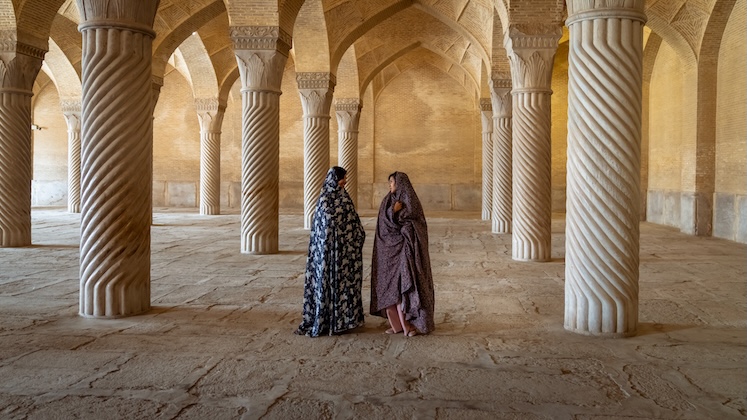
Main image: HknKirmizi via Shutterstock.
Enjoyed this post? Subscribe to our newsletter for a round-up of the latest reviews sent straight to your inbox every other Tuesday.