

Nationalism and the Transformation of the State by Lars-Erik Cederman, Luc Girardin, Carl Müller-Crepon and Yannick I. Pengl argues that nationalism shapes borders as well as identities, examining how states are remade through secession, unification and territorial conflict. This innovative book makes a strong case for putting border change at the centre of nationalism studies, though its exploration of the social and colonial politics underpinning nationalist claims is lacking, write Nora Maher and Noor Suwwan.
Nationalism as a territorial force
For decades, the study of nationalism has focused on identity, political mobilisation and the creation of national communities, while theories of state formation have concentrated on war, coercion and state-building. This encompasses scholarship on nationhood and nationalism, including Kolstø’s study of nationalism and ethnic conflict and The Cambridge History of Nationhood and Nationalism to work on state formation by Heather Rae (2007) and Oliver Richmond (2013). Nationalism and the Transformation of the State by Lars-Erik Cederman, Luc Girardin, Carl Müller-Crepon and Yannick I. Pengl brings these two traditions together by asking a less explored question: what happens to the state when its political borders do not correspond to the territorial distribution of nations?
Cederman et al. argue that nationalism is not simply an ideology or a sentiment. It is also a territorial force. When ethnic or national communities are divided by state borders, or when several communities are contained within the same state, nationalism can generate demands to redraw those borders through secession, unification and irredentism (annexation). This places the book between Charles Tilly’s Coercion, Capital, and European States, AD 990–1992, which emphasis war and coercion in the development of the modern state, and Ernest Gellner’s Nations and Nationalism which argues that nationalism seeks correspondence between political and cultural boundaries. The authors extend this literature by examining how nationalism transforms the territorial structure of the international system.

From the breakup of multinational empires to conflicts over Crimea, Ukraine and other contested territories, questions of who belongs to which state remain connected to borders. The authors therefore challenge approaches that treat borders as fixed and state territory as the starting point rather than an outcome of political struggle. As the book’s introduction explains, their aim is to bring border change back into explanations of nationalism, state formation and conflict.
Centring borders in the study of nationalism
The book hinges on state-nation congruence: this measures how well a country’s political borders match the geographical footprint of its ethnic groups. The authors’ breakthrough is making this concept measurable. Using historical maps and demographic data, they show that European states became much more ethnically homogeneous between the late 19th century onwards. Strikingly, they found that shifting borders, rather than just moving populations or assimilation, accounted for over half of this increase in congruence.
Instead of assuming nation-states just appeared naturally, the authors show how borders were deliberately redrawn to group people together. Their spatial data proves that existing ethnic boundaries influenced where future state borders would be drawn.
The book is strongest here. Instead of assuming nation-states just appeared naturally, the authors show how borders were deliberately redrawn to group people together. Their spatial data proves that existing ethnic boundaries influenced where future state borders would be drawn, even after factoring in geography and history. The authors also acknowledge the dark side of this process: creating homogeneous states wasn’t always peaceful, and a statistic showing “greater congruence” can hide violent historical realities. Indeed, Michael Mann has demonstrated how projects of nation-building have frequently relied on the violent removal of populations that did not fit the desired national community.
Taking nationalism seriously in IR
Realism either treats nationalism as a power boost to states or as a blind spot, limiting its ability to consider nationalism’s subversive capacity in domestic and international relations. Cederman et al. argue that IR no longer takes nationalism seriously. Meanwhile, as Nootens similarly shows, liberal thought can underestimate the continuing importance of nationalism and the sovereign territorial state, despite the central place of territorial sovereignty in the modern state system. This diagnosis is particularly relevant from a non-Western perspective: it is specifically Western IR scholars who need to re-centre nationalism.
The book’s quantitative evidence is convincing when it links ethnic geography to border changes. The authors acknowledge this distinction, but their spatial measures capture territorial patterns more directly than political agency. The data captures geography well but struggles to capture human agency, political motivation, and the messy reality of nationalist mobilisation. They find that an incongruence between a state and the nation(s) living within it is destabilising. They put forward configurations of state-nation congruence in Chapter Seven and test conflict likelihood.
Importantly, they find that ethnic nations divided across separate but self-ruling states are less likely to enter conflict or re-unite. However, if a kin-state is ruled by aliens, then the home-state is likely to mobilise on its behalf. Historically, this mobilisation used to be in the form of war, but today the same mobilisation is in the form of support for ethnic rebel groups. This finding calls for new datasets on government support for ethnic rebel groups. Because their regional focus was Europe, this work should trigger replications across other regionsby empirical IRists. For instance, Harris Mylons’s work on nation-building highlights how such dynamics operate globally.
The power of restorative narratives
Cederman et al. further show that this mobilisation is rooted in narrative. They test specifically for golden-era effects, or the extent to which nations that had historical golden eras are more likely to mobilise for restorative action. This is what they call restorative nationalism. They emphasise that it isn’t the objective presence of a golden era that is destabilising, but the idea of one. The authors give a spatial element to nationalist claims of golden eras (245) which makes a major contribution to empirical IR
Not only do they find that historical claims of greatness and territoriality make conflicts more likely, they also find that prior statehood causes more violent uprisings.
Not only do they find that historical claims of greatness and territoriality make conflicts more likely, they also find that prior statehood causes more violent uprisings. While the authors seem to be clear that it is the narrative that produces the conflict-effect, they are less clear on how. They suggest that it does so through “emotional power”, yet do not realise the systematic nature of their own interest in the affectivity of narrative (191). Feinstein also highlights this work as a crucial missing piece in research on nationalism and political conflict.
More importantly, the authors’ call to measure national narratives is undercut by a limited approach to it themselves. Instead of capturing nationalist narratives from the broader nation or a network of actors, they rely mainly on the historical claims of specific political elites; for instance, examining how leaders like Slobodan Milošević in Serbia or Vladimir Putin in Russia invoked past imperial “golden ages” to justify territorial expansion (195). Their focus on the single actor of the “nationalist leader” overlooks how narratives are contested and framed differently by the masses. We invite further studies to test this divergence, qualifying the Palestinian case as an appropriate starting point.
Discussing Israel and Palestine, the authors invoke restorative nationalism, arguing that both sides are trying to reclaim historical “golden eras” (258). This approach, however, ignores the reality of European colonialism and the ongoing Israeli occupation. The idea of restoring a historical “golden age” applies to the Israeli settler-colonial narrative, which weaponises historical claims to legitimise the occupation of Palestine. Reducing Palestinian territorial claims to a “plausible” historicism, rather than an empirical reality rooted in indigenous presence, reflects a clear Eurocentric unfairness that obscures the settler-colonial dynamic.
Nationalism and the Transformation of the State puts border change exactly where it belongs: at the centre of nationalism studies
Despite these limits, Nationalism and the Transformation of the State makes a significant contribution. It puts border change exactly where it belongs: at the centre of nationalism studies. The blend of historical analysis and spatial data gives it a fresh perspective on how we got the modern political map. It is a must-read for scholars and students of nationalism, international relations, comparative politics, and political geography. Crucially, it reminds us that nationalism does not just change how people imagine their communities; it changes where those communities are drawn on the map.
Note: This review gives the views of the author and not the position of the LSE Review of Books blog, nor of the London School of Economics and Political Science.
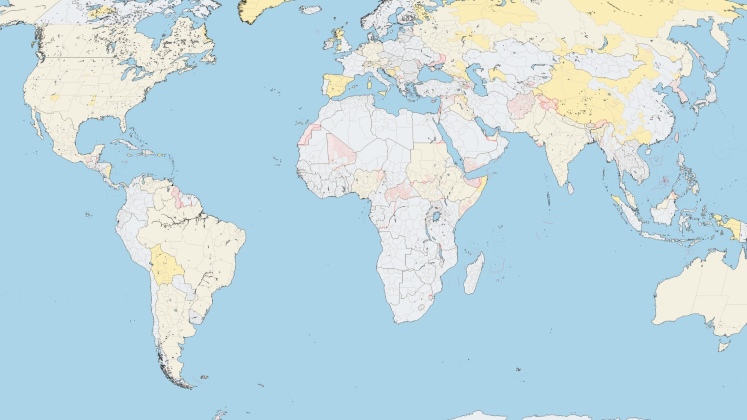
Main image: A map of the World aimed at showing border disputes and disputed areas as well as rebel-controlled areas (in red) and at showing autonomous areas and federations (in yellow) via Wikimedia Commons. License: CC BY-SA 4.0.
Enjoyed this post? Subscribe to our newsletter for a round-up of the latest reviews sent straight to your inbox every other Tuesday.