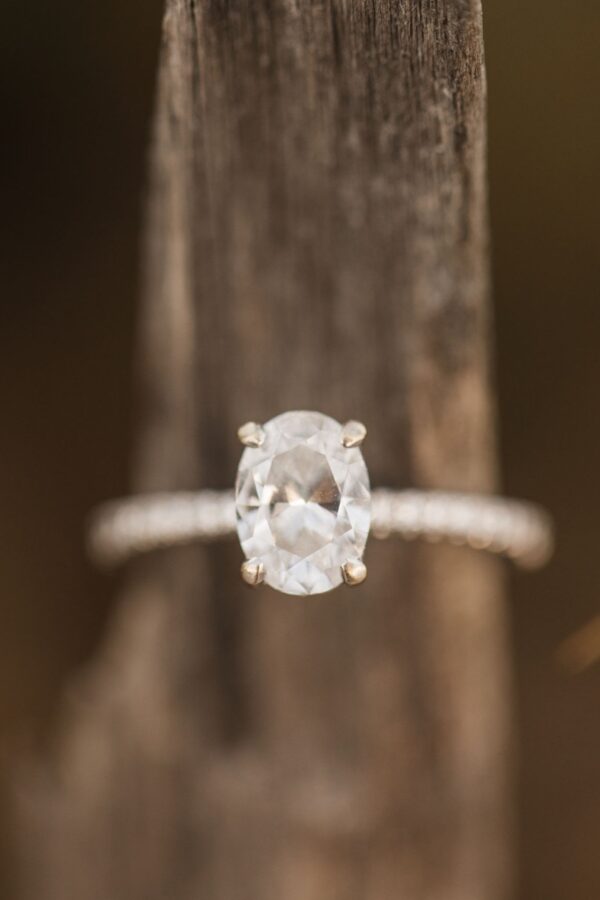
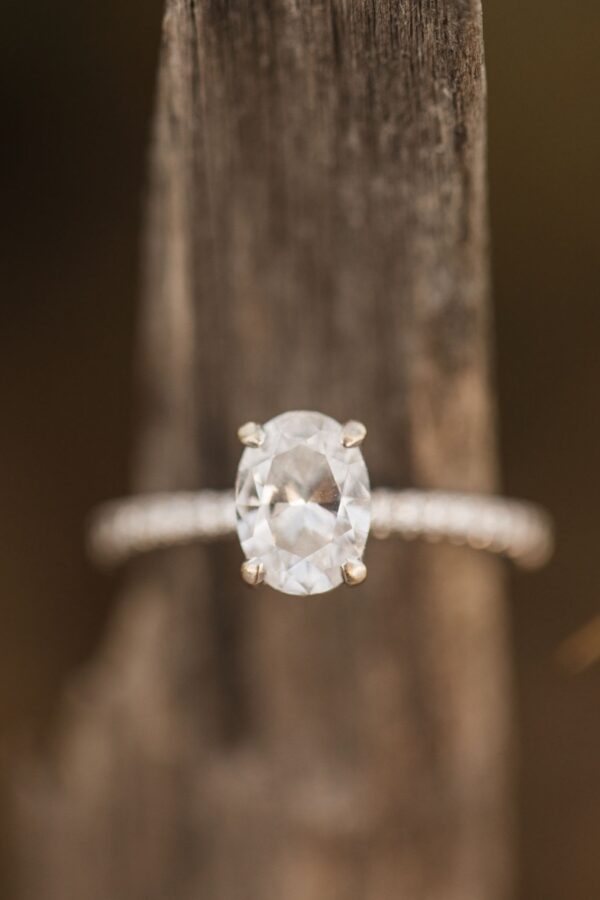
While the stone you choose has a considerable impact on the overall aesthetic of the ring, it also plays a critical role in the technical aspects and overall stability of the design. A larger marquise, pear, or oval-cut stone may need a bulkier setting to ensure the stone is secure and prevent it from flipping around on your finger, for example.
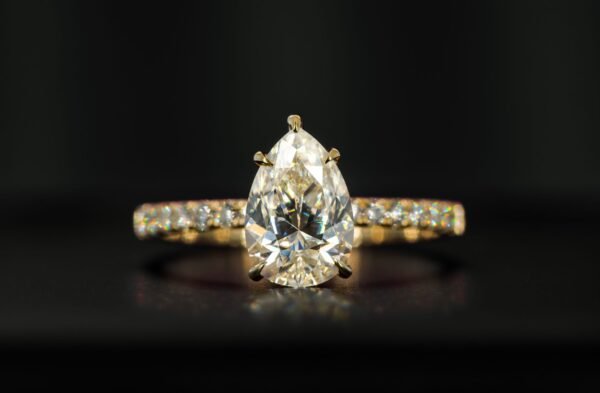
Why elongated cuts play by different rules
Round diamonds are the same in every direction. So a setting just has to hold it securely. Marquise, pear, and oval cuts are elongated shapes, where length and width relate to each other in a specific way, with thin points or exposed corners that a round stone doesn’t have. Get the proportions wrong, or protect the vulnerable points poorly, and the ring looks off, even if the diamond itself is flawless.
This isn’t a new problem. The Marquise cut has been around since the 18th century when King Louis XV is alleged to have commissioned a diamond shaped like the lips of the Marquise de Pompadour (GIA). That’s a long design history for a shape that’s still this difficult to set correctly three centuries later. The cut carries weight – literally and stylistically – and the setting has to carry that weight as well, rather than trying to fight it.
The length-to-width ratio is the first decision
Before considering prongs or metal, you must determine if the stone’s proportions are suitable for the shape it represents. Marquise diamonds look best when their length-to-width ratio is between 1.85:1 and 2.0:1. Pear-shaped stones should fall between 1.45:1 and 1.60:1. Ovals should land between 1.33:1 and 1.45:1.
The setting can either respect the ratio or destroy it. A chunky halo that builds upon the widest portion of an oval will visually shorten it. A band too skinny beneath a marquise will only highlight its extremely pinched point. The rule is that the setting should allow the natural proportion of the stone to shine, not rescue a bad ratio or ruin a good one.
The bow-tie effect and how setting choice changes it
All elongated cut diamonds, including the marquise, pear, and oval, will exhibit a bow-tie effect to some degree. This is a perfectly natural optical feature seen in many of these stones. The bow-tie gets its name because that dark, bow-tie shaped shadow that crosses the center of the stone can look a little like a man’s bow-tie. The actual size, darkness, and visibility of the bow-tie can vary based on the proportions and facet angles of the diamond. The bow-tie effect varies from stone to stone but with the right cut, the shadows will be light and less noticeable. As bow-tie effects are dependent on the observer and the stone, the question shouldn’t be whether it’s there; it should be whether you can notice it from one foot away.


Why the tips need more than a basic prong
Marquise and pear-shaped diamonds have delicate pointed ends which are their weakest parts. A prong pushing against that thin point creates unnecessary pressure which could potentially cause the diamond to chip. This is where the V-prong comes in. The prong is split and shaped to resemble the end of the stone, allowing the pressure to be distributed along both edges, not just one. It both protects the stone and hides the prong for a smooth, seamless look. This style of setting is perfect for people who don’t want their prongs to be the centerpiece of their ring.
Halo or solitaire: the sizing tradeoff
Halos are there to do a job. They make that center-stone look-at-me-I’m-glowing effect even more dazzling by reflecting light off the central diamond. They also add a bit of sparkle to a less-than-ideal stone, which hey, awesome. And they create the optical illusion of a bigger diamond, which, when we’re talking about a 0.75-carat rock, is totally sensible.
But a halo on a 2-or-3-carat diamond is just overkill. That rock doesn’t need your help looking massive. It already is the statement piece. An oversized halo takes away from the rest of the ring and starts to make the diamond look like it’s wearing its own tiny piece of jewelry. A more subtle halo or no halo at all will look far more elegant and expensive on a larger ring.
East-west settings and everyday practicality
Many people imagine a long narrow stone and a traditional setting in which the point of the stone extends north to south on the finger. In an east-west style, the stone turns on its side, and the specifics of how this particular choice has gone from edgy to trendy to classic should be obvious.
The double halo or other detailed design elements inherent when the stone is oriented horizontally (presumably reminiscent of a horizon, hence the name) are perfectly suited to the current tastes in engagement-ring styles. And certainly, the unique look makes an east-west setting, practically by default, a contemporary ring decision.
Aesthetically, it does offer what many are looking for right now, but there’s more to an east-west setting than its current design cred. This isn’t just a passing fancy. It might be called trendy, but the style has been around for a surprisingly long time and does count some seriously traditional jewelry fans, Cleopatra among them. Yep, there are some who are nearly 3,000 years late to the east-west game, despite what accessories magazines are telling us is hot right now.
Band width has to scale with the stone
This is where a lot of otherwise well-chosen rings fall apart visually. A delicate pavé band, a couple millimeters wide with tiny pointed diamonds, looks graceful under a 0.5-carat stone. Put that same thin band under a 2.5-carat marquise or emerald cut and the proportions collapse. The stone looks like it’s floating above the ring rather than belonging to it.
Larger elongated stones generally need a band of 2mm or more, sometimes a tapered shank that widens as it approaches the setting to visually support the mass above it. Cathedral shoulders – the raised metal arches that lift on either side of the stone – do double duty here. They lift the diamond to a flattering crown height and give the eye a sense of structural support instead of a big stone perched on a thin wire. This is the piece most buyers underestimate: a 3 carat marquise diamond ring only looks elegant when the band width, prongs, and crown height are engineered to support its scale, and you can see that balance worked out correctly in 3 carat marquise diamond ring designs built specifically around that proportion.
Girdle thickness and crown height are not cosmetic details
There are two technical details that matter more than most salespeople are willing to tell you upfront: girdle thickness and crown height. The girdle is the very outer edge of the whole diamond, and at the points (tips) of a marquise or a pear, the girdle is very thin by the nature of the cut. A thin girdle cannot handle heavy prong pressure at that point, and here is another reason why V-prongs matter so much – they spread that pressure over a wider area, as opposed to concentrating it in a fragile edge.
Crown height is how far your diamond rises above your actual band. A high crown makes your stone look super dramatic from a few angles, but it also makes the setting catch on EVERYTHING from your seatbelt to your sweater. For a ring that’s supposed to be worn and used daily, as opposed to just admired in a box, a slightly lower crown height paired with cathedral shoulders or a bezel edge will usually win you over the raw height. It still reads as a statement piece. It’s just one that survives the varied mess that is contact with real life.
Bezel settings for the security-first buyer
Not everyone likes prongs, and for individuals who are rough on their jewelry, a bezel setting eliminates many potential issues. A solid metal ‘collar’ encases the entire edge of the diamond, including the delicate pointed corners, leaving absolutely no exposed edges to get damaged. It also provides a sleeker, cleaner look that many people just like the aesthetic of, regardless of other factors.
The downside to a bezel is that it conceals a fraction of the edge of the stone, which possibly means a bit less light going in and out of the diamond around the sides. For the vast majority of wearers, this difference is practically invisible to the naked eye at arm’s length. The peace of mind in terms of diamond security generally makes for a worthwhile tradeoff, particularly for a stone like a marquise that requires constant vigilance to make sure the corners remain intact.
Treat the ring as one object, not a stone plus a mount
Many buyers fall into the trap of selecting the diamond first and regarding the setting as a mere triviality to be settled once the “real” choice is made. This is particularly not the case with elongated statement cuts. The band width, the prong style, the presence or absence of a halo, and the crown height all marry the stone’s own proportions to create one single silhouette on the hand.
A balanced ring is not one where a massive diamond simply sits on a dainty band. It is one where each part was meticulously chosen to accommodate the same visual weight and the same physical strains. That’s the actual design skill behind a great statement ring, and it’s the difference between a diamond that just looks big and one that looks intentional.

Martin is a freelance journalist and copywriter based in Manchester, UK, specialising in lifestyle, culture, travel, music, art, design and sustainability.