Subscribe to our ▶️ YouTube channel 🔴 for the latest videos, updates, and tips.
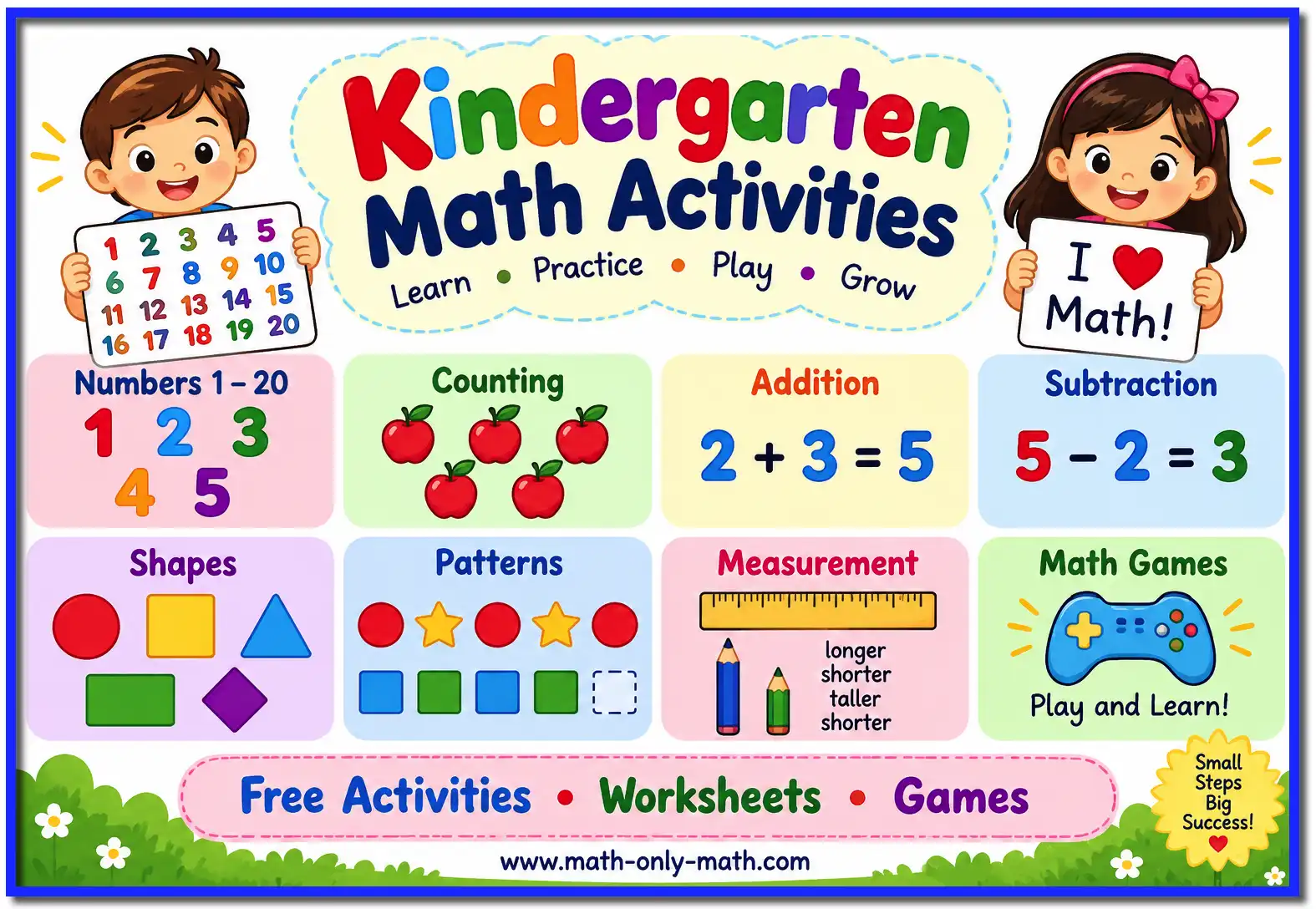
Kindergarten math activities help children build a strong foundation in numbers and early mathematical thinking through fun, simple, and engaging practice. At this age, children learn best when they can count, compare, sort, recognize patterns, explore shapes, and solve simple problems using pictures and familiar objects.
This collection of free kindergarten math activities, games, and worksheets is designed to make early math learning enjoyable and easy to practice at home or in the classroom. Children can learn to recognize and write numbers, count objects, compare quantities, practice simple addition and subtraction, identify basic shapes, complete patterns, and explore measurement and other early math concepts.
Parents and teachers can use these Common Core-aligned resources to provide extra practice, reinforce classroom learning, or introduce a new math skill in a fun way. Printable kindergarten math worksheets are also available for children who enjoy learning with pencil and paper, while interactive math games and quizzes provide an engaging way to practice skills online.
Start with numbers and counting, then move on to addition, subtraction, shapes, patterns, measurement, and problem-solving. With regular practice and playful activities, children can develop confidence and important early math skills step-by-step.
What You’ll Find in Our Kindergarten Math Activities
Fun Kindergarten Math Activities
Try these simple, hands-on activities to practice counting, numbers, addition,
subtraction, shapes, patterns, measurement, and early math thinking.
1. Count and Match
How many apples are there?
🍎 🍎 🍎 🍎
Tip: Touch each object once as you count.
2. Number Hunt
Click the numbers in order: 1, 2, 3 … 10.
Find number 1 first!
The numbers are mixed up each time. Find them one by one in the correct order.
3. Build a Number
Build the number 6 with six counters.
0 counters
Tip: Count the counters as you add them.
4. More or Less?
Which group has more stars?
⭐ ⭐ ⭐ ⭐ ⭐
Tip: Count the objects in each group, then compare the numbers.
5. Shape Hunt
Click the triangle.
Try a shape hunt at home or in your classroom.
6. Number Before and After
What number comes before and after 5?
7. Make 5
Choose a number that makes 5.
More ways to make 5 include 1 + 4 and 4 + 1.
8. Missing Number
What number is missing?
9. Pattern Activity
What comes next?
🔴 ⭐ 🔴 ⭐ ?
Try making your own AB pattern with toys or blocks.
10. Make 10 with a Ten-Frame
There are 7 counters. How many more make 10?
🔵
🔵
🔵
🔵
🔵
🔵
🔵
A ten-frame helps children see how numbers make 10.

Kindergarten Number Activities
● Numbers and Counting up to 20
● Counting Numbers from 1 to 50
● Counting Numbers from 51 to 99
● Counting Before, After and Between Numbers up to 10
● Before and After Counting Worksheet up to 10
● Worksheet on Ordinal Numbers
● Worksheets on Counting Before and After
● Before, After and Between Numbers Worksheet up to 10
● Worksheet on Before, After and Between Numbers
● Worksheet on Before, After and Between Numbers up to 20
● Worksheet on Before, After and Between Numbers up to 50
● One More than Numbers upto 10
● One Less than Numbers upto 10
● Smallest and Greatest Number upto 10
Kindergarten Counting Activities
● Numbers and Counting up to 10
● Counting Eleven to Twenty with Numbers and Words
● Counting Numbers from Twenty One to Thirty
● Counting Numbers from Thirty One to Forty
● Counting Numbers from Forty One to Fifty
● Worksheets on Counting Numbers
● Worksheet on Counting Numbers 6 to 10
● Counting Numbers Practice Test
● Counting Forward and Backward upto 10
● Worksheet on Joining Numbers
Kindergarten Addition Activities
● Addition
● Kindergarten Addition up to 5
● Worksheets on Kindergarten Addition up to 5
● Worksheet on Kindergarten Addition
Kindergarten Subtraction Activities
Kindergarten Shapes & Geometry
● 2D Shapes
Kindergarten Patterns & Sequences
● Patterns
● Sequence
Kindergarten Measurement, Data & Time
● Time
Kindergarten Printable Worksheets
Practice tracing the numbers from 21 to 30
Practice tracing the numbers from 31 to 40
Practice tracing the numbers from 41 to 50
Kindergarten Math Game:
🎯 Kindergarten Math Challenge
Practice counting, numbers, addition, subtraction, shapes, patterns,
comparing groups, and making 10 with this fun 10-question kindergarten math game.
Question 1 of 10
⭐ Stars: 0
📋 Your Review
| # | Question | Your Answer | Correct Answer |
|---|
Frequently Asked Questions about Kindergarten Math Activities:
Answer:
Kindergarten students typically practice counting, number recognition, writing numbers, comparing quantities, simple addition and subtraction, shapes, patterns, measurement, and early problem-solving skills. These skills help children build a strong foundation for first-grade math.
Answer:
Fun kindergarten math activities include counting objects, matching numbers to quantities, finding numbers, completing patterns, identifying shapes, comparing groups, practicing addition and subtraction, using ten-frames, and playing interactive math games.
Answer:
You can practice kindergarten math at home by counting toys or household objects, asking your child to identify numbers, comparing groups of objects, finding shapes around the house, completing simple patterns, and practicing addition and subtraction with pictures or objects.
Answer:
Kindergarten students practice recognizing, reading, writing, and counting numbers. Many kindergarten activities begin with numbers 1–10 and gradually extend counting and number understanding to larger numbers, depending on the child’s curriculum and progress.
Answer:
Kindergarten students generally begin with simple addition using objects, pictures, number sentences, and counting strategies. Activities such as 2 + 3 = 5 and making 10 help children understand how numbers can be combined.
Answer:
Kindergarten subtraction activities introduce the idea of taking away from a group. Children can practice simple subtraction using objects, pictures, ten-frames, and number sentences within a small range.
Answer:
Kindergarten students commonly learn to identify and describe basic two-dimensional shapes such as circles, squares, triangles, and rectangles. Shape activities can include sorting, matching, counting sides, and finding shapes in everyday objects.
Answer:
Start by having children count real objects such as blocks, toys, or counters. Then connect the quantity to the written numeral. Counting games, number matching, counting pictures, and number-writing activities can reinforce this connection.
About Author
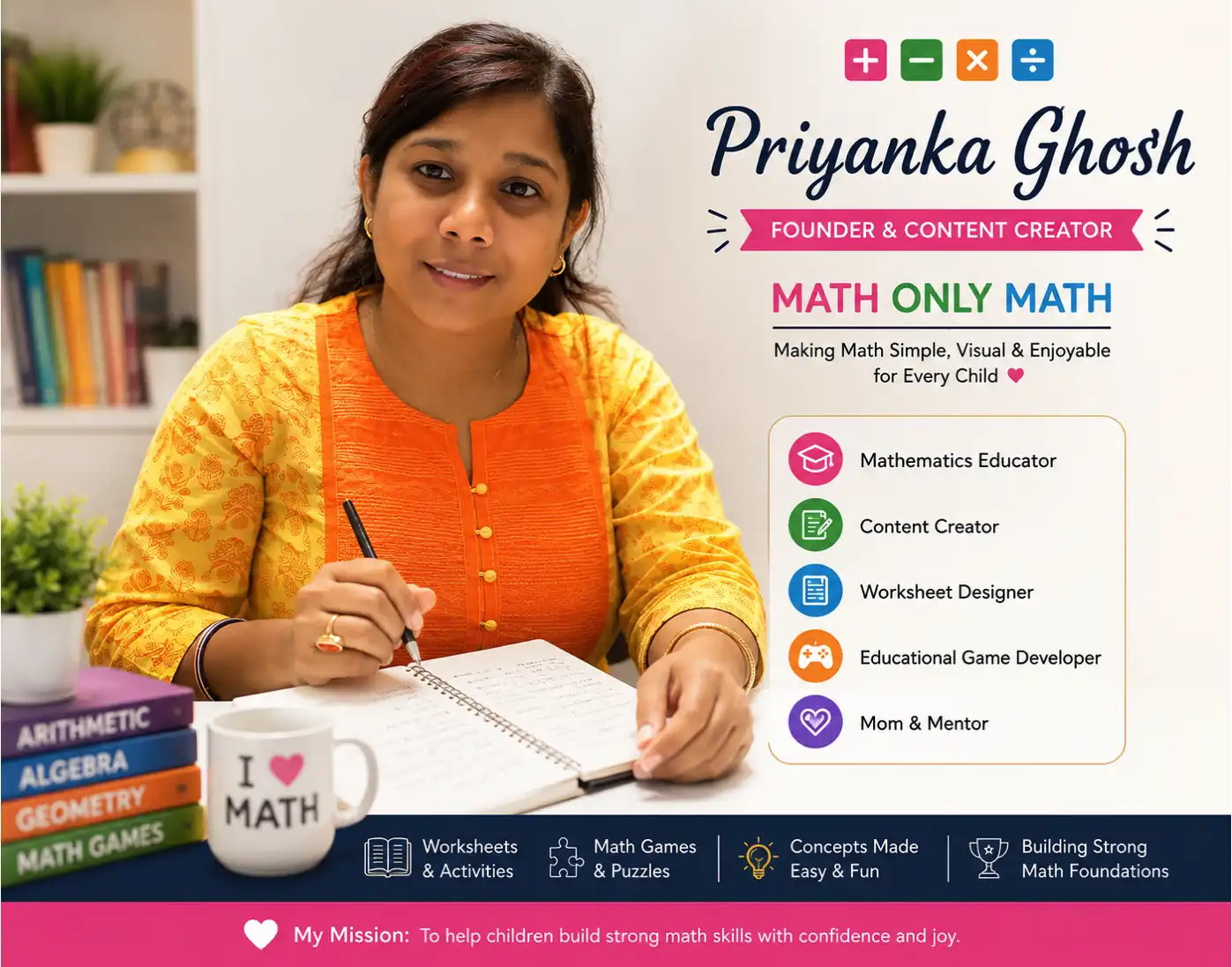
Written by Priyanka Ghosh
Mathematics Educator | Founder of Math Only Math
Priyanka Ghosh has been teaching elementary and middle-school mathematics for over 12 years and specializes in creating simple, child-friendly math lessons and worksheets.
From Kindergarten Math Activities to HOME PAGE
Didn’t find what you were looking for? Or want to know more information
about Math Only Math.
Use this Google Search to find what you need.