Please provide your email address to receive an email when new articles are posted on .
We were unable to process your request. Please try again later. If you continue to have this issue please contact [email protected].
Key takeaways:
The surgeon general nominee appeared before the Senate Health, Education, Labor and Pensions committee.
Members questioned her about her stance on vaccines, abortion bans, scientific integrity and more.
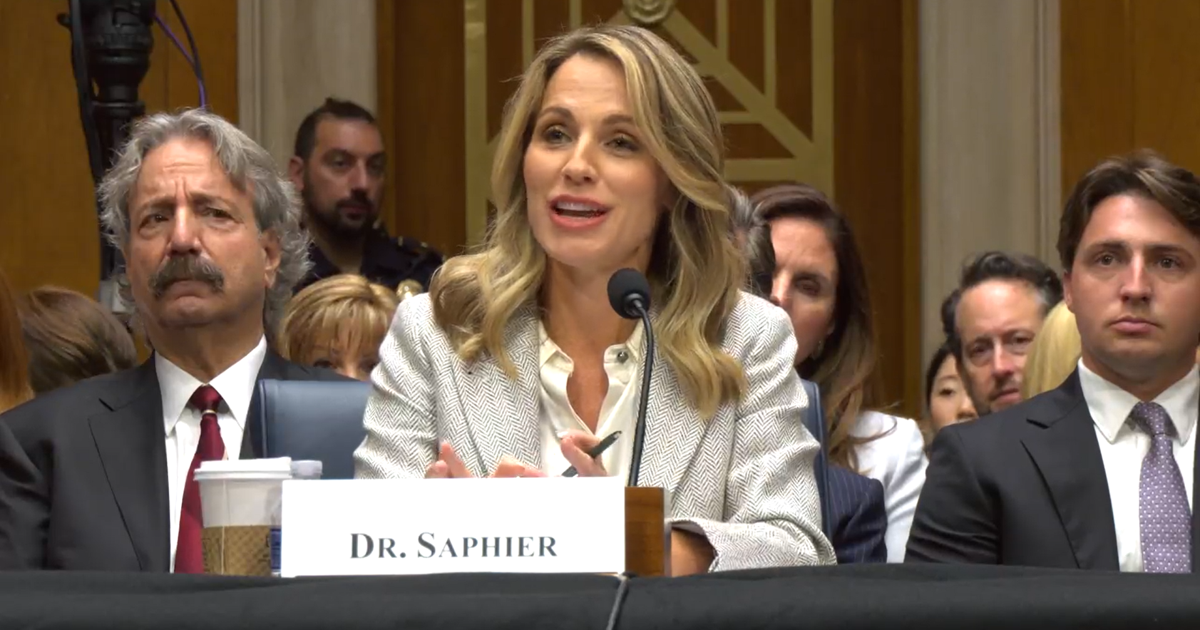
Lawmakers questioned Nicole Saphier, MD, on abortion bans, vaccines and other preventive health issues during Wednesday’s hearing to be the next surgeon general.
Nicole Saphier, MD, fields questions from the U.S. Senate Committee on Health, Education, Labor and Pensions on Sept. 16. Image: help.senate.gov
In a post to Truth Social, Trump described Saphier, a radiologist and director of breast imaging at Memorial Sloan Kettering Cancer Center Monmouth, as “a STAR physician.”
“She is also an INCREDIBLE COMMUNICATOR, who makes complicated health issues more easily understood by all Americans,” he wrote.
Key moments
At the top of the hearing, Committee Chairman Sen. Bill Cassidy, MD, R-La., — typically considered a swing vote in these proceedings — grilled her on vaccines.
He first asked what she would say if a mother asked her, “Does the MMR vaccine cause autism?” When she said she had “not seen reputable evidence that would suggest vaccines cause autism,” he pressed that she left herself some wiggle room in that answer, and others who had sat in her position “used that wiggle room to do things which were quite contrary” to what they said at the time.
Saphier then agreed that the MMR vaccine is not lethal, and is “our greatest tool for combating measles” — which Cassidy said was “music” to his ears — but that she “appreciates that the president is trying to reach the vaccine-hesitant people who are wanting more answers or who are concerned that there are too many doses.”
“I’m not sure that you reach people who are vaccine hesitancy by feeding into untruths,” Cassidy replied. “The way to dispel confusion is not to sow more confusion. The way is to say, ‘No, it does not cause autism.’ And frankly, even [the message] ‘I’ve never seen any evidence for it’ suggests there might be evidence out there, but you just are not briefed on it. That’s a little bit of an equivocation.”
Saphier said she understood his point. “I do not believe that there is reputable evidence that shows this causation of childhood vaccines and autism. What I can say is that I believe vaccines save lives, and they are one of the strongest tools in our arsenal when it comes to public health,” she said.
Cassidy also asked her about the hepatitis B vaccine, which was also a sticking point in Means’ hearing. Saphier said, “We have the most evidence showing universal birth dose vaccination to be safe and effective,” which, Cassidy pointed out, “stops short of saying that it should be recommended.”
“The overwhelming recommendation should be ‘this is what we have shown is tried and true.’ I’m open to future discussions about it, but at this point, the data that we have is based on the universal birth dose,” Saphier replied. “I believe in evidence-based medicine, and that’s all I have right now is that the universal birth dose has been the most effective policy here in the United States for reducing infection.”
When addressed by other members of the committee, Saphier answered questions about cancer screening methods and the current public health risks for children, like social media and AI use — particularly in the case of Adam Raine, who, as Healio previously reported, died by suicide at 16 years of age after extensive conversations with ChatGPT — as well as vaping.
“As surgeon general, you will play a very important role in the messaging to young people about the dangers of smoking and vaping. Do you agree with the FDA’s decision to allow additional flavors in the vapes?” Sen. Susan Collins, R-Me., asked.
Saphier said that she understands the concerns but she also believes “that if flavor can entice an adult to quit smoking cigarettes, then maybe it’s something to be considered.”
“But there are other smoking cessation devices like nicotine gum that are also flavored, and then … we don’t have the same concern for the appeal for the youth,” she said. “But I would look at the data. I would work with the FDA, and I would present a clear, concise message.”
Sen. John Hickenlooper, D-Co., asked about Saphier’s opinion on the administration’s cuts to the NIH and the importance of scientific integrity.
“Last year, the administration formally rescinded the NIH’s scientific integrity policy … The move was meant to ‘ensure alignment of the current administration’s priorities.’ I’m sure you can see why this is concerning, that the administration is seeking this alignment to override sometimes what the facts say,” Hickenlooper said. “We’ve had previous nominees come before the committee that stated their intention to preserve scientific integrity and independence. Multiple times, we’ve seen this commitment not being upheld … How are you intending to preserve the integrity and the independence of the scientists and health experts that are working in your agencies and in power to help keep this country or make this country healthier when we’ve seen so many efforts in the other direction?”
“As a physician, … your professional integrity is everything,” Saphier said. “And if I’m confirmed as surgeon general, when I finish serving the country, I would like to still be a physician. I will do nothing to jeopardize that professional integrity. And being someone in academic medicine, I will do everything I can to preserve the integrity of those around me.”
Sen. Patricia Murray, D-Wa., also asked about the controversial issue of abortion bans.
“In July of 2022, you claimed on Fox News that Democrats were spreading false information about what would happen to women experiencing ectopic pregnancies under abortion bans. You said, ‘I will be the first person — if any of the states stand up and say there will no longer be access to treatment. You will hear me. I will start advocating against that because that would be wrong,’” Murray said. “Well, I have news for you. That is what is happening. CDC data shows that the number of women who died after an ectopic pregnancy has doubled in recent years, with women dying at even higher rates in states that have banned abortion. So, it’s clear that these … abortion bans are killing women. So, will you stick to your word? Will you advocate against abortion bans that are harming women?”
“I always welcome reading more data,” Saphier replied. “I think the maternal mortality rate in the United States is something that we should be judged upon, and, if confirmed, I desperately want to do work with other people in HHS to see what we can do to ensure the lives of our mothers because they deserve better than we’re giving them right now.”
“For the record, from 2020 to 2025, 200 women experiencing ectopic pregnancies died. That is compared with 100 in the previous 6 years,” Murray replied. “I expect you to speak out about it if you’re confirmed.”
Sen. Josh Hawley, R-Mo., later asked about the safety of mifepristone. He cited a paper from the Ethics and Public Policy Center that claims approximately one in 10 women experience serious adverse events like hemorrhaging, infection or sepsis, up to 45 days after taking the drug.
Notably, the research has been heavily criticized. According to an article from KFF, the report’s methodology and data transparency are flawed, and the findings contradict the drug’s “well-established safety profile.” KFF cited FDA’s prescribing information, which states that 10 clinical trials spanning upward of 30,000 patients found that just 0.5% of patients experience serious adverse events.
Saphier said she was “well aware” of the risks associated with mifepristone and thanked Hawley for continuing the conversation.
“Some of the safeguards were removed under the COVID pandemic, and I look forward to reviewing the evidence that from the FDA’s most recent safety review on seeing if anything has changed,” she said. “I would like to hear from the FDA if there were new safety signals after removing those safeguards. I hope that I would be able to work with them to be transparent with the American people. And if there were no safety issues, then I would also translate that as well.”
What’s next?
Next, the Senate committee will vote on whether to send the nomination to the full Senate for a confirmation vote. Nominees need only a simple majority to be approved by the committee or confirmed by the Senate. Notably, Republicans have a one-seat majority on the committee and control the Senate.
Sen. Tammy Baldwin, D-Wi., who closed the hearing, gave senators until 5 p.m. ET Thursday, Sept. 17, to submit additional questions for the record.
What’s the diagnosis?
Arthur L. Caplan, PhD, Professor Emeritus and founding head of the division of medical ethics at NYU Grossman School of Medicine, told Healio that Saphier is “articulate and could add a very respectable voice to many public health questions,” but he also has concerns about her appointment.
“She’s a good communicator, intelligent and could really help with communications to the public. I just hope she pushes as hard as she can [for evidence-based medicine],” he said.
Specifically, Saphier’s take on mifepristone was “the worst part of her testimony,” Caplan said.
“If she’s evidence-based, then she should simply be saying, ‘The FDA has reviewed and reviewed this pill. The evidence is clear. There are no dangers that should keep us from making it available to women.’ And she tap danced around it.” Caplan said.
Caplan also said he does not “know what to trust” about her stance on vaccines.
“I think in the middle of a measles epidemic, she could have been even more forceful — that we don’t want to do anything to undermine mandates for school kids to get shots. Mandates that some states like Florida are backing away from. She didn’t say anything. She was sort of like, ‘Well, I know this is our best weapon,’ but she didn’t really say, ‘I think we have to be far more aggressive than we have been about vaccinating our kids and not weakening the schedule,’” Caplan said. “If she’s evidence-based, the evidence is clear as to what you want to do.”
Despite these concerns, Caplan said he expects her to be confirmed.
“I think she’s going to get confirmed, so this isn’t an issue about disqualifying her because of this testimony. I think she’s going to get through,” he concluded. “But I’m really nervous … It’s going to take a strong voice to stand up in the current climate for vaccines.”