
“The mask protects us, but it also hides us.”
Between Languages, Cities, and Cultural Friction
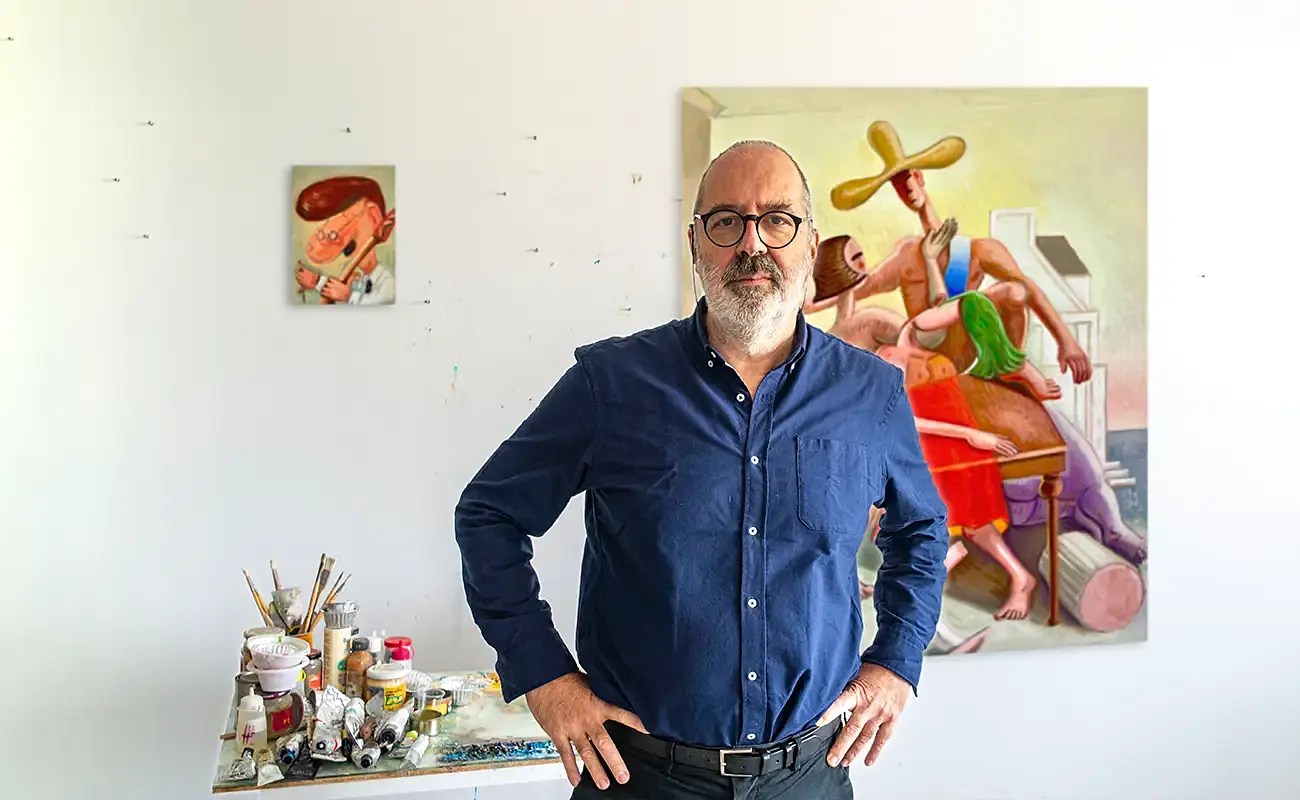
Tomàs Morell Brenner’s paintings emerge from a life shaped by cultural crossings, displacement, and close observation of human behavior. Born in Barcelona in 1964 to a German mother and Spanish-Catalan father, he grew up among three languages and three cultural perspectives. Catalonia remained tangible through his father’s extended family, while his mother brought German culture into the household. Rather than belonging to a single frame of reference, Morell learned early to perceive the differences between social environments, a sensitivity that would become inseparable from his approach to people and painting.
His childhood also coincided with the final years of Franco’s dictatorship, when Barcelona contained sharp contradictions. Political and cultural restrictions persisted, yet the city carried a growing appetite for social change. Morell remembers this atmosphere of movement and expectation before financial difficulties in the family business prompted his father, an engineer, to relocate the family to his mother’s hometown in Germany. The transition from Barcelona to a small, quiet German town during the 1970s profoundly altered the young artist’s surroundings.
Art became an important means of navigating that disruption. His parents enrolled Morell and his sister in ballet, while he also began studying music and painting. Creative activity offered him both independence and a form of expression for experiences he could not readily put into words. By around fifteen, drawing and painting had become more than occasional pursuits. He filled classes with caricatures and small scenes populated by teachers and classmates. At seventeen, largely on his own in Germany, he applied to the Academy of Fine Arts in Nuremberg. Acceptance transformed an intuitive attachment to painting into a formal artistic education.

Tomàs Morell: Distortion as a Language for Human Vulnerability
Morell’s work today concentrates on people and the unstable relationships between them. Vulnerability, identity, sexuality, gender, power, and social difference recur throughout his paintings, but rarely through literal narratives. Meaning instead develops through physical cues: how bodies occupy a space, how figures confront or avoid one another, and how a seemingly recognizable situation begins to feel psychologically uncertain. Personal difficulties and trauma have also informed his practice, with painting functioning as a way to process experiences that resist straightforward explanation.
Humor and the grotesque are crucial to this process. For Morell, humor creates enough distance to approach difficult material without turning painting into direct confession. Bodies can become strange, uncomfortable, absurd, or funny while retaining emotional weight. This attraction to distortion connects with his longstanding interest in German Expressionism, particularly its capacity to combine social criticism, harshness, humor, and psychologically charged representations of the human figure.
His artistic references span Cézanne, Picasso, Matisse, Kirchner, Grosz, and Beckmann, followed by later interests in Philip Guston, Georg Baselitz, Martin Kippenberger, and the early work of Walter Dahn. The early twentieth-century avant-garde also provided an important model for breaking from academic conventions. What connects these otherwise different influences for Morell is not a single aesthetic but artistic independence. He values painters who created unmistakable visual languages and demonstrated that a painting need not be beautiful, agreeable, or correct. Their example encouraged him to build from his own experiences and recurring concerns rather than reproduce an inherited style.

Masks, Models, and the Politics of Looking
A decisive shift arrived in 2012, when Morell left his position as an art director at Saatchi & Saatchi and permanently closed Blackline, the design and communications company he had founded and operated from 1996 to 2011. After years of building a professional career that enabled him to live and work in Barcelona, he chose to concentrate again on painting. Man Holding Mask 3 (2014) and Woman Holding Mask 2 (2013) belong to this pivotal period and helped establish the Ecce Homo series, later presented at Galerina Steiner in Berlin.
The series drew upon years of psychoanalysis and substantial personal reflection. Its title invokes both the Christian image of Christ and Nietzsche’s Ecce Homo, allowing Morell to reconsider the enduring figure of the suffering human being through contemporary men and women. Masks became a central device. They protect their wearers while simultaneously concealing them, leaving the viewer uncertain about what exists beneath the visible persona. His characters can resemble performers caught inside assigned roles, yet their theatrical appearance is accompanied by disorientation. Morell painted these works in oil because its material qualities allowed him to give bodies an emphatic physical presence while making them appear subtly distorted and unfamiliar.
Between 2017 and 2019, he returned to another historically loaded image through three diptychs based on the painter and model. Instead of simply repeating the traditional arrangement in which a male painter observes and a woman becomes the represented object, Morell questioned the mechanics of looking itself. The space became increasingly theatrical, almost a stage on which viewer, painter, and model could enter shifting relationships of visibility and authority. This investigation developed into Enigma y deseo and Déjà-vu. Like Ecce Homo, these works take established motifs and unsettle their expected meanings, asking what changes when familiar images of masks, bodies, artists, and models no longer behave according to convention.

Tomàs Morell: From a Pencil Mark to an Uncertain Outcome
Despite the psychological and historical layers within his paintings, Morell’s daily practice often begins with modest means: pencil and paper. He draws whatever occupies his thoughts without immediately deciding whether the image deserves to become a painting. A promising drawing may remain pinned to his studio wall for days or weeks, giving him time to consider its potential. Gradually, it might suggest a scale, a color relationship, or another clue for translation into paint. Other drawings simply remain unresolved, evidence of an idea that did not need to progress further.
This openness continues once he begins painting. Morell avoids a rigid working method and allows the image to depart from its original premise. A seemingly clear plan can change substantially through the act of painting itself. The movement from a small drawing to a large oil painting is therefore not simple enlargement but a process in which composition, materiality, color, and the behavior of figures can redirect the work. That willingness to relinquish control corresponds with his broader interest in images whose meanings remain unstable rather than settling into fixed explanations.
His immediate exhibition schedule brings these concerns back to two cities central to his biography. On September 19, 2026, he is due to participate in Rojo que te cojo at Baixada 6 Projects in Barcelona, a group exhibition centered on red in painting and marking the opening of the new space. Morell values its intention to build a connection between Berlin and Barcelona, cities that have shaped his cultural references in different ways. On November 12, he is also scheduled to join Bild der Frau at SMAC in Berlin. Dedicated to women, the exhibition intersects directly with Morell’s continuing attention to bodies, identity, representation, and the dynamics of looking. Beyond these projects, his method remains deliberately open: a pencil drawing appears, stays on the wall, and sometimes finds its way into paint.