
By Howard Hardee • Editor
October 8, 2026
Folding wingtips could be considered something of a proven concept since they are a signature feature of the 777X. But before such technology can enable greater wingspans on the eventual successors to the Airbus A320neo and Boeing 737 Max families, several technical challenges still must be resolved.
Boeing has demonstrated the viability of folding wingtips on widebody jets. With its 235-foot wingspan, the 777-9 would not fit at airport gates and in taxiways without them. (FAA airport specifications show the 777-9’s folded wingspan measuring 213 feet.) That means airports do not have to alter infrastructure to accommodate the aircraft.
More importantly for operational economics, the 777-9’s folding wingtips—and the in-flight wingspan extension they allow—are critical for delivering airframe efficiency gains over the 777 Classic.

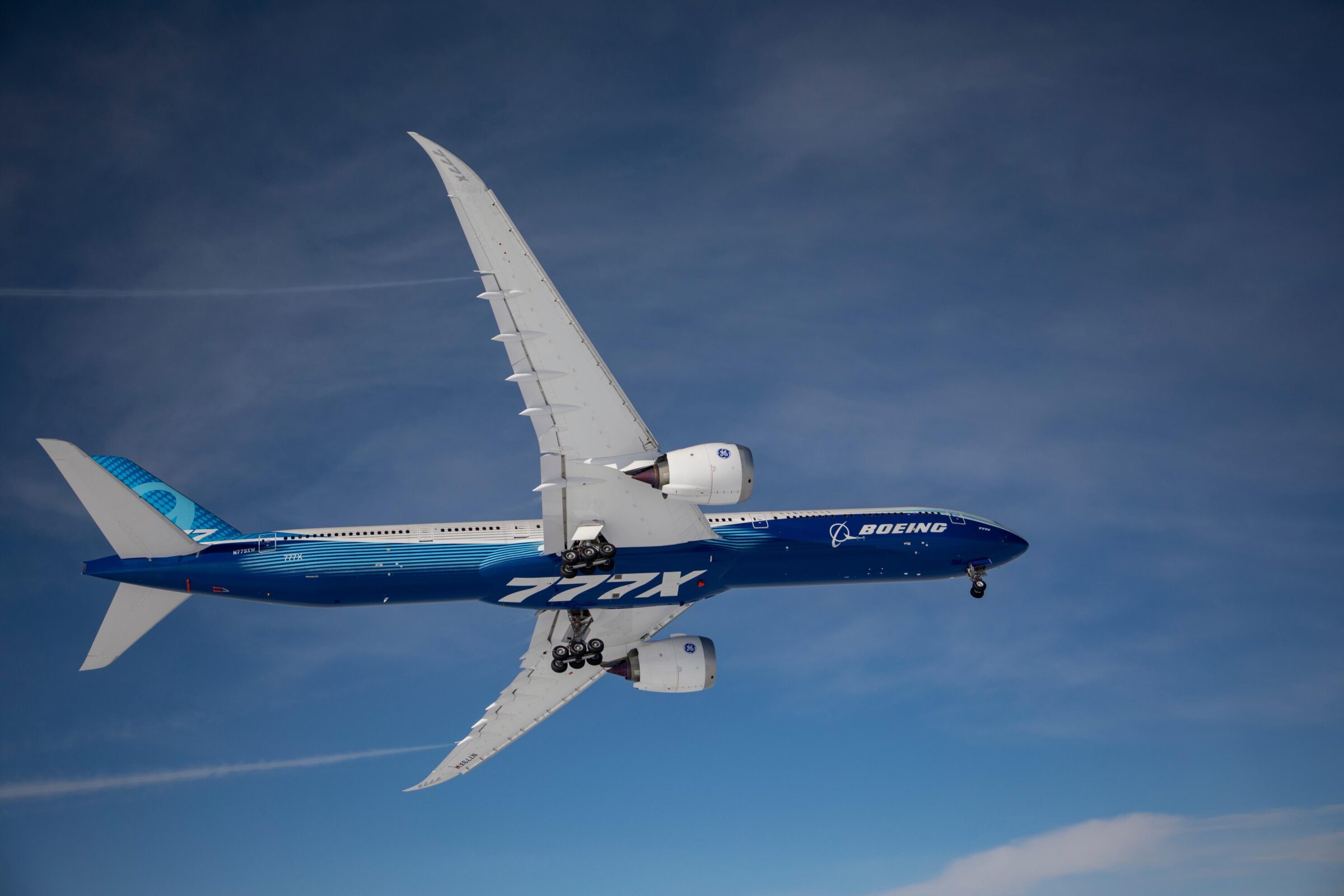
Boeing says the 777X’s high-span composite wing achieves more-efficient aerodynamics than those of the A350-1000, against which it will compete upon certification. Photo credit: Boeing
The 777-9 took its first test flight in January 2020, though it has yet to achieve FAA certification and enter passenger-carrying service. How the folding wingtip mechanisms hold up during airline operations has yet to be observed.
On the military side, several carrier aircraft have featured folding wings for deck storage. But there is no civil air transport equivalent to the 777X’s high-span composite wings with folding wingtips.
Sue Partridge, head of Airbus’ Wing of Tomorrow program, told Leeham News and Analysis (LNA) during this year’s Farnborough International Airshow that applying folding wing technology to future narrowbody jets will be more demanding.
“It’s a big challenge because if you think about a single-aisle product, it flies very, very frequently,” she said. “A 777 may takeoff and land once in a day. If you put this technology on a single-aisle aircraft, we need to know that it’s going to reliably fold and unfold multiple times a day as it does multiple flights. Achieving the same levels of operational reliability that we have on our existing A320 fleet is vital.”
Long Wings and Efficiency Gains
Both Airbus and Boeing are exploring longer composite wing structures for future aircraft platforms. Airbus has been studying such technologies through its Wing of Tomorrow program for the past decade, while Boeing is considering thin-wing technology that to provide efficiency gains.
Boeing’s thin-wing concept was initially part of the X-66 Transonic Truss-Braced Wing airframe configuration that it explored with NASA. The partners have since paused work on the demonstrator, dropping the “aerodynamic, structural braces” and focusing on the thin wings alone.
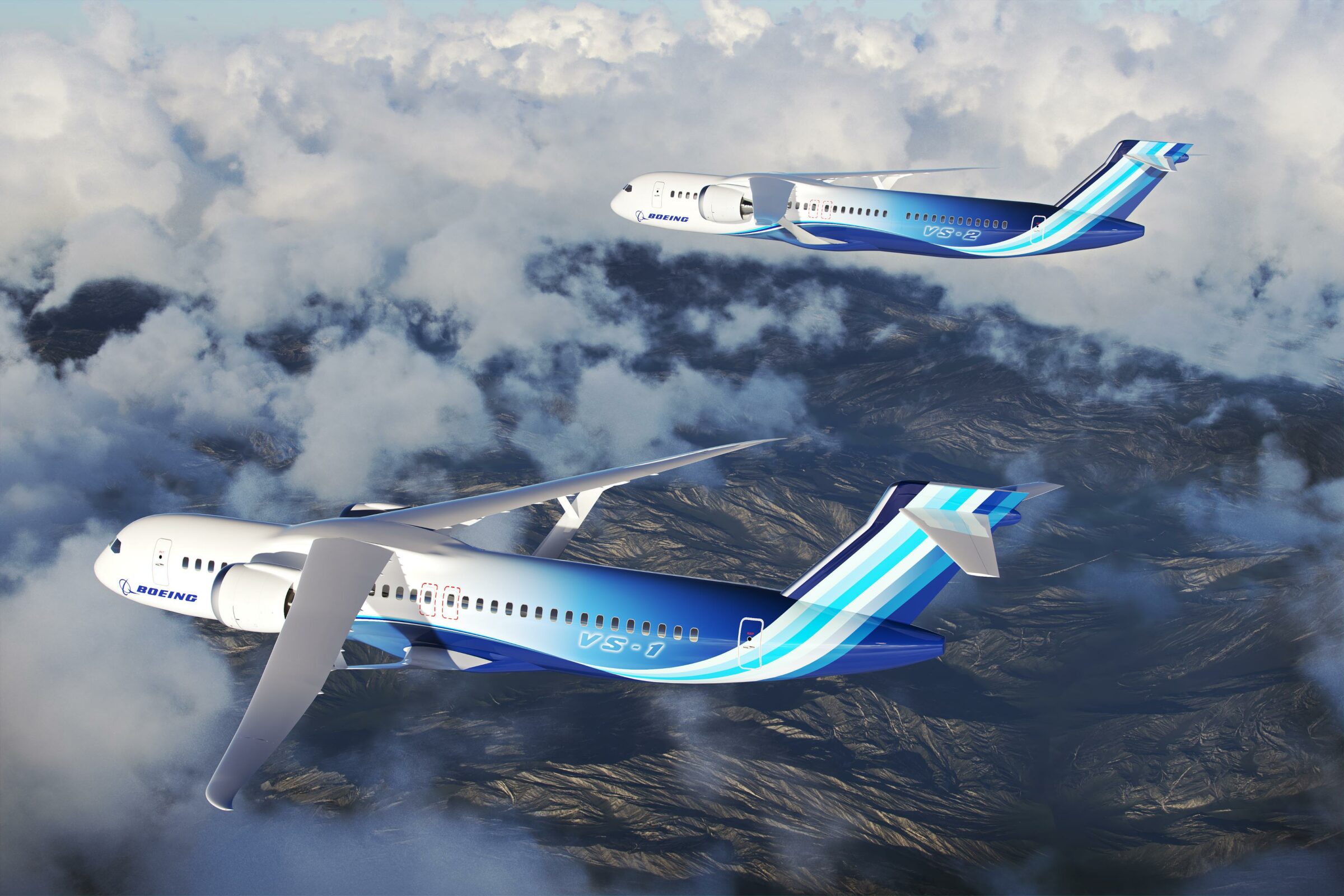
Boeing looked at a truss-braced wing design for future airliners, though it and NASA have since narrowed focus. Photo credit: NASA
Whether Boeing’s thin-wing concept would require folding wingtips is unclear; Airbus is more openly exploring such a configuration. Both airframers have identified technical issues that must be resolved in order to lengthen the wingspans of their next narrowbodies.
The Wing of Tomorrow program is aimed at “preparing the technologies that Airbus will need for its next-generation single-aisle aircraft,” Partridge said. It is part of the company’s broader efforts to leverage decades of design, engineering and production experience to advance its commercial products.
“One of those important improvements is about the efficiency of the aircraft, to reduce fuel burn and to reduce operating costs, as well,” she said.
At the Farnborough show, Airbus launched a development program to install longer wings on an A321neo and pursue a flight-test campaign. Wingtips on the Wing of Tomorrow demonstrator will be fixed but assume the same size and shape of folding wingtips.
Airbus believes that new wing technology will boost overall efficiency as much as new engines on the next single-aisle jet—likely referencing a next-generation turbofan rather than the open-fan design being explored by CFM International’s RISE (Revolutionary Innovation for Sustainable Engines) program.
“It is a really important lever for efficiency, and the way you improve that efficiency is through wingspan,” Partridge said.
Folding Wingtips Are the Future
Longer, lighter and more-slender wings reduce drag, fuel burn and CO2 emissions. But building wingspans broad enough to realize those efficiency gains creates logistical problems–namely, not fitting at narrowbody gates at airports. Hence the folding wingtips.
“In simple terms, the aircraft will land and as it taxis to the terminal, a portion of the wing will unlatch and fold out of the way,” Partridge said. “When the aircraft is in reverse, taxiing back out to fly, the wings will unfold and latch and lock into place, ready for flight.
“It’s a complex technology because it involves integrating a very reliable system in a very small space on the wing that’s able to actuate and lift quite a large section [of the wing] that is several meters,” she said.
Notably, Airbus has yet to determine whether the folding section of the next-generation wing will feature actuators such as ailerons, or whether that will be an unmoving section of the wing during flight. The folding wingtips on the Wing of Tomorrow’s A321neo demonstrator (highlighted in orange below) will be about 15 feet long.

Flight-testing of the A321neo demonstrator will follow a three-year development period. Photo credit: Airbus
“We’re still studying that part…so we can really understand the aerodynamic performance, and that will help us to then know exactly what the folding wing needs to look like and potentially whether it needs any kind of moving surfaces on it,” Partridge said. “We don’t know yet. But of course, we don’t want to add any complexity that we don’t need that doesn’t bring value.”
Systems in a Smaller Space
Challenges come with thinner wings, however. Speaking at an investor conference earlier this year, Jay Malave, Boeing’s chief financial officer, said that systems integration becomes more difficult.
“If you think about thin wings, obviously, we’re trying to push the next generation of aerodynamics there. What is the challenge with thin wings?” Malave said. “Obviously, there are systems integration challenges. The thinner you make the wing, the harder it is to integrate systems. Think fuel systems but also think actuation.”
At a separate event, Brian Yutko, Boeing’s vice president of product development, got more specific. It is unclear, for example, to what degree future wing architectures will feature hydraulic versus electromechanical actuation.
“We don’t know the answer to that question,” Yutko said. “We know that we’re in a part of the technology curve where you can really start to push electromechanical actuation so that they can be pretty efficiently packaged.”
Producing mostly composite wings at a high enough rate to support a future narrowbody program—which may demand north of 100 aircraft monthly–is another mountain to climb, with composite wing skins presenting particular difficulties. Partridge is “very optimistic” that Airbus’ next-generation wing will be produced at sufficient scale, adding that the Wing of Tomorrow program has always operated with high rates in mind.
Related