
By Howard Hardee • Editor
October 6
Certification of the 737 Max 10 appears back on track despite a software glitch potentially affecting some Boeing narrowbodies—an issue the FAA has since deemed not safety critical, reducing the likelihood of another lengthy delay.
Indeed, the episode now appears to be a hiccup rather than a major setback, representing the more-positive outcome that Max 10 customers such as Ryanair had been hoping for.
Alaska Airlines, another carrier with Max 10s on order, had previously expected the large single-aisle aircraft to be certified by the end of September—suggesting that, barring further revelations, the Max 10 could join the Max 7 in finally clearing its last regulatory hurdle sometime soon.
As Leeham News and Analysis (LNA) reported last week, the Max 10 program stumbled late in the process of securing an amended type certificate from the FAA. It had previously looked like it was on the verge of clearing the path to service entry.

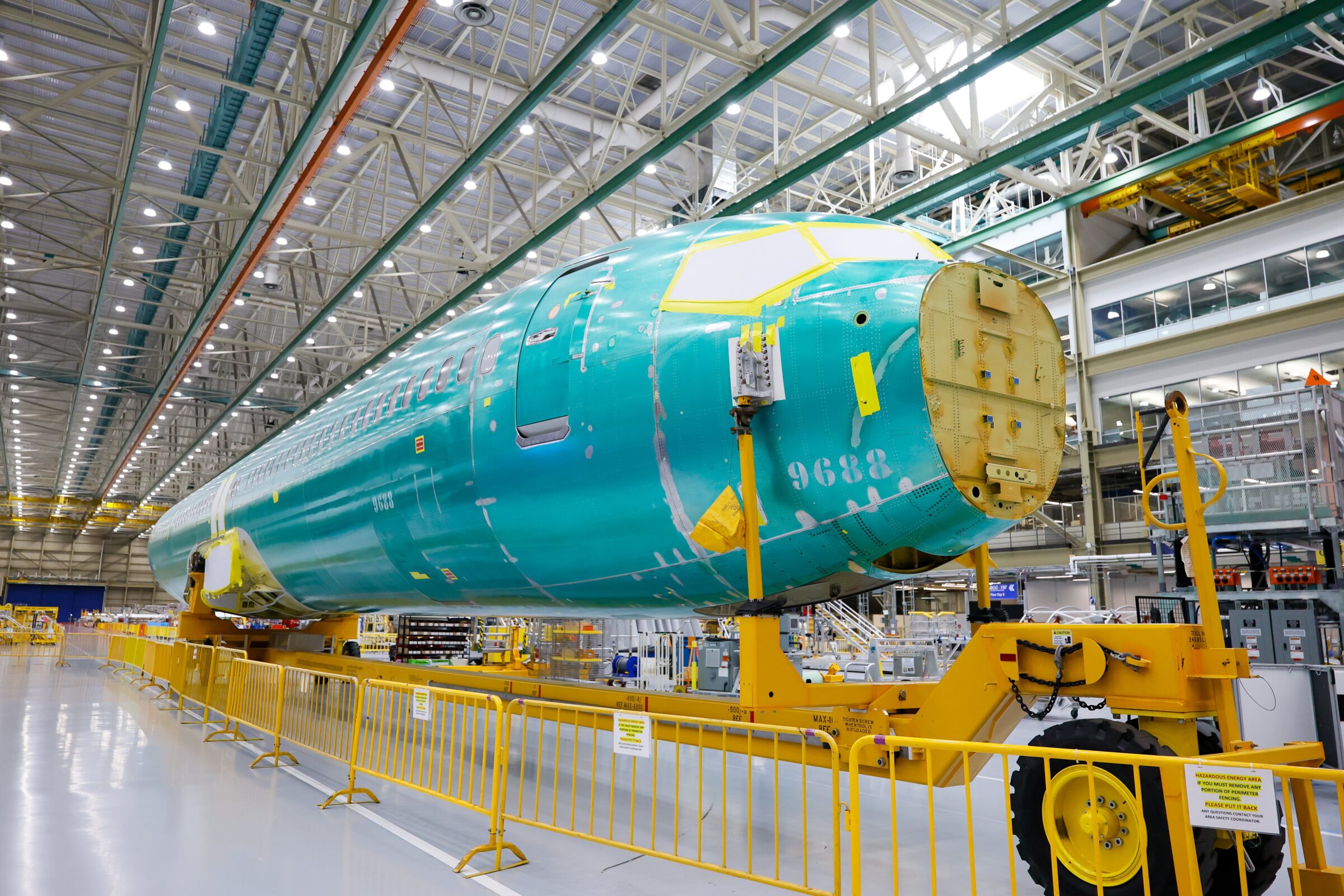
The second 737 Max 10 to be manufactured at Boeing’s North Line in Everett, as pictured in July. Photo credit: Jennifer Buchanan/Seattle Times/Pool
The issue centers on U14 flight-management software installed on certain 737 Max aircraft, including Max 10s and Max 7s. The glitch reportedly occurs sometimes when pilots load a new flight plan for a go-around, meaning the flight crew may have to intervene and manually fly the aircraft. Boeing flagged the issue in a bulletin to airlines, prompting some U.S. carriers to state a preference for 737 Max jets using previous software updates.
The FAA issued a special airworthiness information bulletin to airlines operating affected Max jets, as well as foreign regulators. The regulator also formed a Corrective Action Review Board composed of internal experts on airframes, mechanical systems, flight controls, avionics, propulsion, and flight testing to review potential safety risks. The board determined that, despite the FAA’s prior workload concerns, pilots encountering such a scenario would not be overtasked.
“Following a thorough review, a panel of FAA safety experts on Friday [October 2] determined a software issue in certain Boeing 737 Max flight computers is not a safety concern,” the civil aviation regulator said in a statement. “The FAA’s Corrective Action Review Board made that determination because pilots retain full control of the aircraft and the indications to the flight crew are clear and unambiguous.
“As with any situation, the FAA will consider appropriate action if it receives new information about this issue,” it added.
While the latest snag is apparently minor, glacially slow certification progress has proven to be one of Boeing’s defining issues for the 2020s, and the company would surely like to streamline the process moving forward.
Will it Always Take This Long?
In the post-Max crash era, Boeing’s certification programs have taken years longer than originally anticipated, stymied by increased FAA scrutiny, technical issues, and more-stringent certification processes. As market entry of the smallest and largest Max variants and the 777-9 has dragged later into the decade, the company is eyeing shorter certification timelines for its next generation of commercial aircraft.
FlightGlobal reporter Jon Hemmerdinger reported last week that longtime Boeing executive Doug Ackerman had been tabbed by CEO Kelly Ortberg to review the company’s recent certification programs, and also certification of future aircrafts platforms–an initiative that was in motion prior to the 737 Max 10’s most recent certification delay.
Longer certification times can be at least partially attributed to Boeing itself, which has adopted new processes aimed at boosting technical rigor and safety oversight. Michael Sinnett, vice president of Boeing’s product strategy and development programs, told reporters in July that Boeing has implemented two certification improvements since the Max crashes of 2018-19. He acknowledged that getting an aircraft certified now requires “more sequential work than we’ve done in the past.”
The first is called a development assurance process, which “codifies how you do systems engineering for safety-critical systems in order to minimize the potential for errors,” he said.
“We applied it on the 787 toward the end of the development, and we kind of did it in arrears on the Max 10,”Sinnett said. “We did it on systems that changed… and more broadly to the entire airplane.”
On the 777-9 program, the safety of more than 60 systems has been evaluated by development assurance processes.
“From my perspective, it’s one of the best ways to assure that you’re doing systems engineering well at the beginning of an airplane program, that you’re understanding the top-level requirements,” Sinnett said. “You’re verifying that you’ve implemented the design per all of the requirements that you developed.”
Pilots in the Loop
Boeing also says it has improved how it involves pilots throughout the design process. Sennett pointed to chief test pilot Mike Carricker’s leading role in developing the 787 Dreamliner as an example of the general principle at work.
“There was rarely a design decision on that I made on that airplane without tying Mike Carricker in very, very closely,” Sinnett said.
But the airframer has since formalized the way input from pilots and airlines is implemented into aircraft design and certification. Those processes are now well-defined and repeatable.
“It really is with great rigor, and it causes us to… look at failures that could result in a hazardous or catastrophic condition. Anytime we make any assumptions whatsoever about flight crew response, we document what our assumptions are.”
That includes anticipating how flight crews might respond “inappropriately” during safety-critical scenarios, Sinnett said: “It really expands the formal way in which we seek human vectors input guidance on certification.”
12-Month Certification Timelines?
Boeing will re-evaluate its certification strategies once it has a type certificate for the 777-9, a milestone now expected to come in 2027. Greater efficiency will be a focus.
Parts of the process have taken more time than is justified by the “safety value added,” Sinnett said. “Clearly, we don’t want to have first flight and then six years later go into service.
“We want it to be like a year or two,” he said. There was a roughly year-long period between first flight of the 777-200 and its entry into service in the mid-1990s, and 22 months between first test flight and first revenue flight for the 787 for All Nippon Airways.
In a perfect world, Boeing’s certification programs would last more like 12-24 months: “Those are reasonable timelines. I believe we need to figure out a way to put the work into that box.”
Whether that goal is realistic remains to be seen, with Boeing aiming for a 737 replacement to enter service in the early 2040s. The airframer is also reportedly studying a new light-twin aisle aircraft, though no new clean-sheet aircraft programs have been launched to date.
Related