
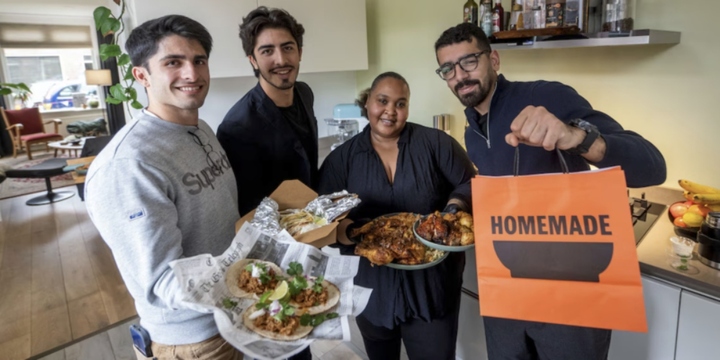
Every day, thousands of passionate cooks prepare meals from home, while millions of food lovers search for authentic local dining options. Homemade bridges this gap by offering a marketplace platform that turns home kitchens into real food businesses.
We sat down with Mahmoud, founder of Homemade, to discuss redefining food delivery through neighborhood home cooks, their go-to-market strategy, and their current round on Leapfunder.

- Hi Mahmoud, thank you for agreeing to do the interview. Tell us about Homemade and the idea that got it all started.
Homemade is a marketplace that lets talented cooks turn their existing kitchen into a real food business. We provide the infrastructure around cooking: storefront, branding, menus, payments, customer acquisition, and order management. Increasingly, we use AI to make those tools faster and more accessible, from helping chefs create menus and branding to simplifying onboarding and operations. The idea is that someone should be able to start selling great food without first needing to open a restaurant or become an expert in marketing, technology, and administration.
The idea came from seeing how strange the traditional path into food entrepreneurship is. There are incredibly talented cooks everywhere, but if they want to earn money from that talent, we often tell them they need tens of thousands of euros, a commercial location, and a huge amount of risk before they have served their first customer. We thought that model should be turned around. Start with the food. Find customers. Build demand. Then grow. Our mission is to make entrepreneurship accessible to far more people and help communities turn skills they already have into real economic opportunity.
- What problems are you trying to solve? What are the benefits of Homemade?
On the supply side, we are lowering the barrier to becoming an entrepreneur. A great cook should not need €50,000 or €100,000 in starting capital just to find out whether people love their food. With Homemade, chefs can start small, build a customer base, and grow at their own pace. For some people, that means extra income. For others, it can become the first step toward building a serious food business. And because much of the operational complexity can increasingly be supported by technology and AI, people who may never have considered themselves entrepreneurs can suddenly have access to tools that were previously only available to larger businesses.
I think this becomes even more relevant in the coming years. AI will create enormous opportunities, but it will also change the nature of many jobs and make some career paths less predictable. Platforms like Homemade can form part of a broader economic safety net by making it easier for people to create income from human skills, cultural knowledge, and creativity that they already possess. Cooking is deeply personal and local. It brings people together. So for us, empowerment is not only about enabling someone to earn money, but also about strengthening local communities and giving people more control over how they participate in the economy.
For customers, we are solving a different problem. Food delivery has become incredibly convenient, but also increasingly standardized. You often see the same chains and the same types of food everywhere. Homemade opens up an entirely different layer of supply: the Surinamese cook around the corner, the Indonesian family recipes you would never find on a normal delivery platform, or the Italian chef building a following from their own kitchen. Customers get something more authentic and personal, while more of the money stays with someone in their local community.

- You have a live round on Leapfunder. What makes it the right tool for your startup, and what do you expect from the round?
What attracted me to Leapfunder is the type of investor around the platform. At this stage, we are not only looking for capital. We want people around us who understand marketplaces, network effects, consumer behaviour, and what it actually takes to build something city by city. Many Leapfunder investors have built companies themselves, so the value can go far beyond the cheque.
The key objective of this round is to prove density. One of our biggest learnings is that marketplace success is not about being present in as many cities as possible. It is about becoming extremely strong in a smaller number of places first. When customers consistently have several great chefs close to them, everything improves: choice, repeat orders, word of mouth, and chef earnings. We want to use this round to prove that model in our strongest cities, build a repeatable playbook, and then use that playbook to expand much faster.
- How much growth potential do you see for Homemade?
The opportunity is much larger than simply building another food delivery platform. The kitchens already exist. The cooking talent already exists. The customers already spend money on food. What has been missing is the infrastructure that allows independent cooks to participate in that market at scale. That is the category we want to build.
We already have more than 14,000 registered users, 113 chefs on the platform, over €138,000 in cumulative GMV and more than 2.4 million organic social impressions. Much of that has been achieved before we have even reached the level of local density we ultimately want. To us, that is the exciting part. We are still early.
And I think the timing matters. As AI makes it possible to automate more administrative and knowledge-based work, there is a growing need for platforms that help people convert human skills into independent economic opportunity. Homemade can use AI on one side to remove friction, while strengthening something very human on the other side: cooking, culture, community, and personal connection. Our ambition is to become the infrastructure for home-based food entrepreneurship, first in the Netherlands and ultimately across European cities.

- What are your plans for the upcoming months? Tell us about your go-to-market strategy and your plan for acquiring customers.
Our focus for the coming months is very simple: density before geography. Earlier, we were excited when chefs signed up from new cities because it made the marketplace look bigger. What we learned is that a marketplace does not become valuable because you have one chef in twenty cities. It becomes valuable when a customer opens the app and consistently sees several great options close to them. So now we are concentrating supply and demand city by city, and in some cases neighborhood by neighborhood.
The go-to-market model starts with building strong chef supply in a specific area. Around that supply, we acquire customers through local social content, referrals, the chefs’ own communities, partnerships, and targeted paid acquisition. We are also expanding higher-value channels such as office lunches, catering, and private-chef bookings, which generate additional demand while creating more earning opportunities for chefs.
At the same time, we are investing heavily in automation and AI to make it easier for a new chef to succeed. We already use technology to simplify onboarding, menu creation, branding, food photography, content and operational support, and we want to keep reducing the amount of technical or business knowledge someone needs before they can start.
The long-term goal is not simply to build a marketplace. It is to build an entrepreneurship layer for local communities: one where technology removes friction, chefs create opportunity for themselves, customers discover the people around them, and more economic value stays within the neighborhood. If we can prove that model in a dense, profitable local market, we believe it can be repeated city by city.
Thank you for sharing your journey with us, Mahmoud. We wish Homemade the best of luck.
Join our network of startups & investors!