

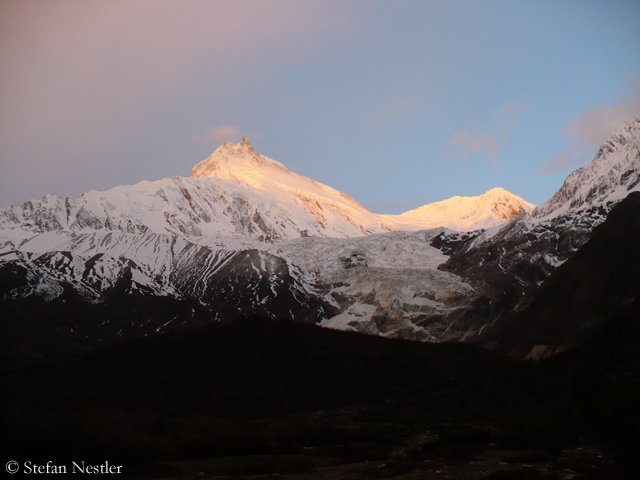
There have never been as many climbers attempting to summit the 8,163-meter-high Manaslu in western Nepal as there are this fall. As of 16 September, the Himalayan state’s Tourism Department has already issued 480 climbing permits to foreign clients from 40 commercial teams. This brings the numbers for this fall season on the world’s eighth-highest mountain close to those of the record-breaking spring season on Mount Everest, which saw 492 permits.
For years, Manaslu has been something of the “Everest of the fall season” – especially when Tibet’s three eight-thousanders – Cho Oyu, Shishapangma, and Everest (north side) – are once again closed to foreign teams, as is the case this fall.
Rope-fixing team expected at the summit of Manaslu in the coming days
When you add in the local guides and other expedition team staff, well over 1,000 people have gathered at Manaslu Base Camp at around 4,800 meters. It’s hardly surprising, then, that long ines are forming on the route secured with fixed ropes – as can be seen in pictures on social media.
Currently, many teams are making their way up to Camp 3 at around 6,800 meters. The fixed ropes are already in place up to that point. The team of Nepalese climbers securing the route to the summit at 8,163 meters with ropes is expected to complete its work in the next day or two, likely by this weekend at the latest. Then the path to the summit will be clear for the commercial teams.
Climate activist announces hunger strike at Manaslu Base Camp
Away from the action on the mountain, an announcement of a political protest made headlines in the Nepalese media yesterday. Dawa Norbu Lama, a young man from the village of Samagaun at the foot of Manaslu, will begin a hunger strike at base camp this Friday, according to reports from onlinekhabar.com and other sources. He aims to draw attention to the dangers of climate change for the Himalayas. It was reported that other young residents of Samagaun may join the hunger strike later.
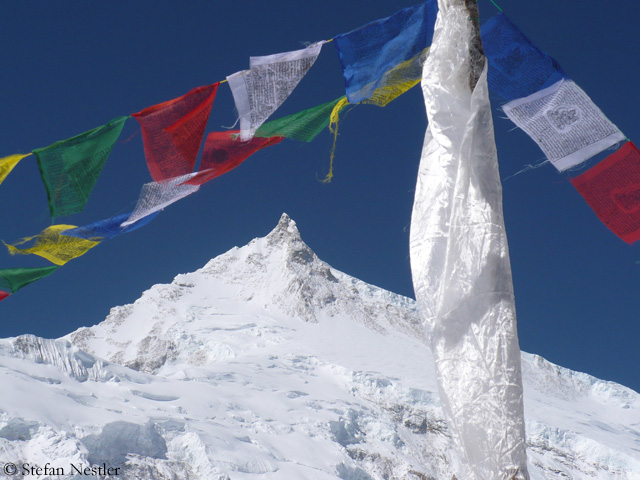
The group led by Dawa Norbu Lama is calling on the government, among other things, to conduct regular inspections of dangerous glacial lakes, which have also formed in the area around Manaslu.
More than 1,400 bodies recovered after flash flood disaster
Nepal remains reeling from the devastating flash flood disaster that struck the border region with Tibet on 26 August. A massive hanging glacier had broken off from the 7,229-meter-high Langtang Lirung. The avalanche of ice and debris triggered a massive flood wave in the Bhotekoshi and Trishuli rivers.
According to the Nepalese Disaster Management Authority, 1,403 bodies have been recovered so far (as of today, 7:00 p.m. local time). 6,150 people are still missing in the disaster area, including 587 from abroad. More than 13,700 people have been rescued, the agency reports.

Here in Germany, I can personally vouch for the following fundraising campaigns for the flood victims:
Nepalhilfe Beilngries e.V., IBAN: DE05 7216 0818 0004 6227 07, Reference/Keyword: Sturzflut (Flash Flood)
Sir Edmund Hillary Stiftung Deutschland e.V., IBAN: DE76 7115 2570 0620 6210 11, Reference/Keyword: Nepal Flutopfer (Nepal flood victims)
Sherpa Nepalhilfe e.V., IBAN: DE27 6039 1310 0309 8640 03, Reference/Keyword: Nepalhilfe
Update 17 September: There has been a second fatality of the season on Manaslu. As reported by the Tourism Times, a 50-year-old man from Singapore died while descending from Camp 2 at an altitude of about 6,000 meters. He had ascended to continue acclimatizing. The cause of death is believed to be a heart attack. Previously, a 20-year-old porter had died at base camp, presumably from high altitude sickness. – Yesterday, an avalanche occurred above Camp 3; no one was injured.
Update, 21 September: The group of young climate activists from Samagaun, led by Dawa Norbu Sherpa, ended their hunger strike at Manaslu Base Camp after three days. The Gandaki provincial government had previously announced that it would address the group’s concerns. Among other things, the hunger strikers had called for the continuous monitoring of dangerous glacial lakes in the region.