

“The transference of wonder from artist to viewer is the experience that, to me, makes art essential to life.”
Finding Wonder Against the Noise
For Sandy Coburn, photography begins with curiosity and the conviction that wonder remains available even when the wider world feels unstable. The American fine art photographer, now based in The Hague, Netherlands, searches for surreal truths in nature, cultural symbolism within cities, and colours capable of carrying emotion on their own. Her photographs often hold opposing forces within a single frame: fragility beside permanence, stillness beside collapse, erosion beside resilience. Glacial water, architectural ornament, expressive wildlife, and changing light become ways of attending closely to what might otherwise pass unnoticed. At the centre of this practice is a desire to preserve a fraction of a second and give it the emotional weight of memory.
Coburn is largely self-taught, although photography first became serious while she was living in China. Her sister Amanda, who studied photography, helped her choose equipment, understand camera setup, and develop composition skills. Coburn then immersed herself in experimentation, spending much of her free time refining technique and learning how light could create the precise atmosphere she wanted. Before long, photography was shaping her movements through the world. Trips became opportunities to pursue particular images, and research became an integral part of finding them.
Her artistic eye was also sharpened through more than a decade in global development communications, where she worked on humanitarian and environmental stories. Large photographic archives taught her how a single image could become the emotional centre of a human-interest narrative, but the work also exposed ethical problems within documentary photography. Coburn rejected the use of images that reduced people to their most traumatic experiences. She preferred photographs communicating dignity, strength, relief, and positive change, an approach that later informed her own work behind the camera.

Sandy Coburn: From Witness to Fine Art
Working on USAID projects placed Coburn in direct contact with farmers, miners, health care workers, students, delivery drivers, small business owners, and local NGOs creating change within their communities. Photographing and interviewing people across linguistic and cultural boundaries required her to establish trust quickly while ensuring that those represented could feel proud of their portrayal. Those experiences taught her photography through human connection as much as technical practice. They also gave her the confidence to travel through remote places, collaborate closely with local communities, and approach unfamiliar environments with greater care.
The work carried an emotional cost. Alongside inspiring examples of resilience, Coburn encountered the consequences of war, oppressive systems, natural disasters, violence, poverty, illness, and inequality. Photography became a private counterweight to that experience. Making art allowed her to isolate moments of calm and beauty when circumstances around her felt overwhelming. Her fine art practice developed partly from this need to find presence within uncertainty, without denying what existed beyond the frame.
A major rupture came in January 2025, when her career connected to USAID abruptly ended amid the dismantling of the agency and hostility directed toward its workers. Coburn had already imagined eventually dedicating herself fully to fine art photography and had built a portfolio spanning 35 countries and five continents. Suddenly, that distant plan became her clearest route forward. She left the United States, first moving to Edinburgh, whose art scene encouraged her ambitions, and later settling in The Hague. Since departing, she has discussed her story in almost a dozen publications and exhibited work in galleries across the UK and Europe.

Landscapes That Alter the Sense of Time
The origins of Coburn’s artistic direction reach back to a formative trip in China. While studying abroad, she visited the Sichuan mountains and encountered teal glacial pools surrounded by autumn leaves in vivid yellows and oranges. Carrying a 35 millimetre point-and-shoot film camera, she photographed repeatedly, trying to preserve an experience that seemed almost too extraordinary to be real. When classmates later responded to the photographs with disbelief, curiosity, joy, and the same wonder she had experienced, Coburn understood that an image could transmit an emotion across time and distance. She bought her first professional camera later that week.
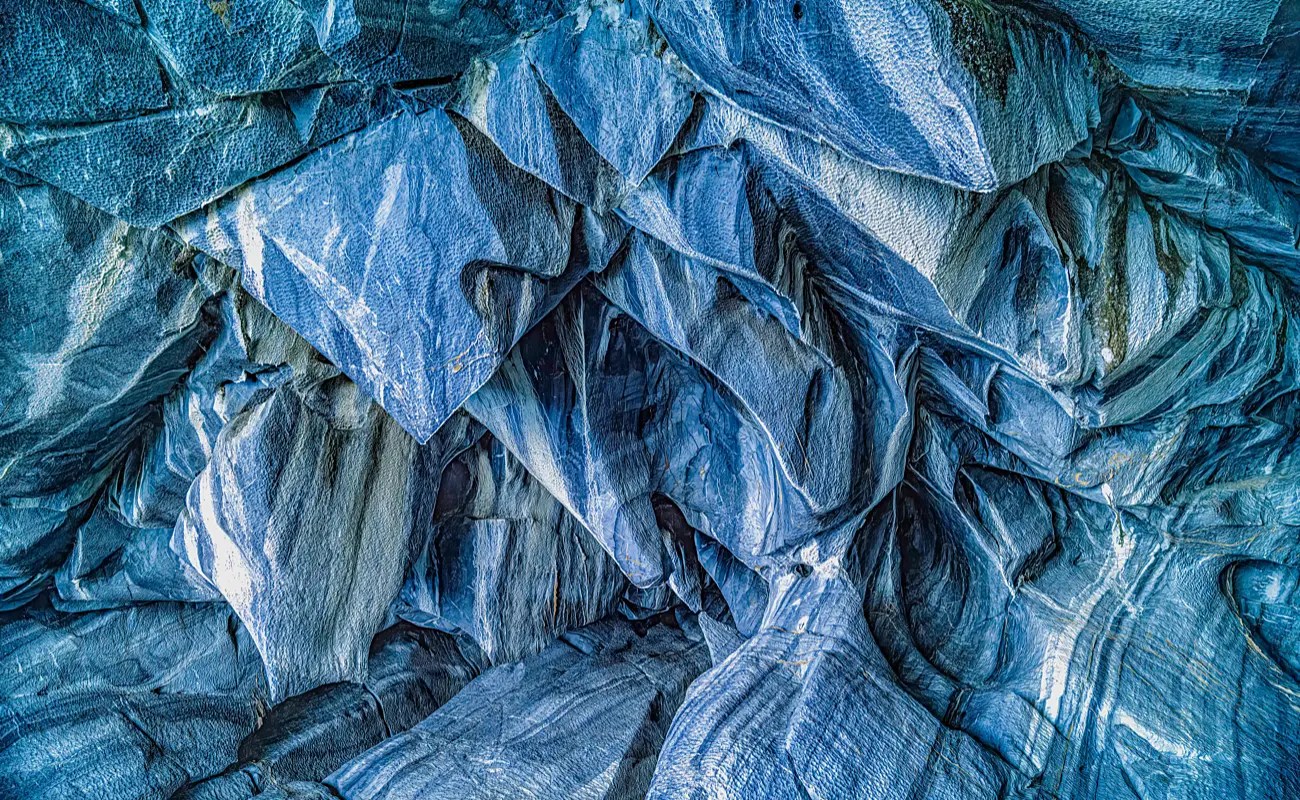
That impulse remains visible in Hollow of Water and Light, photographed in Northern Patagonia’s Marble Caves for her series Echoes in Sapphire. Coburn was drawn to formations shaped by glacial water over millions of years, where sparkling blue and white stone rises above vivid teal water. Reaching the caves required an eight-hour drive across a dirt road and then a fishing boat small enough to enter the narrow formations. Once inside, the driver switched off the engine. Water struck the hull while Coburn’s breathing and shutter echoed through the cave. Striped marble, teardrop-shaped hollows, and slender stone supports produced a scene that appeared simultaneously delicate and enduring.
When she exhibited the work at large scale in Scotland, Coburn watched visitors cross the crowded room toward the photograph, drawn first by its colour and then by the need to understand the seemingly unreal landscape. The response returned her to the experience that first compelled her to photograph in China: wonder moving from one person to another. Her visual language has been shaped by classical Chinese and Japanese art, including the treatment of mountains and water, atmospheric weather, negative space, and small figures inhabiting immense environments. Gao Jianfu, Guo Xi, Katsushika Hokusai, Utagawa Hiroshige, Zhang Lu, and Shin-hanga are among her influences, alongside photographers including Cath Simard, Ami Vitale, Cristina Mittermeier, Paul Nicklen, Andy Parkinson, and Edwin Mooijaart.

Sandy Coburn: Curiosity as a Working Method
Coburn’s relationship with art began well before she became a photographer. Her Uncle Ronnie, a watercolour artist, antiquarian, and curator, filled the family home with wildlife and floral paintings while introducing her to the professional art world. Another formative presence was a Guan Yin Buddha at Kansas City’s Nelson-Atkins Museum of Art, positioned before a painted temple wall. Coburn was struck by the figure’s embodiment of compassion and its transcendence of gender. Growing up in the Midwest, she had felt pressure to conform to expectations surrounding gender, class, and perceived normalcy. The sculpture encouraged her interest in Buddhism and Eastern philosophies, eventually contributing to her decision to study in China.
Today, colour receives the attention of a subject rather than merely functioning as an element of composition. Glacial waters recur throughout her portfolio, while cities attract her through passageways, light fixtures, brass ornamentation, tilework, and other details that preserve traces of their makers. Wildlife offers another form of intimacy. Coburn concentrates on eyes and expression, waiting at a safe distance until an animal becomes comfortable enough to behave naturally. Seals, otters, puffins, and penguins are particular favourites. Her influences extend into documentary portraiture through Robin Hammond, Zanele Muholi, and Deana Lawson, while Yayoi Kusama, Laurie Anderson, Yves Saint Laurent, and electronic music contribute to her understanding of colour, narrative, atmosphere, and mood. Björk’s Homogenic is a recurring soundtrack while shooting and editing.
That combination of intuition and preparation defines her daily process. Coburn may research a destination for months or even a year, studying weather, seasonal conditions, light, local expertise, and the technical demands of a shoot. In the field, she moves constantly, circling doorways, following passageways, and shifting viewpoints until light, colour, and story align. Exhibition photographs are presented using acrylic mounts that create visual depth and allow an image to change as viewers move around it. Her upcoming work includes an exhibition centred on the Tibet series Whispers of the Plateau, a planned book, and releases from her private archive featuring the Netherlands, Costa Rica, Iceland, Norway, and Madagascar. Future shoots she hopes to pursue include Namibia’s Skeleton Coast, Slovenia’s Triglav National Park, Jaipur, and a return to China, bringing her back to the landscape where photography first became a calling.