


ADHD runs through the women and girls in my family. My mom was diagnosed later in life. My sister, who is 18 years younger than I am, has been diagnosed. My daughter has been diagnosed. And then there’s me. I have never been formally diagnosed with ADHD but…when I was a child, my parents had me tested. I’ve definitely always been some kind of neurospicy. But at the time, ADHD, particularly ADHD in women and girls, simply wasn’t a diagnosis that was considered. Certainly not in the way we understand it today.
So when your mother, your sister and your daughter all end up with an ADHD diagnosis, you inevitably start looking back at your own life through a slightly different lens. There are definitely moments when I think, Well, perhaps someone should have checked me, too. At this point in my life, though, I haven’t felt much need to pursue a diagnosis. I have systems that work for me, and I can’t currently see what I would do differently if somebody officially confirmed it. That’s a personal decision, not an argument against adult diagnosis. For many adults, getting diagnosed can open the door to treatment, accommodations or simply an explanation for things they’ve struggled with for years. For me (at least for now), understanding the patterns has been enough.
And that is part of why ADHD Awareness Month, observed every October, resonates with me. ADHD isn’t something I know only from articles or medical definitions. I’ve watched it play out across several generations of my family — and one of the most interesting things about that experience is how completely different it can look from one woman or girl to another.

ADHD Doesn’t Always Look the Way We Expect
For years, the stereotype of ADHD was a little boy bouncing out of his seat at school. That picture was never the whole story. Girls and women with ADHD have historically been easier to overlook, particularly when their symptoms are less disruptive. Instead of obvious hyperactivity, you may have daydreaming, forgetfulness, difficulty starting tasks, losing things, poor time management, emotional overwhelm, or constantly feeling like you’re struggling to keep up. And even within one family, ADHD doesn’t necessarily look the same.
My sister and I are a good example. There are 18 years between us, so in some ways we grew up in entirely different worlds when it came to recognizing ADHD. By the time she was growing up, ADHD was something parents, teachers and doctors were far more likely to recognize and discuss (and medicate).
When I was a child, that wasn’t my experience. And even now, our brains seem to operate very differently.
Her time blindness can make me crazy. If we’re supposed to leave at a certain time, I am very aware of the clock. But my sister somehow has an entirely different relationship with time.
Her difficulty keeping her car clean also frustrates me because I am almost the opposite. I am hyper-organized. I like calendars. Lists. Systems. Things having a place. I want to know what is happening, when it is happening and what I need to do before it happens. For years, I have looked at that difference and thought, clearly we don’t work the same way.
Now I think the difference is more complicated than that. Being organized certainly doesn’t mean someone has ADHD, and hyper-organization isn’t an ADHD symptom in itself. But some people build extremely structured systems because they know what happens when those systems aren’t there. Sometimes what looks effortless from the outside has required an enormous amount of scaffolding.
I don’t trust myself to “just remember.” So I don’t. I use my devices to remind me. A lot.
My Mom’s Diagnosis Came Much Later
My mom’s experience adds another layer to all of this. She wasn’t diagnosed as a child. She wasn’t diagnosed as a young woman. She wasn’t even diagnosed when my sister was diagnosed. She started to recognize some of the patterns about ten years after my sister’s diagnosis. A little research confirms that there are a lot of women in her generation with similar stories. And plenty in mine as well.
We grew up long before people were routinely talking about ADHD in girls. We became adults, raised families, worked, managed households and developed whatever coping mechanisms we could without necessarily having a name for why certain things were difficult. A diagnosis later in life can’t rewrite those years, but it can change how you understand them.
Looking at my mom’s diagnosis, my sister’s and then my daughter’s makes the genetic thread difficult to ignore — and makes me wonder how many women in previous generations were simply described as scattered, emotional, disorganized, dreamy or difficult when something more complicated was going on.

Then Came My Daughter
Having a daughter diagnosed with ADHD made the girl part of this story implausible for me to miss. When ADHD is framed primarily as behavioral — the child who cannot stay in her seat, stop interrupting or contain her energy — it’s easy to overlook the girl whose struggle is happening largely inside her own head.
She may be bright. She may be doing reasonably well at school. She may be trying extraordinarily hard. But she may still be struggling with focus, organization, working memory, transitions, emotional regulation, or simply getting started.
In my daughter’s case, some of those struggles have shown up in very ordinary parts of daily life. Her room has been consistently messy. Not occasionally untidy. Consistently, impressively messy. And as someone who is almost compulsively organized, this has always baffled me.
Then there’s food. Left entirely to her own devices, remembering to feed herself at anything resembling regular meal times has not always been one of her strengths. She is away at college and living in residence now, so I am choosing to believe this has improved dramatically. Please don’t destroy the illusion.
But joking aside, eating regularly requires more executive functioning than we sometimes realize. You have to notice that you’re hungry, notice what time it is, stop whatever you’re doing, decide what to eat, get or prepare the food and actually eat it. If you’re absorbed in something else, have a poor sense of how much time has passed or struggle to transition from one activity to another, lunch can apparently just…not happen.
Then there is sleep. Sleep has always been an issue for her. When she was younger, I blamed it on the different sleep schedules between her father’s house and my own. And when I say “schedule” — I’m actually only referring to what happened at my house. Sleep was optional at her dad’s house.
But now I know that Sleep difficulties are common among people with ADHD and can include trouble winding down, difficulty falling asleep, waking during the night or having a sleep schedule that seems determined to run later than everyone else’s. That doesn’t mean every sleep problem is caused by ADHD. Anxiety, medication, restless legs, sleep apnea and plenty of other things can affect sleep too.
But learning that there genuinely can be an overlap was another one of those moments where I thought: Oh. I get it now.
And it reinforced something I’ve learned repeatedly through my daughter: ADHD isn’t necessarily one dramatic problem. Sometimes it’s a hundred small daily things.
The room that never quite gets cleaned.
The meal that gets forgotten.
The bedtime that drifts later and later.
The task that feels impossibly large until someone turns it into a five-minute challenge.
Individually, any one of those things can look like typical teenage behaviour. Taken together — and viewed in the context of an actual ADHD diagnosis — they begin to make a lot more sense.
The Same Family Doesn’t Mean the Same ADHD
One of the biggest lessons I’ve learned is that what works for one person with ADHD can be completely wrong for another. My sister and daughter don’t operate the way I do.
If anything, I seem to need 47 things happening at once. Give me one repetitive task to do all day, and I will be bored out of my mind.
Give me multiple projects, competing deadlines and several completely different problems to solve? I’m happy.
That is probably one reason freelancing works so well for me. On any given day, I may be writing an article for one client, troubleshooting a website for another, planning social media for a third and answering emails about something completely unrelated.
I get to switch gears constantly. My computer currently has about 20 tabs open, and I’m switching back and forth between them fairly regularly. There is always another problem to solve. There is always something different coming next.
For my brain, that variety works.
My sister is different. She needs more structure. She tried freelancing too, and the actual work wasn’t necessarily the problem. It was everything surrounding the work.
Because freelancing isn’t just doing the thing you’re good at and getting paid. You have to figure out how to register everything properly. You have to deal with government tax paperwork. You need insurance. You have to determine who to call, what forms to complete and what order everything needs to happen in.
And that was where she hit a wall. I could send her the links. I could give her the phone numbers. I could tell her who to contact and even give her a script. But knowing what needed to be done wasn’t the same as being able to start doing it. Task paralysis would set in, and she’d get stuck in her head.
The task would become enormous. And the more enormous it felt, the harder it became to begin.
In ADHD terms, task paralysis is knowing that something needs to be done, perhaps even knowing exactly how to do it, but still feeling unable to initiate it.
Watching that happen was frustrating because, from my perspective, I had removed all the obstacles. Here are the links. Here is the phone number. Here’s the first thing you need to do. And the second. And the third. Go.
Except the obstacle wasn’t really missing information. The obstacle was getting started.
It took me some time to understand that distinction. It’s also why I’m glad she’s working for a company now. She has the structure she needs. Somebody else has already dealt with the taxes, insurance and administrative machinery around the job. She can focus on the work instead of first building an entire business infrastructure around herself.
And that suits her.
Neither approach is inherently better.
Freelancing suits my brain.
Working inside an established structure suits hers.
That’s exactly why I get wary of articles offering the five things everyone with ADHD should do.
There isn’t one ADHD brain.
There isn’t even one ADHD brain in my family.
My Best Strategy: Don’t Rely on Memory
Of all the ADHD strategies I’ve encountered, this is probably the one I use most:
If something is important, don’t make your brain responsible for remembering it.
Put it somewhere else. Write it down. Put it in your calendar. Set an alarm. Make a list. Put a note beside the door.
I automatically set four reminders for every calendar appointment: the day before, three hours before, one hour before and 15 minutes before. That may sound excessive to some people. But if I don’t do it, I end up walking the dog when I should be at the dentist.
It works for me.
There is no prize for successfully remembering a dentist appointment using nothing but your own brain. I am organized precisely because I externalize so much information. My calendar remembers appointments. My lists remember tasks. My alarms remind me when I’m supposed to stop doing one thing and start doing another. My systems remember so I don’t have to.
And I think that’s an important distinction.
From the outside, being highly organized can look like evidence that someone couldn’t possibly struggle with attention or executive function. But sometimes the organization is the coping strategy.
I don’t casually trust myself to remember something later. I built a system so I don’t have to.

Calendars Are an External Brain
I am very pro-calendar. But the best calendar is not necessarily the prettiest or most complicated one. It’s the one you’ll actually use.
For one person, that might be a large magnetic dry-erase calendar on the refrigerator where the entire family can see appointments, school events, practices and deadlines.
For me, it’s several shared Google calendars. Three for work, one for home.
For families that want something more substantial, a digital wall calendar such as the Skylight Calendar can put everyone’s schedule in one highly visible place.
The visibility matters.
A planner tucked into a drawer isn’t helping anyone.
And in my world, if it isn’t on the calendar, there’s a very real possibility it doesn’t exist.
Calendars and alarms can also be useful for things we don’t necessarily think of as appointments.
Lunch can be an appointment. Bedtime can have an alarm. Google’s reminders to get into my car so I get there in time are SO helpful. Sometimes adding external structure to an everyday activity is enough to stop it disappearing into the day.
Time Blindness Is Real — and Sometimes Maddening
This is one of the areas where my sister and I can drive each other crazy. I am a clock watcher. She is decidedly not.
Time blindness — difficulty accurately perceiving how much time has passed or how long something will take — can be a significant issue for people with ADHD. Knowing that is helpful. But it doesn’t mean I’m never irritated when we’re supposed to leave in five minutes, and someone has apparently decided it’s time to take a shower. I am human.
But understanding why something keeps happening can change the conversation.
Instead of:
“Why are you always late?”
the question can become:
“What would make it easier to be ready on time?”
That might mean multiple alarms.
A ten-minute warning.
Putting everything needed for the morning beside the door the night before.
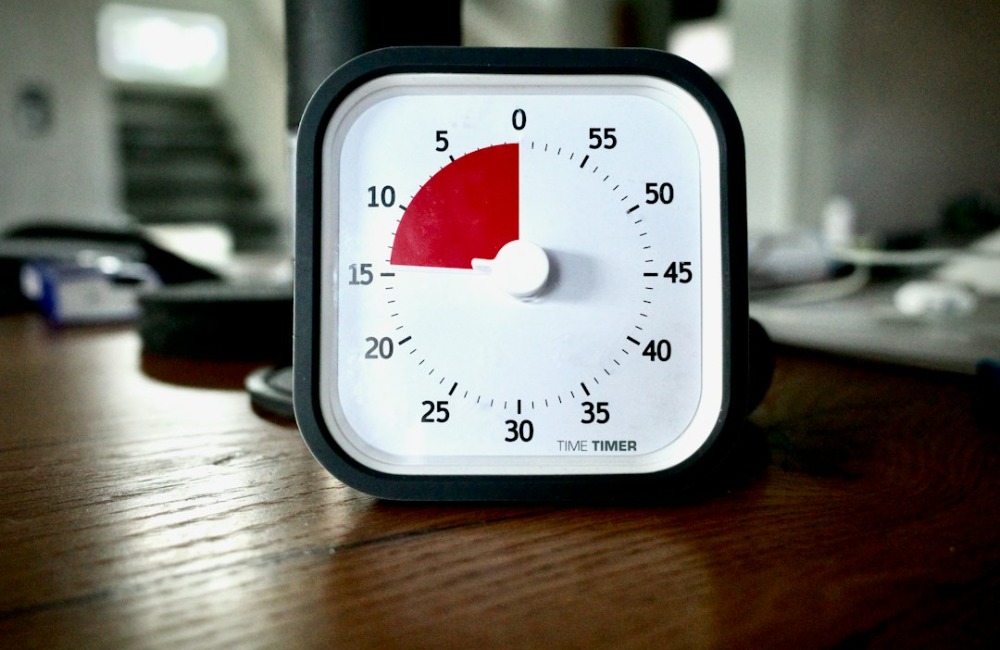
Or using a visual timer.
A Kitchen Timer is particularly useful because you can actually see the remaining time getting smaller. Ten minutes stops being an abstract concept and becomes something visible.
Sometimes the Hardest Part Is Starting
Task avoidance is another big one in our house. My kids can look at a sink full of dishes and insist they don’t want to wash them because it will “take too long.” To them, the task already feels enormous before they’ve even started.
If I tell them to wash all the dishes, we can spend longer negotiating about the dishes than it would have taken to actually wash them.
But turn it into a challenge? Different story.
I’ll set the timer for five minutes and say:
“Let’s see if you can get them all done before the timer goes off.”
Suddenly we’re not facing an endless sink full of dishes. We’re doing five minutes. Five minutes has an end point. It feels manageable.
And often, the thing they were convinced would take forever is either finished before the timer goes off or close enough that they might as well finish it.
That has taught me something important about task avoidance. Sometimes the resistance isn’t really about the task itself. It’s about the idea of the task. It feels too big. Too boring. Too long. Too many steps.
And what works for my kids is remarkably similar to what didn’t work for my sister when she tried freelancing.
The hardest part isn’t always doing the thing.
Sometimes it’s getting your brain to cross the line between thinking about the thing and starting the thing.
So instead of arguing about whether it really will “take forever,” I try to shrink it. Make it five minutes. Make it a race. Put on one song and see what can be finished before it ends. See if you can do it before the kettle boils. Make the starting point so small that it is harder to avoid than to begin.
Break the Task Down — Way Down
“Clean your room” sounds like one task.
It isn’t.
It’s dozens of decisions:
- Where do I start?
- What do I pick up first?
- Where does this go?
- Should I deal with this now?
- What about that pile?
- Oh, I forgot I owned this.
And suddenly we’re reading something we found underneath the bed, and the room remains untouched.
I have plenty of firsthand evidence of this one. My daughter’s room and my sister’s car can both make my hyper-organized brain twitch. My instinct is to look at the mess and think: Just clean it.
But “just clean it” assumes that seeing the mess and knowing how to attack it are the same thing. And they aren’t always.
So instead of:
Clean your room.
Try:
Put all the dirty clothes in the hamper.
Then:
Take every dish to the kitchen.
Then:
Pick everything up off the floor.
Then move to the next step.
This applies to adults too.
“Do the taxes” is terrible.
“Find the tax folder” is manageable.
“Write the article” sounds enormous.
“Open the document and write the headline” doesn’t.
Sometimes the goal isn’t to finish. It’s to create enough momentum to begin. And sometimes, once you’ve started, the thing you were sure would take an hour turns out to take seven minutes.
Organize for the Person You Actually Are
This is where I think families can get into trouble. We create organizational systems based on how things are supposed to work, not how people actually behave. If someone consistently drops her backpack beside the front door, putting the official backpack hook in a closet three rooms away may guarantee the backpack never reaches it.
Put the hook where the backpack lands.
If clothes consistently end up in one particular spot, perhaps that’s where the hamper belongs. If someone forgets things when she can’t see them, closed bins may be less useful than open storage. There is no moral superiority attached to storing something in the “proper” place. A successful organizational system is one that gets used.
This is also where my sister and I differ. I find order reassuring. Visible clutter makes me uncomfortable. She has a much higher tolerance for it.
Neither of us is going to magically become the other person, so sometimes the answer is to figure out systems that work for the person using them rather than insisting everyone organize exactly the same way.
Try Body Doubling
One of the more interesting ADHD strategies is body doubling. It simply means doing something while another person is nearby.
Homework at the kitchen table while someone else works.
Folding laundry together.
Cleaning separate areas of the same room.
Working quietly on a dreaded project while a friend works beside you.
The other person doesn’t necessarily need to help. Their presence provides a little structure and accountability. It sounds almost too simple. But sometimes simple works.

Fidgets Can Be Useful — For Girls or Women
Fidgets aren’t necessarily evidence that someone isn’t paying attention.
For some people, giving their hands or body something small to do actually makes it easier to focus.
What works is incredibly individual, so I wouldn’t treat any particular fidget as an ADHD solution. But they’re inexpensive tools to experiment with.
Some worth trying include:
- ONO Roller — quiet, discreet and decidedly more adult-looking than many fidget toys.
- Fidget rings — useful for school, meetings or anywhere you want something unobtrusive.
- Fidget cubes — good if buttons, switches and repetitive movements are appealing.
- Therapy putty or stress balls — particularly useful if squeezing or resistance is calming.
- Chair fidget bands — helpful for children who need to move their legs while sitting.
The point isn’t to train someone to sit perfectly still.
It’s to figure out whether movement helps that particular person concentrate.
Apps That Can Help Carry the Mental Load
There are approximately six million productivity apps available, which creates a uniquely ADHD problem:
You can spend an entire afternoon designing the perfect system instead of accomplishing any of the things the system was supposed to help you accomplish.
Still, a few are worth exploring.
Tiimo
Tiimo is a visual planner designed with neurodivergent users in mind. It combines schedules, routines, tasks, reminders and visual timers. For someone who benefits from seeing the shape of the day rather than a traditional list, it can be very useful.
Todoist
I like the basic philosophy behind Todoist: get things out of your head. Tasks can be recurring, scheduled and organized into projects, so you don’t have to keep mentally rehearsing what you’re afraid you’ll forget.
Finch
Finch gamifies everyday goals and self-care by tying them to the adventures of a tiny virtual bird. Is that ridiculous? Maybe. But if looking after a cartoon bird gets someone to brush her teeth, drink some water or complete the task she’s been avoiding for three days, I’m not going to argue with success.
Don’t Overlook the Apps Already on Your Phone
You may not need anything new.
- Calendar
- Reminders
- Notes
- Alarms
- Shared grocery lists
- Widgets
- Voice assistants
Use them ruthlessly.
A system does not need to be sophisticated to be effective.
ADHD Books For Women Worth Reading
Books have also helped me understand ADHD in a way that turns frustrating behaviour into something more understandable. That doesn’t mean everything suddenly stops being frustrating. Trust me. I can understand time blindness intellectually and still be standing at the door thinking, WE WERE SUPPOSED TO LEAVE TEN MINUTES AGO.
Both things can be true.
A few books worth exploring:
How to ADHD by Jessica McCabe
Jessica McCabe is the creator of the popular How to ADHD YouTube channel, and her book is one of the most approachable introductions I’ve found. It combines lived experience with practical strategies for executive-function challenges, motivation, routines, organization and emotions. It’s an especially good starting point if clinical ADHD books tend to make your eyes glaze over.
A Radical Guide for Women with ADHD by Sari Solden and Michelle Frank
This belongs particularly strongly on this list because we’re talking about women and girls. The book looks beyond productivity hacks and explores what happens when women spend years feeling as though they’re failing at things everyone else seems able to manage. It also addresses shame, expectations and learning to understand your own brain rather than constantly measuring yourself against other people.
Women with Attention Deficit Disorder by Sari Solden
This is another useful read specifically about ADHD in women and why so many have historically reached adulthood without recognizing what was going on. For women who grew up before anyone was really looking for ADHD in girls, there can be a lot of Ohhhh. That explains something in these pages.
Smart but Scattered by Peg Dawson and Richard Guare
For parents, Smart but Scattered focuses on executive skills such as planning, organization, working memory, emotional control and getting started. Those skills aren’t exclusive to ADHD, but they’re areas where many kids with ADHD struggle. And, frankly, quite a few adults could probably benefit from reading it too.
Understanding Doesn’t Mean Never Being Frustrated
I think this is important to say. Learning about ADHD does not turn you into some endlessly patient saint. I understand my sister’s time blindness better than I once did. BUT IT STILL FRUSTRATES ME.
I understand that keeping a room tidy can involve executive-function challenges that aren’t obvious from the outside. Looking at my sister’s car — or my daughter’s room — can still make my hyper-organized brain twitch.
I understand why my kids may see a sink of dishes as an enormous task. There are still moments when I look at the same sink and think it will literally take you five minutes. Sometimes I’m right. That’s why there’s a timer.
And I can understand intellectually why a college student might get caught up in what she’s doing and somehow reach mid-afternoon without having eaten a proper meal while still having the extremely maternal reaction of: PLEASE GO EAT SOMETHING. Both things can be true.
Awareness isn’t pretending difficult things aren’t difficult. It’s separating the person from the behaviour.
It’s being able to think:
This drives me crazy.
And also:
She isn’t doing it specifically to drive me crazy.
That distinction matters.
Lose the Moral Judgment
This may be the biggest thing ADHD awareness has taught me.
So many executive-function struggles get interpreted as character flaws.
- Lazy.
- Messy.
- Careless.
- Irresponsible.
- Unmotivated.
- Disorganized.
- Not trying hard enough.
Girls, especially, can become very good at internalizing those judgments. Some compensate. Some mask. Some become perfectionists. Some become extremely organized. Some spend enormous amounts of energy trying to make sure nobody notices how difficult certain things actually are.
Understanding ADHD doesn’t mean expectations disappear.
It means we can replace:
“Why can’t you just do this?”
with:
“What is getting in the way, and what might help?”
Sometimes the answer is making the task smaller. Sometimes it’s turning it into a game. Sometimes it’s putting on a five-minute timer. Sometimes it’s scheduling lunch like an appointment because otherwise lunch somehow becomes 4:30 p.m. Sometimes it’s recognizing that someone does better with multiple competing projects and constant novelty. Sometimes it’s recognizing that another person needs an employer to provide the structure that freelancing requires you to create for yourself. Sometimes that answer involves medication, therapy, coaching or professional support. Sometimes it involves accommodations at school or work.
And for some adults, getting a diagnosis itself can be enormously valuable. For others, like me at this point in my life, understanding the possibility and having effective coping systems may feel sufficient. There isn’t one correct path.
Sometimes the answer is a giant calendar stuck to the refrigerator. Sometimes it’s four reminders for a single appointment. Sometimes it’s a five-minute timer beside a sink full of dishes. Sometimes it’s realizing that you need 47 things going on at once to stay interested.
Use what works.
Four Women. Four Different Experiences.
When I think about ADHD Awareness Month now, I think about four women and girls.
My mom, diagnosed later in life.
My sister, 18 years younger than me, who grew up at a time when ADHD was much more likely to be recognized.
My daughter, now away at college, growing up in an era when we are finally paying more attention to what ADHD can look like in girls.
And me — never diagnosed, assessed for other things as a child, and now looking back with considerably more information than anyone had at the time.
What strikes me most isn’t how similar we are. It’s how differently the same threads can weave themselves through different lives. My brain seems happiest juggling far too many things at once. My sister does better when the structure already exists around her. My daughter has her own combination of challenges.
One person’s ADHD may be obvious. Another’s may be quiet.
One person may struggle enormously with organization. Another may build her entire life around being almost obsessively organized.
One person may thrive in the controlled chaos of freelancing. Another may stare at a form, know exactly who to call and still be unable to make herself pick up the phone.
One woman may finally receive a diagnosis late in life. Another may decide she doesn’t currently need one.
One girl may be recognized early enough to understand that struggling with certain things doesn’t mean she is lazy, careless or failing.
That, to me, is why awareness matters. Not because we need to turn every forgotten appointment, messy bedroom, missed lunch or sleepless night into a diagnosis. And not because everyone with ADHD needs the same planner, app, routine or productivity hack.
But because the more we understand how differently ADHD can present — particularly in women and girls — the less likely we are to miss someone simply because she doesn’t fit the stereotype.
And the less likely we are to mistake a brain difference for a character flaw.
For me, that may be the most useful lesson of all.
This article reflects personal experience and is intended for general information only. ADHD and other neurodevelopmental conditions should be evaluated by a qualified healthcare professional. Persistent sleep or eating problems can have causes unrelated to ADHD and should be discussed with a qualified healthcare provider.