
Dreamland in Rijeka as Tuchel’s England deliver historic 7–0 thumping of rival Croatia – Back Page Football

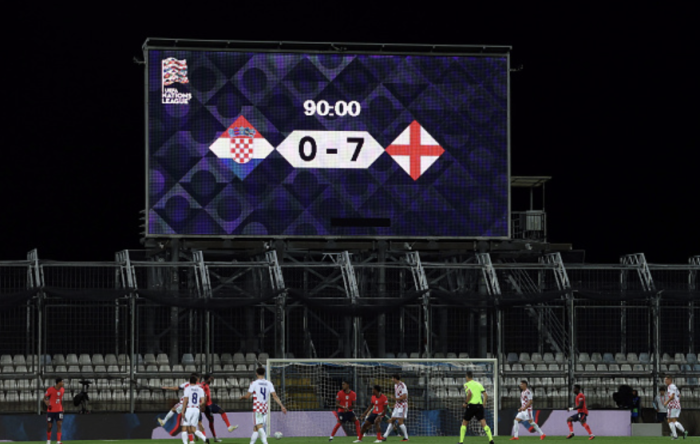
Due to unusual circumstances, England’s third match of the Nations League group stage, played in Rijeka, took place predominantly in front of roughly 5500 to 6000 Croatian children.
But ironically, it was the 100 English supporters who were no doubt in dreamland today as they witnessed England deliver a historic 7–0 defeat of Croatia.
One particular clip has followed Thomas Tuchel throughout his tenure as England manager.
Before he ever took charge of the team, Tuchel was asked about Gareth Southgate’s England. He spoke about a side that lacked an identity and offered a vision of something different: a team that played to win rather than one that played not to lose. This, he told us, was supposed to be the team to beat.
It was exactly the message many England supporters wanted to hear. Ironically — and, from an English perspective, tragically — Tuchel’s first tournament at the helm ended up looking almost like a caricature of the Southgate teams he had criticised.
If you closed your eyes to who was standing on the touchline and simply looked at England’s performances and ultimate outcome at the World Cup, in spite of Tuchel’s superior messaging, much of the end product was painfully familiar. England consistently played down to lesser opponents before ultimately snatching defeat from the jaws of victory when they finally encountered a major one.
And that opponent just happened to be Argentina.
This was an opportunity to exorcise some of the oldest demons in English football. Argentina, England’s most iconic international nemesis. The Hand of God. Decades of controversy, heartbreak and history between two nations whose meetings have so often produced moments that live far beyond the tournaments in which they occurred.
And in that semifinal, Tuchel didn’t just retreat. He went one step further than even Southgate. England ended the match with six defenders on the pitch. Six. Not even Southgate would have done that against Argentina.
It was the retreat of all retreats, and Argentina duly overpowered England, scoring twice and ending the World Cup dream.
But I digress.
Last week, following England’s 3–2 defeat against Spain, I wrote an optimistic appraisal of what I considered to be a forward-thinking and encouraging performance. It also illustrated an important distinction I have made when evaluating both Southgate and Tuchel.
Football matches can come down to the most fortuitous of bounces, a refereeing decision or a matter of inches. Those moments determine results, but when evaluating a team and its manager, we should be willing to look beyond them. And that standard has to apply equally when England benefit from the bounce and win as it does when the bounce goes against them and they lose.
Against Spain, it went against them.
Harry Kane slipped slightly while aggressively striking a potentially decisive penalty and watched the ball crash against the crossbar. I actually liked the optimism of the attempt: high and hard, the way a former England talisman so often approached his penalties. On another day it flies into the net, and what became a disappointing defeat might instead have been remembered as a signature England victory.
That bounce of the football mattered enormously to the result. It did not change my overall appraisal of the performance. I was encouraged. England played more freely and aggressively. They played on the front foot. They looked like a team attempting to beat Spain rather than one preoccupied with avoiding defeat.
There was, of course, an important piece of context. The Nations League is not the World Cup. It is not the Euros. Playing with that freedom here is not the same thing as doing it with a World Cup semifinal hanging in the balance.
The second match against Czechia did not provide much additional material for evaluation. Most probably would agree that the match should have been easier than it was, especially in light of England playing with a man advantage for much of it.
Nevertheless, it was a victory and a clean sheet, with the names you want to see on the scoresheet. Gordon and Kane again supplied the goals, as they had in the first match against Spain. Gordon’s remarkable streak of goal contributions for England has now reached seven matches, and he is emerging as a bona fide star for club and country, rounding out an attacking trio with Kane and Bellingham that gives England plenty to be excited about.
And despite the horrific manner in which the World Cup ended, along with some underwhelming performances along the way, there were certainly bright spots. Perhaps none was brighter than England’s 4–2 opening victory over Croatia.
There were slip-ups in the first half that allowed Croatia to score twice, but England’s second-half performance gave us a glimpse of the front-foot team Tuchel had promised us.
That match was a source of optimism, but today was the stuff of dreams.
Aside from last weekend’s implications for the table in this group, the past week also saw a wild swing in the Ballon d’Or odds, trending away from Kane and towards Lamine Yamal. No doubt the events which unfolded in that match played a large role. It will be interesting to see where those odds sit once the dust settles on today’s performance, led by captain Harry Kane.
Kane served as the catalyst, starting the party early with a decisive strike after eight minutes following a slick through ball from Bellingham. Bellingham himself returned to score the second just 13 minutes later, Gordon continued his remarkable run of goal contributions, and Saka made it four before halftime.
Kane added another after the break to complete his brace and later turned provider for Saka, finishing with two goals and an assist. Saka’s second and a late goal from Morgan Rogers rounded out the historic 7–0 scoreline. Kane now has four goals through England’s opening three Nations League matches, adding to his historic calendar year for club and country.
Tuchel previously took umbrage when questioned about England’s record against top-10 nations. His response was that nobody seemed to mention that statistic when England actually won one.
Point taken.
Let the record show that England have now beaten top-10 nations on seven of their last 16 opportunities, which is nothing to scoff at. And credit where it’s due for Tuchel: four wins from six opportunities under his management, which, excluding context, is certainly a good record.
The lingering question is how England will fare against this level of opposition in the latter stages of tournaments. And while I’m not sure how much longer Croatia will remain a top-10 nation, they are nevertheless a quality opponent, and this was a historic and emphatically positive result.
I mentioned after the Spain game that losing early in a tournament can sometimes ultimately be beneficial. In a forgiving group stage, England had the opportunity to absorb that defeat without allowing it to define them. Perhaps we are seeing that play out here. England lost to Spain while playing positively, got the necessary victory against Czechia, and have now gone to Croatia and won 7–0.
Assuming England take care of business in their next two matches, based on the goal differentials as they currently stand, it seems increasingly likely that they will travel to Spain for the final match of the group stage with an opportunity to win the group.
The Nations League is not the World Cup. It is not the Euros. But it is a great opportunity to watch our country compete at the highest level, and as this initial trip concludes, there is a lot to be excited about.
And I, for one, am excited to see what Kane, Bellingham, Gordon and Tuchel’s England deliver next.
Increasingly, this is starting to look like the team Thomas Tuchel told us he intended his England to be: a team that plays to win rather than playing not to lose.
And perhaps, the team to beat.