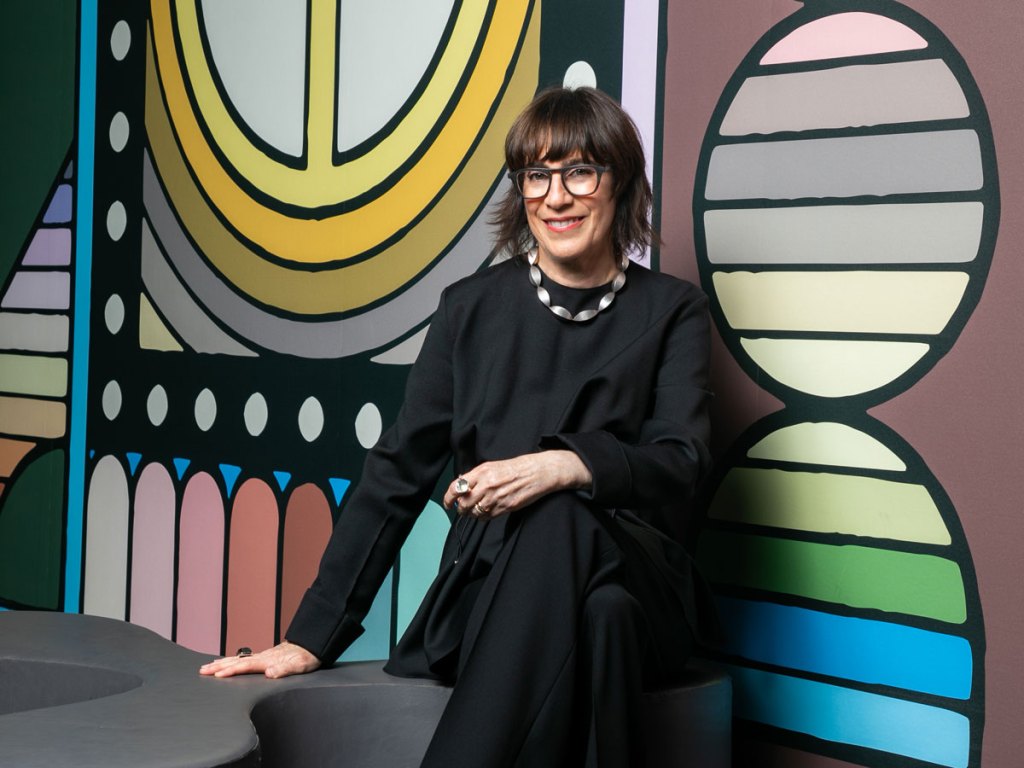
Leslie Bluhm (left) and Meredith Bluhm have donated $5 million to the MCA Chicago on behalf of the Bluhm family.
The Museum of Contemporary Art Chicago has received a $5 million endowment from trustee and board vice chair Leslie Bluhm, on behalf of the Chicago philanthropic Bluhm family, that will benefit the institution’s Women Artists Initiative (WAI), which is geared toward ensuring gender equity in the museum’s exhibition programming and permanent collection.
To mark the upcoming departure of longtime MCA Chicago director Madeleine Grynsztejn, who established the initiative, the WAI will be renamed the Madeleine Fund for Women Artists.
Related Articles

“Madeleine, I think, has been all of our teacher and mentor, and the greatest leader. It makes perfect sense that it’s in her name, recognizing everything that she has done. We all in my family have been so personally touched by Madeleine’s leadership and her vision,” Bluhm told ARTnews in an interview.
She continued, “It’s been gratifying to watch Madeleine help the MCA achieve her vision. We want to continue Madeleine’s incredible work, and this was a wonderful way to honor Madeleine, who has been a visionary at the MCA and has taken the MCA to levels and heights that none of us could have ever dreamed.”
For board chair Bill Silverstein, who called the recognition of Grynsztejn a “well-deserved honor,” the transition of WAI into an endowed fund is also significant institutionally. “It’s a real sign of the commitment of the institution and the permanence of the commitment going forward,” he told ARTnews. “It’s a culmination of 10 years of work, but we’re not done. We’re going to keep pushing forward on what’s important, and we feel this is very important.”
Leslie Bluhm (left) and Meredith Bluhm have donated $5 million to the MCA Chicago on behalf of the Bluhm family.
WAI began in 2015 with the simple mandate for the MCA Chicago to achieve gender parity in its exhibition program and its acquisitions. “We have a duty as a public trust to be in service to our audiences [so that] when our public walks through our doors, they see themselves on our walls and on our stages,” Grynsztejn said in an interview of the decision. “We agreed internally that gender parity for women artists in our institution was a given. It had to be a given in a just society, in a meritocratic society. This isn’t a favor.”
Silverstein, who had recently become a trustee when WAI launched in 2015, said the decision to establish the initiative wasn’t the result of “any external political, cultural, or social events” and instead is proof that the museum has been “on the cutting edge of equality. The context of art in museums is very important, and you can’t have good context without full representation of the full spectrum of all voices, including women.”
For the first five years, Grynsztejn and her team tracked how it fundraised for its exhibitions. Per their own accounting, they found that it was 37 percent harder to raise the funds to realize an exhibition of a woman artist than that of a male artist, which she contrasted to the data that women artists’ solo exhibitions were 16 percent better attended than those of male artists. That is on top of the fact that the US population is around 50 percent female.
For Grynsztejn, she sees the MCA Chicago’s work as a way to not only “influence the direction of the field” more broadly but “to close the exhibition funding gap between men and women artists.” She added, “Museums have an extraordinary responsibility because collections become history, and this is part of that level of thinking.”
“My family was very shocked by the huge gender imbalance in collections of major art museums across the United States,” Bluhm recalled of her reaction to Grynsztejn’s presentation of the data. “From the beginning, it’s been very clear that Madeleine had a vision for the museum and how it could rewrite the history of art by including voices that have been left out of the conversation, including women artists.”
WAI works rather simply. Once a budget for a given exhibition has been set, the MCA Chicago evaluates how much has been raised and what is left. When no other funding can come through, it taps the fund “very intentionally to make it fiscally possible to execute on those shows at the highest level,” Grynsztejn said.
Over the past decade, the museum has raised $2.5 million for WAI, with funding going toward the production of an exhibition catalog or operational costs like installation, shipping, or insurance. WAI-supported shows include solos for Faith Ringgold, Nicole Eisenman, Firelei Báez, and Yoko Ono, with the latter show using funding to help realize 40 performances during its run.
As of yet, WAI funds have not been used toward the purchase of an artwork for acquisition but could be used that way in the future; works commissioned for exhibitions via money from WAI, however, have entered the permanent collection. Grynsztejn added, “We never again have to hesitate and ask ourselves, ‘Do we have the money?’”
Per the museum, 54 percent of its solo exhibitions between 2020 and 2025 were dedicated to women-identifying artists, while 50 percent its annual acquisitions for that period were by women-identifying artists. Those figures are significantly higher than the national average; according to the Burns Halperin Report, which looked at data for US museums from 2008 to 2020, women artists represented 14.9 percent of solo exhibitions and 11 percent of acquisitions.
Now that this work has resulted in an endowment, Grynsztejn said, “The proof is in the pudding. … This is a landmark institutional commitment to permanently embed gender equity into the museum’s future.”
Grynsztejn also characterized WAI’s work as a “good business decision” because of how it impacted museum visitorship. “It’s clear that when we change whose works we put on our walls and on our stage that resonates and reflects in the public that comes through the door,” she said. “This is not only frankly the right thing to do. It’s the right business thing to do, and, at your peril, if you don’t pay attention to the demographics of your public.”
Silverstein agreed, describing the endowment as “a real financial commitment” that allows the MCA Chicago, which will celebrate 60 years in 2027, to “sustain our ability to put that in practice for the next 60 years. There’s a real permanence to the practice and mindset to DNA of the museum now.”
The $5 million gift is part of the MCA Chicago’s ongoing capital campaign “to strengthen the institution’s long-term financial support and ensure its continued impact for generations to come,” per a statement. Silverstein said that he sees it as a challenge to other patrons. “I think all of our donors take note of it, and it challenges all of us to elevate our own standards of what we should be doing philanthropically for important art causes such as this,” he said.
Bluhm said she hopes her family’s donation is just the first of many. “We hope that this gift is going to inspire a lot of other donors to give to the Madeleine Fund,” she said. “It will start with our initial gift, but we anticipate it will grow over time. I think a lot of people just don’t know that there is such a huge gap of women artists in these collections, so I think it’ll serve to educate people and to get them excited about giving to support women artists.”
Bluhm added, “Madeleine will be missed, but she will never be forgotten. Her legacy will live on at the MCA.”