
More Of An Oblong Table

HIGH The in-depth character developments.
LOW Felt a little too easy.
WTF My fully armored knight died fighting rats.
Edward Norton’s masked King Baldwin in Kingdom of Heaven has always been one of my favorite performances, so Sovereign Tower immediately had me hooked. Here, the main character is a similarly masked and mysterious figure born with leprosy and simply known as Sovereign, and at their disposal is a round table of mixed-and-matched knights.
There are multiple endings depending on which dialogue options the player chooses, who they trust, and how they handle diplomacy — but at the beginning, things are much more localized. Forced to flee from their burning village, the player discovers that they are the “chosen one”. Only they can claim the empty throne of the Kingdom of Brizh, which hasn’t seen a monarch in centuries. With little time to spare, the player is quickly thrust into a turbulent game of royal judgment.
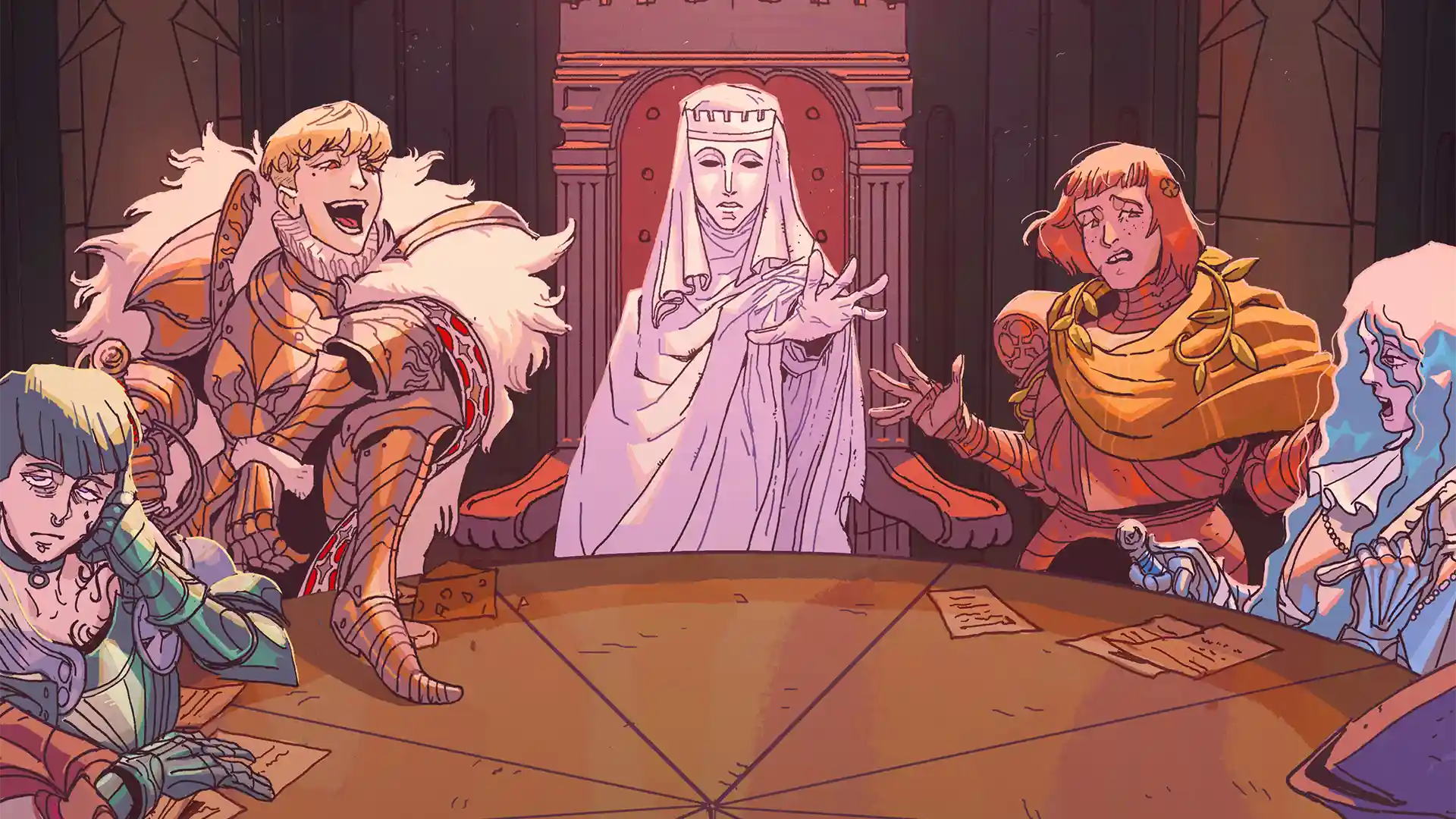
The Tower, where the monarch resides, has a multitude of rooms for the player to discover. Presented in a 2D, hand-drawn style, the core of the Tower houses a charismatic blacksmith for weapons and armor, a kitchen that prepares meals, and a stableboy who cares for mounts — but the real stars of the show are the knights. These capricious characters enter the Tower at various times, bringing their own sets of skills, traits, and personalities that make them suited for different types of missions.

Take Gwendan as an example — a flamboyant warrior with glittering armor and fierce opinions who despises assassination because it isn’t “noble” enough. Sending him on secretive quests will lower his opinion of the court, while letting him convince peasants with his dashing charisma will increase his affinity. Eventually, the player can send him on a redemption mission. With the right dialogue choices, Gwendan returns a transformed man, shedding his snobby origin.
Across three playthroughs, my dialogue options were distinct, and as a result, only a few of the same knights reappeared. Beyond the physical variety of knights, many (like Gwendan) also have specific quests they can be sent on or items they can be given, each of which can unlock a new element of their personality or transform them completely. Watching characters pursue their goals, overcome hardships, or discover a new dimension of themselves was incredibly gratifying, and quickly immersed me into their lives.
Beyond the knight management, Sovereign Tower also possesses an intriguing political aspect. Townsfolk, ambassadors, new knights, and mysterious figures appear in front of the player, with decisions that can initiate quests and affect the story. These choices aren’t as detailed as they are with the knights, though, as they often have short, simple results. In fact, this brevity is one of my bigger grievances — oftentimes, management of the kingdom feels too easy.

When faced with a problem, rarely did I get dialogue options with substantial consequences. Most of the villager decisions had me choosing between “lose 50 coins” or being forced to go on a mission. Those coins barely made a dent in my wallet of thousands, and the mission was usually an easy fetch quest. It really didn’t matter which one I chose, as the consequences would have no actual effect on my overarching playthrough.
While large consequences are rare, Sovereign Tower offers an unusual feature for players who feel like they’ve made serious errors — the devil room. Available from the start, this chamber holds a caged demon that allows the player to rewind time. Upon traveling back, new dialogue options that can predict requests, solve mysteries, and even undo deaths appear.
The devil room exacerbates some of my previous concerns, as being able to rewind my mistakes made them feel temporary — not exactly the kind of quality that a story-driven RPG benefits from. Theoretically, the player can also use this ability infinitely with minimal side-effects, which I felt further undercut the weight of any choices. That said, I do like how the room opens up new story routes. Being able to explore “what ifs” without having to restart the entire campaign allowed me to see every ending. Ultimately, the room ends up being a great amenity for curious players interested in exploring every possibility, but not for those who value tough, kingdom-altering decisions.

While the premise and the knights of Sovereign Tower are compelling, they wouldn’t have the same impact without the atmosphere and art tying everything together. Each character has their own distinct design, and I appreciated the diversity of the crew. Unlike typical medieval media which emphasizes dark and dusky environments, the kingdom’s knights come in bright colors and outfits. Everything from the armor trims to the weapon hilts complements the knights’ identities, all perfectly encapsulated by the art-nouveau style.
As a sucker for medieval, high fantasy media, I enjoyed the worldbuilding and characters of Sovereign Tower. My knights truly felt personalized, and I was thoroughly invested in their individual journeys. But while the story itself is unique, the consequences feel unsatisfyingly light and mistakes made during my rule often went unpunished, making Sovereign Tower feel better-suited for players seeking a breezy visual novel instead of a heavy, choices-matter experience.
Rating: 7.5 out of 10
— Eddie Guo
Disclosures: This game is developed by Wild Wits Games and published by Curve Games. It is currently available on PC. This copy of the game was obtained via publisher and reviewed on PC. Approximately 15 hours of play were devoted to the single-player mode, and the game was completed. There are no multiplayer modes.
Parents: This game is currently unrated by the ESRB. There is no violence or blood onscreen, but implied killing and sabotage are in some quest descriptions and subplots. There are themes of betrayal, murder, revolution, and romance, but nothing is overly brutal or explicit and this game is safe for teenagers.
Colorblind Modes: There are no colorblind modes available. There is, however, an option for dyslexic font.
Deaf & Hard of Hearing Gamers: All of the dialogue is communicated through large text bubbles which cannot be resized. Nothing is audibly spoken, and audio is not necessary to get the full experience, making this game fully accessible.

Remappable Controls: No, this game’s controls are not remappable. This game does not offer
a controller map diagram, as it doesn’t really have controls. It is a point-and-click game where
everything is done with the left-click mouse button.