Disparagement Suit in India: Complete Legal Guide for Businesses, Professionals, Startups and Individuals | Apex Law Office LLP: Appellate Lawyers


A disparagement suit protects reputation against false statements harming business, profession, products, services, or personal standing. Indian courts recognize reputation as a valuable legal right deserving protection through civil and criminal remedies. Therefore, businesses often file a commercial disparagement suit when competitors publish misleading advertisements or defamatory reviews. Professionals may seek injunctions against online campaigns causing loss of clients, contracts, or goodwill. Apex Law Office LLP advises clients across Chennai, Tamil Nadu, and India on defamation law, disparagement actions, injunctions, damages claims, and digital reputation disputes. Moreover, the firm handles matters before District Courts, Commercial Courts, High Courts, consumer forums, and appropriate criminal courts. Modern disputes frequently arise through social media posts, YouTube videos, Google reviews, WhatsApp messages, LinkedIn comments, and online marketplaces. Consequently, affected parties require urgent legal strategy, evidence preservation, takedown requests, police complaints, and court protection. A well-drafted disparagement suit can stop continuing harm and recover compensation for reputational loss.
Understanding Disparagement Under Indian Law
Meaning of Disparagement and Defamation
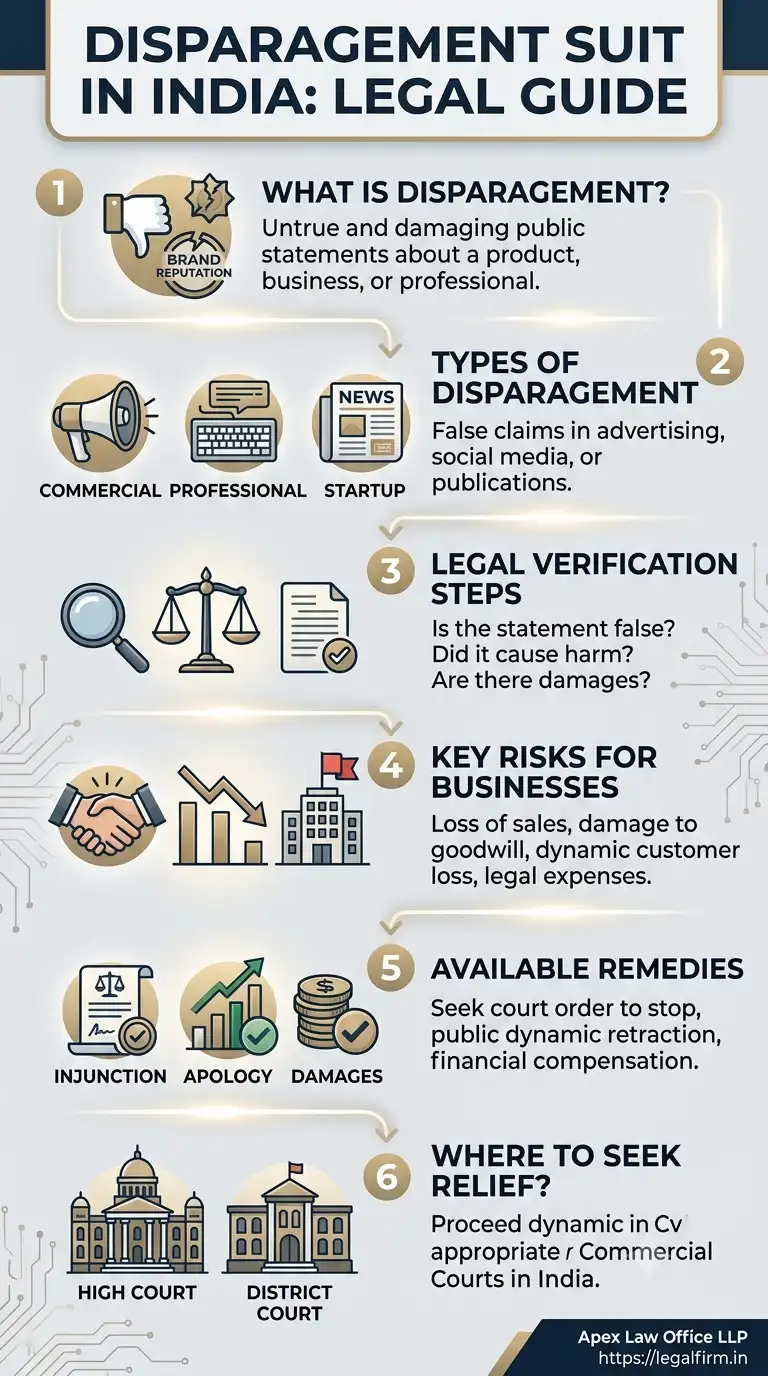
Disparagement involves false statements that reduce public confidence in a person, business, product, service, or profession. Defamation generally concerns injury to reputation, while disparagement often targets commercial interests and market reputation. Indian courts examine falsity, publication, malice, intention, and resulting damage before granting relief. Additionally, courts distinguish honest opinion from false factual assertions made to cause commercial harm. A business disparagement suit usually arises after advertisements compare products unfairly or spread misleading allegations. Professionals may file actions when competitors accuse them of fraud, negligence, incompetence, or unethical conduct without proof. Digital platforms have increased such disputes significantly because information spreads instantly across multiple audiences. Consequently, prompt legal action becomes essential for preventing wider reputational injury. Common sources include social media campaigns, influencer content, customer complaints, anonymous blogs, and competitor communications. The law balances free speech with protection against false and malicious statements affecting reputation and business goodwill.
Essential Ingredients of a Disparagement Claim
A successful disparagement claim requires specific legal elements supported by credible evidence and surrounding circumstances. Courts usually expect proof of publication, falsity, identification, malice, and measurable reputational or commercial damage. Therefore, claimants should preserve screenshots, emails, videos, advertisements, sales records, and witness statements immediately. The burden generally rests on the claimant to establish falsity and resulting harm. However, defendants may raise defenses such as truth, fair comment, privilege, public interest, or honest opinion. Commercial cases often involve detailed market evidence showing decline in sales, customer confidence, or contractual opportunities. Lawyers frequently seek interim injunctions before trial when continuing publication threatens serious harm. The court then assesses urgency, prima facie case, balance of convenience, and irreparable injury. Proper pleadings significantly influence interim relief applications and final damages claims. Early legal assessment helps identify available civil remedies, criminal remedies, regulatory complaints, and digital platform takedown mechanisms under Indian law.
Key Ingredients at a Glance
- Publication to a third party
- False factual statement
- Identification of claimant
- Malicious intent or reckless conduct
- Reputational or commercial loss
- Causal connection between statement and damage
Statutory Framework Governing Disparagement Suits
Civil and Criminal Provisions
Indian disparagement disputes involve both civil law and criminal law depending upon facts and seriousness. Civil suits generally proceed under the Code of Civil Procedure, 1908, seeking injunctions, damages, and declarations. Commercial disputes may fall within the Commercial Courts Act when specified value requirements are satisfied. Criminal complaints may invoke defamation provisions under the Bharatiya Nyaya Sanhita, 2023. Investigation procedures follow the Bharatiya Nagarik Suraksha Sanhita, 2023, while evidence is governed by the Bharatiya Sakshya Adhiniyam, 2023. Furthermore, information technology issues may involve intermediary rules, platform policies, and cybercrime procedures. Courts also consider constitutional free speech principles while evaluating restrictions on publication. Regulatory bodies may become relevant when advertisements, medical claims, financial products, or consumer representations are involved. Consequently, strategy often combines civil injunctions, criminal complaints, platform takedowns, and regulatory representations. Businesses should obtain legal review before publishing comparative advertisements or allegations against competitors, former employees, professionals, or commercial entities.
Relevant Statutes and Forums
| Subject | Law / Forum |
|---|---|
| Civil injunction | Code of Civil Procedure, 1908 |
| Commercial dispute | Commercial Courts Act |
| Criminal defamation | Bharatiya Nyaya Sanhita, 2023 |
| Procedure | Bharatiya Nagarik Suraksha Sanhita, 2023 |
| Evidence | Bharatiya Sakshya Adhiniyam, 2023 |
| Consumer misleading claims | Consumer Commissions |
| Advertising issues | ASCI complaints mechanism |
Practical Legal Insight
Businesses should evaluate both civil and criminal remedies simultaneously because each process serves different strategic purposes. Civil injunctions stop publication quickly, whereas criminal proceedings may create stronger deterrence against repeated misconduct. Additionally, commercial courts usually provide structured timelines for high-value business disputes involving disparagement allegations.
Jurisdiction and Territorial Competence
Jurisdiction in disparagement cases depends upon publication location, defendant residence, business operations, and cause of action. Online publications create complex jurisdictional questions because content remains accessible across several states simultaneously. Indian courts increasingly accept jurisdiction where reputational harm occurs and business impact becomes visible. Therefore, companies operating in Chennai may sue even when defamatory content originated elsewhere. Commercial Courts handle specified commercial disputes involving trade, commerce, intellectual property, advertising, and business reputation. District Courts hear ordinary civil suits, while High Courts may exercise original jurisdiction in notified territories. Criminal complaints usually proceed before Magistrate Courts having territorial connection with publication or harm. Cybercrime complaints may be filed before local cybercrime police stations or through national cybercrime portals. Careful forum selection influences court fees, procedure, timelines, interim relief, and appellate remedies. Experienced legal counsel should evaluate territorial competence before issuing notices or filing proceedings to avoid maintainability objections and procedural delays.
Common Jurisdiction Triggers
- Place of publication
- Place of business loss
- Defendant residence
- Location of customers affected
- Place where reputation suffered damage
Commercial Disparagement and Business Reputation
Comparative Advertising and Market Competition
Comparative advertising remains lawful when statements are truthful, verifiable, and non-misleading. However, advertisements become actionable when they ridicule competitors or make false quality allegations. Courts examine overall impression rather than isolated words while deciding commercial disparagement disputes. Businesses should avoid unsupported claims regarding safety, performance, ingredients, certification, or regulatory approval. Moreover, visual depictions, packaging similarities, and implied allegations may also create liability. Market competitors frequently seek urgent injunctions against television advertisements, digital campaigns, influencer endorsements, and promotional videos. Commercial Courts often hear such matters urgently because continuing publication may cause immediate market damage. Evidence usually includes market surveys, consumer complaints, sales data, expert reports, and advertising material. Companies should implement internal legal review before launching aggressive comparative campaigns. Responsible marketing reduces litigation risk and protects long-term brand value. A successful commercial disparagement action may result in injunctions, corrective advertising orders, damages, account of profits, and litigation costs against the wrongdoer.
Business Sectors Facing Frequent Disparagement Claims
- Pharmaceuticals and healthcare
- Food and beverage industry
- Real estate and construction
- Financial services and fintech
- Education institutions
- E-commerce marketplaces
- Information technology companies
Risk Reduction Measures
- Verify all factual claims before publication.
- Maintain documentary proof supporting comparisons.
- Obtain legal vetting for advertising campaigns.
- Avoid ridicule, mockery, and exaggerated allegations.
- Respond professionally to competitor criticism.
Professional Reputation and Service Disputes
Doctors, lawyers, chartered accountants, architects, consultants, and other professionals frequently face reputational attacks online. False allegations may affect licenses, employment, client trust, and future professional opportunities. Therefore, professionals should preserve digital evidence immediately after discovering defamatory material. Complaints may involve fabricated malpractice allegations, forged documents, fake client reviews, or anonymous social media campaigns. Regulatory bodies such as professional councils may also receive complaints based on disputed statements. Legal strategy should address both reputational protection and regulatory consequences. Interim injunctions often become crucial because search engine results influence public perception rapidly. Professionals may additionally seek platform takedowns, cease-and-desist notices, and public clarifications. Courts generally consider professional reputation an important civil right deserving meaningful protection. Prompt legal action often limits further dissemination and reduces long-term damage. Structured communication with clients, employers, regulators, and media outlets should accompany litigation strategy. Professional indemnity insurers may also require early notification when allegations relate to professional services or alleged misconduct.
Immediate Steps for Professionals
- Capture screenshots with date and time.
- Download videos and webpages.
- Record URLs and account details.
- Inform professional insurer if required.
- Seek urgent legal advice.
Social Media, Reviews, and Digital Platforms
Online disparagement spreads rapidly through social media platforms, review websites, messaging applications, and video-sharing services. False content may remain searchable for years and continue harming reputation indefinitely. Consequently, digital disputes require immediate evidence collection and platform-specific takedown procedures. Businesses should document URLs, account names, timestamps, engagement metrics, and audience reach before requesting removal. Many platforms provide reporting mechanisms for defamation, impersonation, harassment, and misleading content. Legal notices to intermediaries may strengthen later court proceedings. Cybercrime police stations can receive complaints involving impersonation, hacking, extortion, threats, obscene content, or coordinated harassment. The National Cyber Crime Reporting Portal also accepts online complaints in appropriate categories. Courts increasingly grant dynamic injunctions directing removal of identified URLs and future substantially similar content. Search engine de-indexing requests may become relevant in exceptional circumstances. Effective digital reputation management combines litigation, technical takedowns, public communication, search optimization, and continuous online monitoring. Delay often increases audience reach and complicates restoration of reputation.
Digital Evidence Preservation Checklist
- Take full-page screenshots.
- Record web addresses and profile links.
- Save videos, audio files, and images.
- Preserve metadata when available.
- Use independent witnesses for capture.
- Maintain chronological evidence folders.
Useful Authorities for Online Complaints
- Local Cyber Crime Police Station
- Commissioner of Police
- State Cyber Crime Wing
- National Cyber Crime Reporting Portal
- Platform grievance officers
Procedure for Filing a Disparagement Suit
Pre-Litigation Strategy and Legal Notice
Pre-litigation preparation often determines the success of a later disparagement suit. Lawyers usually begin with evidence review, damage assessment, and identification of all publishers. A carefully drafted legal notice demands withdrawal, apology, correction, and compensation within a specified period. Such notices may encourage settlement and demonstrate reasonableness before court proceedings. However, urgent injunction cases may proceed without waiting for a response. Businesses should avoid emotional public replies because those responses may become evidence later. Financial records, customer communications, contracts, and market data should be organized systematically. Counsel must also examine limitation periods, jurisdiction, valuation, court fees, and interim relief requirements. Strategic decisions include choosing civil proceedings, criminal proceedings, regulatory complaints, or combined action. Early forensic preservation becomes important when anonymous accounts or edited digital content appear involved. Confidential settlement discussions may protect commercial relationships and reduce publicity. Nevertheless, persistent false publication generally requires decisive litigation to prevent continuing reputational and financial damage.
Documents Commonly Required
- Identity and business documents
- Certificate of incorporation or registration
- Screenshots and digital records
- Advertisements or publications complained of
- Sales figures and financial statements
- Customer complaints or cancellation records
- Correspondence with the defendant
Suggested Pre-Litigation Timeline
| Stage | Indicative Action |
|---|---|
| Day 1 | Evidence capture |
| Day 2-3 | Legal assessment |
| Day 4-5 | Notice drafting |
| Day 6 | Notice dispatch |
| Day 7-15 | Response evaluation |
| Day 16 onward | Suit filing if necessary |
Court Process and Interim Relief
A disparagement suit begins with filing a plaint describing publication, falsity, harm, and requested relief. Plaintiffs usually seek temporary injunctions under the Code of Civil Procedure immediately after filing. Courts may grant ad interim orders when delay threatens serious irreparable injury. Defendants then receive summons and may file written statements, documents, and objections to interim relief. Evidence may include digital records, expert testimony, financial data, customer communications, and witness statements. Commercial Courts often conduct case management hearings to streamline issues and timelines. Mediation may be explored at suitable stages, especially in business disputes. Final relief can include permanent injunctions, damages, declarations, apologies, corrective advertisements, and litigation costs. Appeals may lie to higher courts depending upon the forum and value involved. Effective courtroom presentation requires coherent chronology, reliable evidence, and quantified loss analysis. Continuous monitoring remains necessary because defendants sometimes republish content through new accounts or related entities during litigation.
Reliefs Commonly Sought
- Temporary injunction
- Permanent injunction
- Damages and compensation
- Public apology
- Corrective advertisement
- Removal of online content
- Costs of litigation
Damages, Compensation, and Enforcement
Courts assess damages by examining reputational injury, financial loss, market impact, mental distress, and defendant conduct. Commercial entities may claim loss of sales, contracts, investment opportunities, and goodwill. Individuals may seek compensation for humiliation, anxiety, professional setback, and social harm. Punitive damages may arise in exceptional cases involving deliberate malicious campaigns. Plaintiffs should maintain financial records demonstrating decline after publication. Expert valuation evidence can strengthen high-value commercial claims substantially. Settlement discussions often focus on apology wording, withdrawal scope, confidentiality, and payment terms. After obtaining a decree, successful parties may initiate execution proceedings for recovery of money and enforcement of injunctions. Continuing violation of injunction orders may invite contempt proceedings before competent courts. Online enforcement sometimes requires repeated notices to platforms, search engines, hosting providers, and intermediary grievance officers. Strategic monitoring after judgment remains essential because reputational attacks occasionally reappear through new digital channels or associated persons despite earlier court orders.
Factors Affecting Damages Assessment
- Extent of publication
- Duration of circulation
- Nature of allegation
- Status of claimant
- Actual financial loss
- Conduct after notice
- Public apology or refusal
Enforcement Tools After Decree
- Execution petition
- Attachment proceedings
- Contempt petition
- Platform compliance requests
- Search engine de-indexing follow-up
Defenses in Disparagement Litigation
Defendants may resist a disparagement suit through several recognized legal defenses under Indian law. Truth remains the strongest defense when statements are substantially accurate and provable. Honest opinion on matters of public interest may also receive protection. Fair comment generally requires factual foundation and absence of malice. Privileged communications, including certain judicial and official proceedings, may enjoy immunity. Courts carefully scrutinize whether defendants acted responsibly before publication. Businesses should preserve research material, expert opinions, testing reports, and correspondence supporting disputed statements. Mere repetition of third-party allegations rarely guarantees protection. Online users often mistakenly believe anonymity eliminates legal responsibility. Indian courts can direct disclosure of account information through appropriate procedures when justified. Responsible criticism remains permissible, whereas false factual allegations invite liability. Early legal evaluation helps defendants assess settlement possibilities, apology options, evidentiary weaknesses, and litigation exposure before positions become entrenched through prolonged proceedings and public controversy.
Frequently Raised Defenses
- Truth
- Honest opinion
- Fair comment
- Qualified privilege
- Public interest
- Lack of identification
- Absence of publication
Police Complaints and Criminal Proceedings
Criminal action may accompany a civil disparagement suit when allegations involve intentional reputational harm, threats, extortion, or harassment. Complaints may be lodged before local police stations, cybercrime police stations, or jurisdictional Magistrates. The Bharatiya Nagarik Suraksha Sanhita governs procedural aspects of investigation and complaint processing. Police may record information, preserve digital evidence, and conduct preliminary inquiry where legally appropriate. However, every reputational dispute does not automatically justify criminal prosecution. Courts generally discourage criminal process for purely commercial disagreements lacking defamatory intent or criminal ingredients. Strategic criminal complaints may create settlement pressure, yet misuse can attract adverse judicial observations. Complainants should present organized evidence, publication details, witness information, and chronology of events. Lawyers often coordinate civil and criminal proceedings carefully to maintain consistency of allegations. Professional communication with investigating officers improves procedural efficiency and evidence preservation. Victims should promptly report threats, impersonation, blackmail, or coordinated cyber harassment connected with disparaging publications.
Authorities Commonly Approached
- Local Police Station
- Cyber Crime Police Station
- Commissioner of Police Office
- District Superintendent of Police
- Jurisdictional Magistrate Court
Preventive Reputation Management for Businesses
Preventive legal planning reduces exposure to future disparagement disputes and protects commercial goodwill effectively. Businesses should adopt written social media, advertising, and public communication policies. Marketing teams require training on comparative advertising, intellectual property, consumer protection, and defamation risks. Contracts with influencers, agencies, employees, and distributors should contain reputation protection clauses. Regular online monitoring helps detect harmful content before widespread circulation occurs. Customer grievance mechanisms can prevent dissatisfied consumers from escalating complaints publicly. Legal audits of promotional material should occur before major product launches or campaigns. Crisis communication plans should identify spokespersons, approval processes, and evidence preservation procedures. Insurance review may reveal coverage for certain media or professional liability claims. Moreover, maintaining transparent records strengthens future defense if criticism arises from genuine consumer experiences. Reputation management works best when legal, technical, marketing, and management teams coordinate consistently. Long-term brand value depends upon truthful communication, responsible advertising, prompt complaint resolution, and disciplined public engagement practices.
Corporate Prevention Checklist
- Create communication approval policies.
- Train marketing and sales teams.
- Monitor social media continuously.
- Respond quickly to genuine complaints.
- Preserve advertising substantiation records.
- Review influencer contracts carefully.
- Conduct periodic legal audits.
Legal Support from Apex Law Office LLP
Apex Law Office LLP provides comprehensive legal support for disparagement, defamation, commercial reputation, and digital reputation disputes. The firm assists businesses, startups, professionals, educational institutions, healthcare providers, and individuals across India. Services include legal notices, emergency injunctions, commercial suits, criminal complaints, cybercrime coordination, and online takedown strategy. Lawyers conduct evidence assessment, jurisdiction analysis, damages evaluation, and litigation planning before initiating proceedings. The firm also advises on advertising review, influencer agreements, social media policies, and crisis communication management. Matters are handled before District Courts, Commercial Courts, High Courts, consumer forums, and appropriate criminal courts. Clients receive practical guidance focused on speedy protection of reputation and business continuity. Additionally, the firm coordinates with technical experts for digital evidence preservation and online monitoring. Early consultation often improves prospects for urgent relief and effective settlement. Reputation represents a valuable commercial asset, and timely legal intervention can prevent extensive financial and professional damage.
Read More
How to Choose the Best Lawyers in Chennai Madras High Court?
CITY CIVIL COURT Lawyers: How to hire the Best Attorneys?
Mastering Complex Commercial Transactions: Insider Legal Strategies for Risk-Free Busin
Recovery Of Money Suits: How To Pursue Legal Action?
A Guide to Filing Human Rights Complaints and Fighting for Justice
Frequently Asked Questions
Can a business file a disparagement suit for false Google reviews?
Yes. A business may seek removal, injunction, damages, and other remedies when reviews contain false factual allegations causing commercial harm.
Which court handles commercial disparagement disputes in Chennai?
Commercial Courts generally hear specified commercial disputes, while District Courts hear other civil reputation matters depending on valuation.
Can social media posts lead to criminal defamation proceedings?
Yes. False social media publications may attract criminal defamation provisions if legal ingredients under the Bharatiya Nyaya Sanhita are satisfied.
What evidence should I preserve immediately after discovering defamatory content?
Preserve screenshots, URLs, videos, account details, timestamps, witness details, and all communications connected with the publication.
Can the court order removal of online content quickly?
Courts may grant urgent interim injunctions directing removal of identified online content when continuing publication causes serious irreparable harm.
Is a legal notice mandatory before filing a disparagement suit?
A legal notice is not always mandatory, although it often helps settlement efforts and strengthens the claimant’s overall litigation record.