

Figures That Refuse a Fixed Identity
Audrey Kawasaki creates figurative paintings in which intimacy never quite becomes familiarity. Female figures emerge through delicate color, precise drawing, and the natural grain of wooden panels, appearing close enough to encounter yet psychologically difficult to possess. Sensuality meets melancholy, innocence brushes against eroticism, and finely rendered faces coexist with surfaces that remain visibly organic. Born and raised in Los Angeles and now living in Norwich, UK, the Japanese-American artist has developed a visual language shaped by Japanese manga, Art Nouveau, figurative painting, and a sustained fascination with line. Since 2005, she has exhibited professionally in galleries across the United States and internationally.
Drawing entered Kawasaki’s life long before galleries did. Growing up with Japanese manga comics encouraged her to draw from an early age, and by her teenage years sketchbooks had become an intensely personal space. She spent hours drawing for pleasure and expression, allowing uncertainty and vulnerability to take forms that could be fierce, strange, vulgar, or emotionally exposed. Without the demands of a professional practice, drawing offered freedom and a way to understand feelings that were otherwise difficult to articulate.
Formal instruction arrived in her late teens through after-school fine art classes at Mission Renaissance, where she developed foundational drawing and painting skills. After high school, Kawasaki moved to New York to attend Pratt Institute, studying fine art painting for two years before leaving without completing her degree. Her interests were already gravitating toward figurative and illustrative imagery. Rather than abandoning that direction, she pursued it independently and soon began exhibiting professionally, bringing disciplined draftsmanship together with an increasingly recognizable approach to painting.
Audrey Kawasaki: Women Between Presence and Apparition
The female figure sits at the center of Kawasaki’s imagery, but her women resist conventional portraiture. Graceful gestures, delicate features, direct gazes, and restrained expressions suggest longing, introspection, vulnerability, or melancholy without supplying a definitive narrative. Seduction is often present, yet it does not cancel innocence. A figure may seem uninhibited while remaining emotionally inaccessible, or return the viewer’s gaze while appearing suspended somewhere beyond ordinary experience. Such contradictions give the paintings their particular psychological charge.
Kawasaki thinks of these women as fictional and ethereal presences, describing them through ideas of ghosts, spirits, apparitions, and fleeting visions. They are not simply representations of identifiable individuals. Instead, they develop through the act of making, acquiring an imaginative independence that allows Kawasaki to treat the recurring female presence almost as a muse. She follows what an image seems to require until the figure assumes a convincing presence. The distance between maker and imagined subject also leaves room for romanticizing the creative process itself.
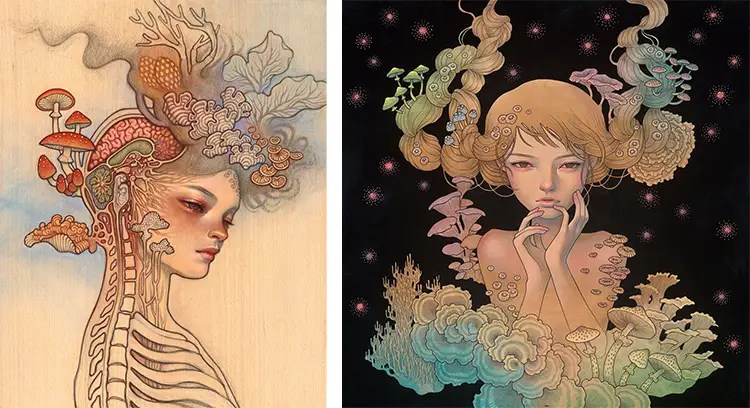
Faces are crucial to this transformation. Kawasaki develops them through restrained color, subtle shading, tonal shifts, and repeated transparent layers, waiting for the point at which the woman seems to come alive. Psychological intensity arises without theatrical expressions or exaggerated gestures. A minute adjustment to an eye, the inclination of a body, or a change in shadow can alter the emotional register. The resulting women remain deliberately unresolved, simultaneously sensual and spectral, vulnerable and self-possessed. Their ambiguity asks viewers to encounter them without fully decoding them.

Building an Image From Line, Glaze, and Grain
Kawasaki’s controlled surfaces begin with drawing, and line remains one of the strongest pleasures in her practice. A work may start with a small paper sketch before she draws loosely onto the wooden panel, concentrating first on placement and composition. From there comes an extended cycle of softening, erasing, redrawing, and refinement. Larger paintings and murals can require a more complete preliminary drawing that is scanned and projected onto the final surface. This stage may take as long as a week, partly because the pencil is not destined to disappear. Selected marks remain visible as elements of the completed image.
Wood is equally important. Kawasaki has favored maple, elm, and birch, whose relatively smooth surfaces accommodate detailed drawing while providing warm tones and flowing grain. She has also worked with veneers laminated onto MDF panels for greater resistance to warping. Each surface already possesses a pattern before she begins, so the support contributes actively to the composition rather than functioning as something pigment must conceal. After sanding the panel to a fine finish and completing the drawing, Kawasaki applies fixative followed by transparent acrylic medium, helping control absorption while retaining the grain beneath subsequent paint.
Color develops through thin applications instead of heavy impasto. Kawasaki has used both acrylic and oil, sometimes establishing the tonal foundation in faster-drying acrylic before moving into oils for color and refinement. Transparent washes and glazes gradually create light, shadow, and chromatic depth. A middle tone can establish the broader atmosphere before lighter and darker values accumulate across the surface. Because these layers remain translucent, wood grain and fragments of pencil continue to participate in the finished composition. Carefully modeled faces can sit beside flatter patterns, open wood, and graphic contours, allowing representation and decoration to operate simultaneously.

Audrey Kawasaki: Following the Image Until It Lives
Kawasaki’s sensitivity to line connects several influences without reducing her work to any single tradition. The flowing decorative contours associated with Art Nouveau meet the graphic clarity of Japanese visual culture and manga, while realistically modeled faces and bodies introduce another pictorial vocabulary. She considers line quality, texture, pattern, rhythm, balance, and flow as interdependent decisions. Finding the right configuration can resemble solving a puzzle: many arrangements are possible, but only a particular combination feels appropriate for a given painting. That concentration gives even her quietest compositions a strong internal structure.
Reference material provides another layer of construction. Kawasaki began collecting magazine cuttings when she was young, preserving fashion photographs, advertisements, illustrations, paintings, faces, hands, poses, lighting conditions, colors, and moods that attracted her. Digital collections later extended this archive. She does not necessarily build a figure from one source image. An eye might come from one reference, a mouth or hand position from another, while remaining elements are improvised. Accumulated over time, the archive functions as both a practical resource and a record of the visual qualities to which she repeatedly returns.
For Kawasaki, technical skill ultimately serves the parts of making that continue to hold her attention most strongly, particularly drawing lines and painting faces. Rather than attempting to master every possible aspect of an image equally, she has concentrated on those enduring fascinations and allowed them to shape the identity of her practice. The patience required to revise a contour, build a face through translucent paint, and negotiate an image around existing wood grain reinforces that focus. Her figures emerge through this accumulation of controlled choices, yet the final paintings preserve uncertainty. Held between pencil, pigment, and organic grain, the women remain fleeting presences whose identities never become entirely available.