
There are ways of romanticizing Cairo, but I want to be clear from the get-go: it is, on the whole, a rather dirty and ugly city.
The suburbs in particular, which I usually witnessed from a taxi window, are absolutely littered with plastic waste. Just about everywhere the dominant colors are beige and brown, the haze of polluted air further adding to the sense of drabness. At times I felt like I was maybe somewhere in South Asia; horse-drawn carriages are sometimes still used for regular transportation.
But… I say this only to set realistic expectations.
Many bucket-list travellers come for the Pyramids but surely end up shocked that most of Cairo itself is not nearly as glorious. So if you detect a certain negative vibe around Cairo online, this is why — along with Egypt’s broader reputation for tourist-targeted scams. If you’re looking for a beautiful holiday in a perfectly picturesque place, this isn’t it.
Then again, the Ancient Egypt sites are genuinely spellbinding. And what most guides won’t yet tell you is that as of 2026, the Giza site is completely redeveloped (and now very low-stress). This, along with the stunning new Grand Egyptian Museum, makes Cairo a must-visit, despite its overall aesthetics. (Though I have to say I personally enjoy the sensory overload!)

While some hassle still exists in Cairo, particularly at the markets, the city now has a core Ancient Egypt itinerary that I think will get more positive reviews from travellers.
Beyond the ancient Egypt sights, some other elements of Cairo itself surprised me positively. I loved exploring the windy cloistered alleyways of the Coptic neighborhood, one of the world’s oldest Christian communities.
The monuments from the Medieval and Ottoman eras, overshadowed as they are by the Pharaohs, end up being strangely underrated. And the faded glory of the Parisian boulevards and crumbling neoclassical architecture of Downtown Cairo provided an interesting backdrop in between my sightseeing.

Sure – if you’re expecting a very beautiful, liveable city you’ll be disappointed. But go in expecting a fair deal of chaos and grit, as well as Ancient Egypt’s greatest wonders, and you may find it just as compelling as I did.
Since I wanted to cover the city thoroughly for this blog, I spent 6 nights in Cairo. While I got a little weary of Cairo by the end, you can have a great experience by planning a punchier 2 or 3 nights. Let me share exactly how to get to the good bits – and minimize the potentially stressful aspects of Africa’s largest metropolis.

While researching Cairo I noticed many travel guides are out of date. Before I get to the what/how/where, let me quickly highlight several major changes you need to know about.
- The Giza site changed management in late 2025. It’s now perfectly doable to explore in a self-guided way. The advice that you must hire a guide to avoid a nightmare is out of date. Check the full section on Giza below.
- The Egyptian Museum is no longer the main one. While you can still go to the original to see an old-school, 1900s-style museum with arched hallways and wooden cabinets, it’ll now be strangely quiet. The long-awaited Grand Egyptian Museum is now the place to go (and it’s stunning).
- Uber exists in Cairo and using it will side-step any taxi scams. Just one tip for Uber: if your driver isn’t moving towards you and starts negotiating prices via the chat function, be sure to cancel and get another ride.
- The security issues from the 2010s, still a big theme in some articles, are long past.
I know some of the changes are still fresh and not every source can be up to date. I’m just using this opportunity to set the record straight. If anything else changes, I will add it here.
Where to stay in Cairo
I’ll get to all the things to do in a moment, but first: your location! A common mistake is to assume that staying closer to Giza lets you avoid some of the less appealing aspects of Cairo. In fact, I found it works exactly the opposite way.
I actually found the urban areas east and north of Giza among the least attractive in Cairo. They’re hemmed in by huge roads, often littered with trash, and the streets near the old gate suffer from a pungent smell of manure due to the many horse and camel rides passing through here. And yes, you’re close to the Pyramids, but you’re also at least 30 minutes from other key sights in Cairo, so the logistics aren’t necessarily better.
My advice is to stay in Giza only if you’re on a quick stopover.
If the Pyramids and Great Egyptian Museum are the only things on your to-do list, then staying in Giza can make sense. On a quick visit, maybe what’s directly around your hotel doesn’t matter so much, as you won’t be exploring the neighborhood anyway. Pick a hotel with a great rooftop terrace and you may find yourself relaxing in a pool with a direct angle onto these epic monuments. This aspect can be unforgettable, even if at the street level there’s less to write home about.
👉 Want a rooftop pool with the pyramids right there? Sahary Pyramids View Hotel and Villa Khufu Pyramids Hotel both deliver close-range views of the Giza Plateau.

However, if you’re here for at least 2 nights, I recommend Downtown Cairo (known locally as Wust al-Balad). This is the area once conceived as the ‘Paris on the Nile’ with many wide boulevards and stately architecture. Parts are quite dilapidated, but it has a certain soul that makes it the ideal hotel area in my opinion. If there isn’t too much traffic, it takes a 30 minute taxi ride to get to Giza. Many other sights are in the 10 to 20 minute range by taxi or subway.
There is a lot of great budget accommodation here. During the winter high season, a nice boutique hotel room will cost about per night, which can go down to half that price in low season. I stayed in two hotels around here that I’m very happy to personally recommend.
Eileen Hotel Cairo is my top suggestion for Downtown Cairo. It’s a classy, small-scale hotel that feels personal and local. Located on a top floor, the balconies offer fantastic views of the city below. The super calm vibe here made my stay in chaotic Cairo so much more endurable. It’s clearly a popular pick, though — even in low season, I missed out on it initially, but was able to grab a room on my return. Book early!


Aphrodite Boutique Hotel is my second pick. The rooms here are clean and modern, the staff is amazingly friendly and helpful, and I loved that you can have your breakfast in your room. It’s located in a heritage building in a traffic-free street with arched arcades.
Due to not having a dining room or large reception it feels a bit more like a guesthouse, but it’s a homely place that’s right in the middle of the historic center. It doesn’t quite have the same views at the back as Eileen Hotel, but it was good value for money and in a perfect central location.

Finally, I suggest staying at Dahab Hostel for backpackers and budget travelers. It was recommended to me by a long-term traveller who stayed there a whole week. I soon understood why he stuck around, as despite Cairo’s challenges the hostel itself has an amazing atmosphere.
The hostel has a 9.7 on Hostelworld, lots of activities available, and has a homely bohemian style, very reminiscent of the Egyptian beach town Dahab that it’s named after.

Pyramids of Giza – the new situation
For years I’ve been reading about the absolutely torturous experience that is the Giza site. Words like ‘disgrace’ and ‘unworthy’ were regularly used on travel forums, which honestly had been a factor in me avoiding Egypt until now.
I was bracing myself for a frantic, scam-filled, headache-inducing experience, but imagine my shock when I found none of that in 2026.
At last, Egypt has cleaned up its act at Giza. Gone are the pushy salesmen, now corralled into one specific zone near the Sphinx, making them easy to avoid. A new shuttle bus system lets you hop around the site for free, there’s a brand new entrance and online ticketing system, and air-conditioned shops and cafes provide welcome respite from the searing midday sun.
This is now a proper set-up befitting one of the world’s most famous ancient monuments.


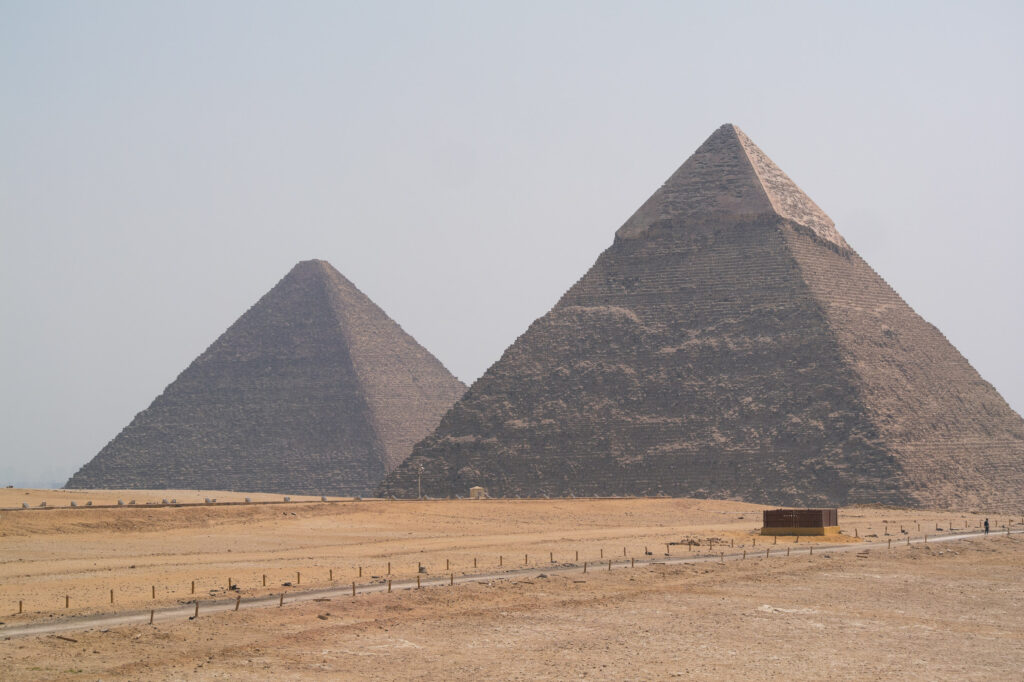
While the site is now much less stressful overall, I still recommend going in the early morning to avoid the crowds. I arrived at the site at its opening time of 7.30 am and for at least two hours it felt like I had the Pyramids to myself. Rather than any sort of frustration, I simply felt reverence and awe for these ancient structures which survived over four millennia.
A qualified guide could add some further context, though I felt like I knew enough about the Great Pyramids from countless documentaries and articles, so I opted to explore by myself. I found that self-guided exploration is now very much possible, and it’s no longer true that you must have a guide just to swat away the constant hawkers (a tip I’d often heard). I was very glad to have had the immersive and contemplative experience I had hoped for, without ever being interrupted by annoying sellers.
While the pyramids speak for themselves, you should still properly prepare your visit! The tickets come with several optional add-ons worth considering. You can choose between two entrances that hugely impact the initial reveal. There are also some specific ways to beat the crowds.
Not to get lost in the weeds too much here, I wrote a seperate guide to visiting Giza. It will explain everything and can help you avoid some potential disappointments. Give it a read for all the practical details!
The Grand Egyptian Museum
Besides the Giza site itself, Cairo now has a must-visit second site that I think deserves to be included in every itinerary.
After two decades of delays, the highly anticipated Grand Egyptian Museum finally opened its doors in late 2025. Was it worth the wait? Absolutely!
This massive complex is a world-class museum and a deeply immersive experience truly befitting the epic subject matter. I expect that many will be travelling to Cairo in years to come just for this museum.


Twelve galleries take you on a chronological journey through the dynasties. What I really appreciated about the curation is that each gallery also has a sub-theme, so you’re learning about different facets of ancient Egyptian society while also stepping forward in time with each room. These main galleries can easily take 3 hours to work your way through at a casual pace.
Then, the Tutankhamun collection. In a darkened gallery off to the side, you can gawk at the numerous golden objects that were found in this ancient ruler’s burial chamber. You’ll also see the glorious sarcophagus and the three coffins within it, originally nested like matryoshka dolls. The most famous object is Tutankhamun’s mask, a bit like this museum’s Mona Lisa, having its own queue and a limited time to observe it up-close.
The GEM is located at a separate site north of the Pyramids of Giza (there is a large window inside giving a direct angle onto Khufu and Menkaure). For now, there is no metro, so this is a taxi or Uber trip.
Important: you HAVE to prebook your tickets for a specific timeslot. No tickets are sold at the entrance. You can easily book your GEM tickets here.


Other things to do in Cairo
Exploring Downtown Cairo
If you’re staying in the Downtown area (as I recommend) then it’s worth spending an hour or two just exploring the neighborhood.
This area was once designed to be the ‘Paris on the Nile’, and while it’s lost much of its luster since the early 1900s, the faded glory still makes it an interesting place. It’s worth looking up regularly so you can notice the balconies with cast-iron fences and Belle Époque and Art Deco façades. Occasionally you’ll still see some of the original French signage.


Talaat Harb Square makes for a good starting point, from where you can follow the streets fanning out from it. While you have to look closely, you can find some nice vibey cafes. Check out the rooftop cafe Kemet or this lovely art cafe.
I happened to kick off my Cairo exploration on a Friday, the Muslim day of rest, which made this area strangely quiet. On other days, the boulevards will be brimming with traffic.

Diving into the Bazaar & Islamic quarters
Tip: If in doubt, go with a walking tour guide!
I should warn first of all of the intensity of Cairo’s bazaar. I thought the medina of Marrakech in Morocco was the most annoying market experience I’d had — that is, until I went here.
Sellers will be on you like locusts. I’m an experienced traveler and have a well-developed Teflon layer for this stuff, but I recognize it can be intense. If you’re here as a (solo) woman, things will be worse: staring, cat-calling, and inappropriate behavior are commonly cited issues here. It’s not necessarily dangerous, but exhausting.


One solution – for any traveller – is to dive into this area with a local guide. I found mine on a site called Guruwalk, where you can easily find free (or rather donation-based) walking tours. The twist here is that they come with actual ratings and reviews, so you can choose exactly who you’ll go with. Many of the guides on Guruwalk are just locals doing this on the side, not full-time tour guides doing the same route numerous times per week, so you tend to get a more personal and passionate take.
Specifically I went with Kamal — a financial analyst by day and occasional guide by night. He was very well-informed about all of the history and delightfully chatty, which massively elevated my experience of exploring this maze of little streets. Better yet, he seemed to know just about all the shop and cafe owners, so they didn’t run their usual scripts on me at any part of the walk.
book the walking tour with kamal


I was happy to come away with a more meaningful impression of the old quarters and bazaar, and to visit the beautiful Al-Azhar Mosque along the way. There’s a real vibe to some of the streets with arched gateways through stone walls and numerous oil lamps, hookahs, leather bags, and other items laid out for sale. A popular stop is the El-Fishawy Café, a famous 18th-century coffeehouse.
If you go in by yourself, expect to have to say a lot of “la, shukran” (no thanks). Assume all prices are massively marked up and require extensive haggling.

I found that online prices for tours are actually often cheaper for Cairo than in person. For instance, my hotel was trying to sell me a Saqqara tour for $100, while on Viator it costs about half that — and it comes with some reassuring ratings and reviews.
When I tried looking directly with local operators, I often ended up on websites that seemed to be from the 1990s. My email inquiry to one of the recognized tour companies even bounced back, so I decided not to bother. The well-known platforms offer much-needed price transparency, reliable reviews, and a smooth booking process.
Coptic Cairo
If you’re keen on some maze exploration that’s infinitely less stressful than the Islamic Quarter, head to the Coptic neighborhood instead. I’d read a lot about the churches here, but I hadn’t expected that the area itself would be so cosy and inviting.
Okay, let me back up here first.
Egypt is Muslim-majority, but it also has a sizable Christian minority. The Coptic Church is actually one of the world’s oldest, predating the Catholic and Eastern Orthodox churches. (‘Coptic’ is essentially a different word for ‘Egyptian’). Some of the oldest Coptic church buildings can be found here in Cairo, most notably the Hanging Church.


Instead of just ticking this sight off the list, I recommend exploring the whole area around it. The walls around the neighborhood and the narrow alleys within it give it a cloistered and private feeling. This isn’t a coincidence — the walls historically protected the community from religious persecution. Coptic Cairo feels a bit like a mini-medina, with different courtyards giving way to small churches and cafes.
The Coptic churches felt very intimate to me, almost like living rooms, each being architecturally different. Many of the churches feature Medieval stone walls, though one church with low ceilings was made mainly of wood. The smallest of the churches could sit barely 10 people, with additional seating spilling out into the corridor.

I also recommend paying a visit to the Coptic Museum, where many artifacts, textiles, and manuscripts are on display. I found it interesting how the highly stylized ancient Coptic art bears a close resemblance to Byzantine Art, actually having sprung from the same artistic roots.
The alleyways inside the quarter as well as the traffic-free street outside its walls offer a chance of some wonderfully low-stress exploration. You can either take the Cairo Metro to Mar Girgis Station, or get here by taxi (about 15 minutes from Downtown).


White Desert & Black Desert
While this is not in Cairo, in fact it’s 6 hours driving west, I definitely need to mention this here. Firstly, because it’s from Cairo that the tours regularly depart, and secondly because it was the surprise highlight of my Egypt trip.
Honestly, I had no idea that deserts could be so diverse. Starting in the oasis town of Bawiti, my 2-day desert tour took me to spectacular areas that were all very geologically distinct — and they went beyond the typical visions of a purely sandy Sahara.

The Black Desert is unbelievable. Here numerous black cones of ancient volcanic origin poke up from the sandy terrain as far as the eye can see. The White Desert by contrast was once an ocean floor; chalky white mounds sculpted by millions of years of erosion dot the landscape, feeling like some kind of Martian mission landing zone.
Another area is known as the ‘Crystal Mountain’ – here you can see numerous quartz crystals sparkling along the rocky ridges. All in all, it was beyond my expectations.


After comparing a lot of reviews, I did this exact 2-day tour that I booked on Viator. I was very pleased with the experience; it’s a small-scale operation run by a very welcoming local family in Bawiti.
It included the black and white deserts, a swimming stop at an oasis, some sand-boarding, plus camping overnight in the desert in simple tents. At night, our campsite was visited several times by a desert fox, a creature I was thrilled to finally have seen in real life.
A few tips if you want to do this:
- It definitely requires at least 2 days. The drive to the oasis takes 6 hours – yes, a lot of driving, but worth it. Going back and forth on the same day would be pretty brutal though.
- There is also a 3-day option. Friends of mine did this and loved it; added stops include a salt lake and several more remote spots. The cost between 2 and 3 days really spikes up though (by much more than a third) so I opted to save money by sticking with the 2-day option. That said…
- Don’t just book the cheapest tour you can find. I almost did but then noticed all the complaints about not getting any water, drivers smoking inside the car, and unsafe driving. You pay peanuts, you get monkeys. My tour was still on the lower end of the price range but was very satisfactory.
- Absolutely do not go in summer. I went in May during a heatwave when temperatures reached 47 degrees C. It was brutal. Even at night it didn’t really cool down until around 3am. Normal temperatures in May are more like 35C so going in this month could still be tolerable, but the best time to go is clearly during the winter high season.

Finally, something I really appreciated was how the campsite felt truly off-grid and in nature. This was a bit different from another Sahara tour I once did in Merzouga in Morocco.
In Morocco, they take you to a town on the desert edge and then leave you at a permanent tented camp about a 10-minute camel ride away. It was great, but I could still see the town lights over the hills and we didn’t have a fully dark night sky.
Here in Egypt, the long drive through sheer nothingness, with sand constantly sweeping across the asphalt, gives you a real appreciation for the vastness of the desert. The campsite was still within a 30-minute drive or so of the town, but felt like it was in the middle of nowhere. I often felt like I was in my own version of Dune.
Apart from maybe the Pyramids, this was the best thing I did in Egypt.
The other Egypt Museums
Even though the new Grand Egyptian Museum has a massive exhibition space, this still isn’t enough to hold the wealth of Egyptian ancient artifacts. If you haven’t tired of ancient Egypt yet, there are two more places you can go.
The Egyptian Museum, Tahrir Square
The Egyptian Museum is the old museum in a pink neoclassical building from the early 1900s. After the opening of the GEM, visitor numbers here dropped massively, so this has now somewhat oddly become the quiet ‘hidden gem’.
Most Tutankhamun artifacts have been relocated to the GEM, but there are still major artifacts here. For instance, the King Khafre statue is the largest surviving sculpture from the Old Kingdom. The Diary of Merer (a.k.a. the “Red Sea Scrolls”) is also on display here. It’s the famed document discovered in 2013 that gave spectacular proof that the Pyramid’s limestone blocks were shipped in by boat.

Still, this museum is now probably more for the Egyptology completionist. Note that the similar names lead to a fair bit of confusion; many user pictures on Google Maps for this museum are actually of the new GEM. The Tutankhamen collection is still pinned to the old location, but it has definitely moved.
The National Museum of Egyptian Civilization (NMEC)
Few foreign visitors seem aware of this museum, but it would be my main suggestion beyond visiting the GEM. It actually covers the whole breadth of Egyptian history – not just the Pharaonic dynasties, but also the Greco-Roman, Coptic and Islamic period.
I find this broader scope very captivating. The Ancient era can be so dominant that it easily overshadows whole other chapters of Egyptian history. This museum will remind you there was in fact a lot more after Cleopatra’s death. (How about the Mamluk Sultanate, which had a territory spread across huge swathes of the Middle East?).
This is also where you should go to see mummies. The Royal Mummies Hall displays 20 royal mummies, from the 17th to 20th dynasties — a much larger collection than you’d find in the GEM or Egyptian Museum.
It’s located south of Cairo’s center, so logistically a stop here will combine well with Coptic Cairo.
Museum of Islamic Art
I must confess I had already burned through my allotted museum time when I discovered the Museum of Islamic Art. Close to the Islamic Quarter, it features ceramics, calligraphy, and other artifacts from the Islamic era. I include it here because I wished I’d been able to fit it in!
The other Pyramids (are they worth it?)
Having already seen the three pyramids at Giza, you may wonder if there’s still any point in visiting other, ‘lesser’, pyramids.
I went to Saqqara explicitly to find out. In my view, there are actually some good reasons to go here, though realistically if you’re on a quick visit to Cairo you’ll probably be satisfied with just the Giza highlights.
What’s interesting to see at these sites found further south of Cairo is the progression of building techniques used. Documentaries always speak of the great mystery of how the pyramids were built, as if they just suddenly appeared out of nothing (and I guess left there by aliens?).
But while the exact building techniques are unknown, you can very clearly see a process of steady iteration in the designs. It doesn’t totally demystify the Great Pyramid, but it might help you appreciate the very human learning process that ultimately led to it.

First, there’s the Step Pyramid of Djoser, the earliest example of a pyramid. You can clearly see how it’s basically a set of mastabas (rectangular tombs) stacked on top of each other — it’s the original inspiration.
Next is the Bent Pyramid, essentially a failed experiment where the angle was too steep, forcing the builders to change tack midway through, giving it a uniquely odd shape.
Finally, there’s the Red Pyramid, the first to have perfect angles — it’s the final prototype for what you see at Giza today.


These sites are a lot less visited than Giza. Without the crowds, you can live the fantasy of being some kind of archeologist here a lot more. What’s also really cool is that you can go deep into the tunnels of the Bent Pyramid and Red Pyramid — and they go much further than the ones in Khufu.
I especially loved going into the Bent Pyramid, first descending around 80m (~260 ft) then navigating a claustrophobic sequence of further tunnels and stairs. Note this is definitely not recommended if you get uncomfortable in tight spaces or if you have any mobility issues. But if you can handle it, it’s a tiring but fun adventure.

These sites are too far outside of Cairo to reach by taxi, so a private driver or tour will be necessary. I found mine on Viator but I have to say the guide wasn’t particularly informative, so I wouldn’t directly recommend my specific choice. Check reviews or try to get a personal recommendation for a guide that can properly bring these sites to life.
On the way back, my tour also visited Memphis, once ancient Egypt’s very first capital. Apart from the large statue of Ramses II, there is not much to see here, so I would rate this fairly skippable.

Citadel & Al-Azhar Park
For an expansive view of Cairo it’s worth hitting up the Citadel, a large fortress built in the middle ages to defend Cairo against crusades.

Apart from the hilltop views, you can visit two impressive mosques built during the Mamluk and Ottoman eras. (Wear modest clothes for entering the mosques. You can take off your shoes or use the plastic coverings provided.)
The Citadel is only about 10 minutes by taxi/uber from Downtown Cairo. Put the ‘Bab Al-Gebel’ gate as your destination. A trip here pairs well with the nearby Al-Azhar Park, one of Cairo’s rare green spaces with nice well-maintained gardens and a large fountain. If you enjoy just soaking up the vibes, this is another relatively low-stress place to do so.


What I’d do on a return trip
Even though I spent 6 nights in Cairo, I still didn’t get to it all. Let me mention two more activities that would be on my to-do list when I’m back.
First up, a Nile boat trip is one of the popular activities in Cairo. Most options are either chartered or involve a romantic dinner cruise, so this didn’t fit into my solo traveller itinerary. If I come back with company, I would put this on my to-do list.
A dinner cruise will cost about per person with sunset of course being a great time to do it. Just a sailing trip during the day without a meal will cost around .
I also really wanted to see the Cave Church but ran out of time. This is a Coptic Orthodox church that’s carved entirely into the rock, creating a cave-like ceiling. To get there you have to pass through “Garbage City”, a deprived area where locals collect different types of waste for recycling.
Taxis/ubers only take you so far, after which you have to walk the final bit. I thought this seemed super interesting, if you’re willing to navigate through a potentially smelly area of course. It’s still on the list.
visit the church on a guided tour

Essential practical tips
Getting in
Arriving from Cairo International Airport, things may be confusing at first. If you’re here on a visa-on-arrival, you’ll need to queue up at one of the bank counters first. Once you’re given a little voucher you can take that to the immigration officer to get your stamp and gain entry.
There is currently no metro connection and the taxis at the airport are a shitshow. Overcharging or scam attempts are a near-certainty. Using Uber is a much better bet, though even this isn’t guaranteed to be without headaches (at least at the airport).
Ignore any claims from Uber drivers that credit cards aren’t working today, that there’s a new municipal fee, or that Uber is illegal — these are all setups to get you to cancel and pay them directly, in cash, at inflated prices. If an Uber driver isn’t coming to your location but is opening up a chat window to discuss prices instead, cancel immediately and get another — that is, unless you relish the thrill of the price remaining uncertain until you finally arrive, or having to pay at least 3X the going rate.
Ubers will stop in the parking lot near this food truck. Taxi drivers here will besiege you, claiming they have a better price, or that Ubers will never arrive. They’ll talk to you like you’re the asshole for not jumping in their car right away. Just ignore all the BS and simply wait for your Uber to arrive.
While there are a few scammers using Uber to get off-platform work, there are luckily also tons of honest, friendly drivers who simply take you into Cairo for a normal price. The Uber price will already include any tolls or parking fees. It should typically cost .
Getting around
Phew, okay! Getting from the airport to downtown can be intense.
But Ubers within Cairo are a lot less stressful.
I found that almost all drivers are honest, completing the trips without any stress and not even asking for a tip. (I do tip them generously as my self-imposed ‘tourist tax’, and simply as a nice gesture for the drivers not giving me any stress versus taxis.)
There is also a somewhat usable metro system in Cairo. It’s currently most relevant for going to the Coptic Cairo neighborhoods. There are plans to extend Line 4 to the Pyramids and GEM, scheduled to open in 2028 (if all goes well).
Alcohol in Cairo
I know that many Western travellers enjoy having a beer or two on their holiday. Being a Muslim-majority country that’s going to be difficult in Egypt, but not impossible.
A cold beer on a sunny open terrace realistically won’t be a thing, though you might be surprised to learn that alcoholic drinks do exist and are even produced locally. This is due in part to Egypt having a significant Coptic Christian minority.
There are several bars in Cairo that you can easily find on Google Map. Look for a classy place. I ended up in a weird smoky basement where only men sit at tables quietly nursing half liter beers.
On each table was also a bottle of whiskey, a big bucket of popcorn, and a plate with cucumber and carrot slices, while some old silent movie played in the background. No one spoke unless a new customer entered, sparking some brief cross-talk between the tables. It was very strange, but pretty fascinating.
Alcohol consumption, if it exists at all, is mostly a private affair in Egypt. It’s ok to consume in your hotel room or some other personal setting, but you won’t really find it on restaurant menus. A chain called Drinkies does exist in Cairo that is basically like British off-license corner shops. You can easily get various Egyptian brands of beer and liquors here.
Watch out for Sakara though — they have a normal lager, but also a hyperstrength 15% version that was a lot stronger than I bargained for.
Thanks for reading!
I hope this guide has better prepared you for this contradictory city. As you can probably tell from my descriptions, Cairo won’t charm you the way Rome or Barcelona might. It’ll surely frustrate you, surprise you, and get under your skin in a way that’s hard to explain to people who haven’t been.
Ultimately, it’s a raw and exciting travel experience that I’m very glad I had. Come with the right expectations and Cairo will definitely reward you.
For more on staying scam-free, tipping, and getting your visa sorted, check out my Egypt travel tips guide. Looking to escape somewhere more chill? Then check out my guide to Dahab, Egypt’s quiet and bohemian beach town.