
Can you hike glaciers in Iceland by yourself? The answer is: technically, you could, but you really shouldn’t. Iceland’s glaciers are constantly moving and while they may seem harmless from a distance, they can be unpredictable and potentially dangerous. The good news is that there are several great ways to experience Iceland’s glaciers safely, and in this article I’ll explain what you can and can’t do without a guide, and what your options are for getting onto the ice.
I’ve visited Iceland 11 times over the past two decades and have been coming here since 2005. I’ve seen the country change considerably over the years, yet it remains just as beautiful as when I first landed at Keflavík Airport in 2005.
This article was first published in 2015 and updated with new information in 2026 after my most recent visit to Iceland.
A visit to Iceland isn’t complete without seeing a glacier
When visiting Iceland, I highly recommend to add aglacier to your schedule. You’re in the land of fire and ice, and glaciers are one of the country’s most impressive natural features. Just over 10% of Iceland’s surface is covered by glaciers. In total, there are 13 glaciers on Iceland, five of which cover an area of more than 100 square kilometers. These are Vatnajökull, Langjökull, Hofsjökull, Mýrdalsjökull and Drangajökull.
Vatnajökull is Iceland’s largest glacier and one of the largest glaciers in Europe. Many of Iceland’s glaciers are located in the south of the country or in the highlands, making them relatively easy to spot on a road trip. Others are found in different parts of the country, such as Snæfellsjökull on the Snæfellsnes Peninsula and Drangajökull in the Westfjords. Some glaciers also cover active volcanoes. One of the best-known examples is Eyjafjallajökull, which became world-famous after its 2010 eruption disrupted air traffic across Europe.
The good news is that you don’t necessarily need to join a glacier hike to experience one. You can see many glaciers from the road, visit viewpoints, or walk up to the edge of a glacier. But if you want to actually walk on the ice, that’s a different story, and this is where the question of whether you can hike a glacier by yourself becomes important. That brings us back to the question: can you hike glaciers in Iceland by yourself?
Fun fact: if you’re flying to Iceland from mainland Europe, make sure to have a seat at the right side of the plane. If you’re lucky and the weather is good, you may already spot several glaciers from the plane. And you may have already spotted your first glacier without actually being on Iceland yet!

Why you should not hike on a glacier without a guide
The main reason why you should not hike on a glacier without an experienced guide and the proper equipment is that glaciers can be unpredictable and dangerous. They may seem harmless from a distance, but glaciers are essentially moving rivers of ice, filled with crevasses. These cracks and holes in the ice can be several meters deep. While some crevasses are easy to spot, many are hidden from view. A thin layer of fresh snow, for example, can cover a crevasse and make the surface look completely safe when it isn’t.
Glaciers are also constantly changing. Ice can become unstable, and glaciers can calve, meaning that large chunks of ice can break away from the glacier. These ice falls can be dangerous to anyone standing too close.
When walking towards a glacier (I’ll tell you more about the best options further down in this article), you’ll often see what looks like a layer of black or gray rocks covering the glacier. This is called the terminal moraine and consists of rocks, gravel and other debris carried by the moving ice. It may look like solid ground, but you should never cross barriers or ignore warning signs placed by local authorities. These restrictions are there for your safety.


Where to see a glacier safely
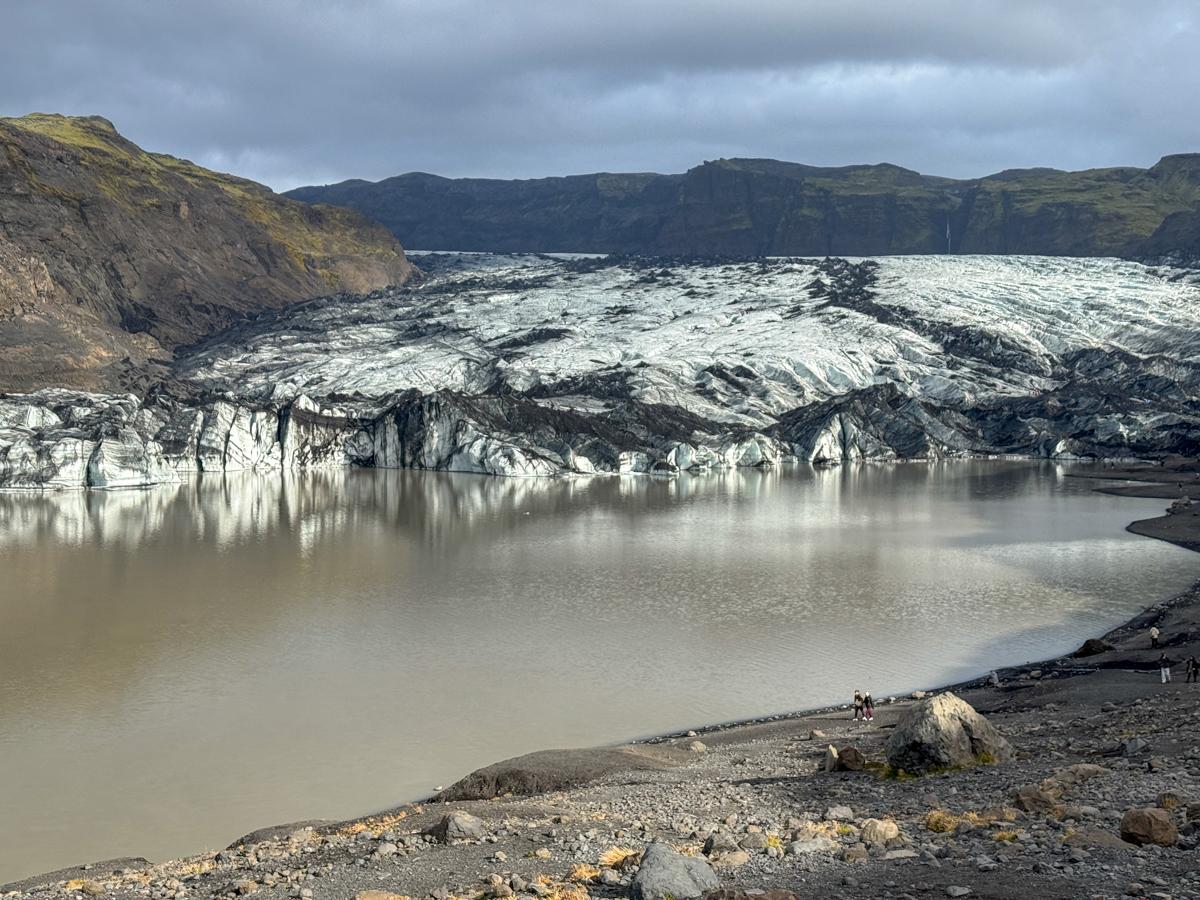
The easiest way to see a glacier close by in Iceland is at Sólheimajökull. This glacier, which is part of Myrdalsjökull, is located a 2.5 hour drive from Reykjavik and included in many South Coast day tours. From the parking lot it once used to be a 15 minute walk to the ice, but currently (2026) this has become quite much longer due to the global warming and Iceland’s glaciers melting.
You can observe the ice from a safe distance here. Please do not go beyond the signposted area and definitely do not step onto the glacier here. The area in front of the glacier consists largely of terminal moraine, made up of rocks and other debris carried by the moving ice. It may look like ordinary ground, but the glacier is right underneath and around you, and the terrain can be unstable.
If you want to explore Sólheimajökull further, you can do this with Icelandic Mountain Guides, which is one of the most established operators in the area. I have done a glacier hike with them in 2015 and it was a truly amazing experience. Most tours are accessible for anyone who can walk for 3 hours without problems and depending on the tour of your choice, you will be on the ice for about 2 hours.
Below you can see some old pictures of me on my Sólheimajökull glacier hike in 2015:


Other options to see a glacier: the glacier lagoons
If you continue along the Ring Road towards the southeast, you’ll eventually reach the area around Vatnajökull National Park, where you can see some of Iceland’s most impressive glaciers and glacial landscapes. One of the best ways to experience them without actually walking on the ice is by visiting a glacier lagoon, such as Jökulsárlón or Fjallsárlón.
At Jökulsárlón, huge chunks of ice break away from the nearby glacier and float through the lagoon before making their way out to sea. If you’re lucky, you can see the lagoon filled with icebergs in all shapes and sizes. Here you will also find the famous Diamond Beach with its icebergs.
You’ve probably heard the expression “the tip of the iceberg”. It refers to the fact that only around 10% of an iceberg is visible above the water, while the vast majority remains below the surface. This also explains why you should never climb onto or swim towards icebergs, even when they appear to be floating peacefully. Icebergs can rotate or suddenly shift as the submerged part changes position. The water around them can also be cold and dangerous, and an iceberg that looks stable may not be stable at all. So please stay on the designated viewing areas and keep a safe distance from the ice.
Iceland’s rescue services regularly have to assist visitors who get too close to the ice, so please don’t risk your safety for a photo or an Instagram post.
You can read my complete guide to visiting Jökulsárlón or Fjallsárlón here.


Into the Glacier
Another important glacier is the Langjökull, the second largest glacier in Iceland. Langjökull one is located in the Icelandic interior and offers ‘Into the Glacier’ as an attraction. Icelanders love special things and a few years ago dug a tunnel into the glacier, so you can literally go inside the glacier.
First, you will be taken onto the ice with a massive truck and once you are at the entrance, you will be guided into the glacier by a guide. You cannot walk into the glacier by yourself.
I did this tour from Reykjavík several years ago and wow, it was awesome! The idea that you literally have tons of ice over your head is a bit bizarre, but also really special. If you want to make this excursion, look here for prices and options.
Is Into the Glacier worth it? It’s not a cheap excursion but I found it absolutely worth it and would even do it again if I may go back to the area once more in the future.


Book your Iceland trip
Do you want to travel to Iceland? Find the best options to book your trip below:
Conclusion and further reading
So to answer your question once again: do not hike on a glacier in Iceland by yourself. It’s dangerous. I hope you found this article useful and that I have inspired you to visit a glacier the right way: without a guide only up to the ice or alternatively with an experienced guide and the right equipment.
If you want to continue reading about Iceland, you may also enjoy the following posts:
This article contains affiliate links. If you make a purchase and/or reservation via such a link, we may receive a small commission at no extra cost to you. Thank you for considering!