

For North American fund managers, currency risk is no longer something that can be managed on autopilot.
Geopolitical tensions and macroeconomic shocks are pulling FX markets in different directions, making both the direction and timing of currency moves harder to anticipate. The result is an environment where FX can flatter portfolio returns one moment and expose costly gaps in risk management the next.
Fund managers are responding by putting more protection in place. Hedging rates have climbed to their highest level in four years, while hedge ratios and tenors have increased from 2025 as managers lock in more protection for longer, suggesting they expect greater volatility to persist throughout the rest of 2026.
Yet greater protection comes with a price, with hedging costs rising by an average of 57%. Compared to 2025, the share of respondents reporting that costs have at least doubled has increased from 5% to 11%.
As hedging costs rise, managers are under pressure to make their FX operations faster, more efficient and more transparent. This has seen the operational picture move away from manual processes towards automation and AI.
In an environment where currency volatility is unpredictable and difficult to forecast, resilience will not just depend on hedging more, but on building the infrastructure required to identify exposures, execute efficiently and adapt quickly when conditions change.
Policy uncertainty delays decision-making
Geopolitical, trade and central bank policy uncertainties are all weighing heavily on fund managers across the US and Canada. When asked which external factors are having the greatest influence on their hedging strategies, respondents put US tariffs and trade policy and Federal Reserve / Bank of Canada rate policy at 34% each, with Middle East geopolitical tensions following at 31%. The narrow spread between factors indicates that funds are managing several overlapping sources of risk at once, rather than one dominant market driver.
This is having a direct impact on funds’ investment decisions. 98% said US policy uncertainty had caused them to delay investment decisions over the past 12 months, including 35% that had significantly delayed decisions.
These delays can change the timing of acquisitions, disposals, capital calls and cash deployment. They can also alter the size and duration of expected currency exposures, bringing FX planning closer to the investment decision itself.
Simultaneously, currency volatility is producing a contradiction in performance. While 94% reported that dollar volatility had a positive impact on returns from an FX perspective, 97% saw losses from unhedged FX exposure as a result of geopolitical tensions. In Q1 2026, these losses averaged more than $730,000, with 12% of respondents reporting losses between $1 million and $4.9 million.
These favourable currency moves at a portfolio level are therefore not eliminating the financial cost of exposures left unprotected, and this tension is pushing hedging back to the centre of fund managers’ FX strategies.

Hedging reaches four-year high
Hedging rates have climbed to 94% in 2026, up from 85% the year before and bringing hedging uptake to its highest level in four years.
Among the small group of funds that do not hedge, burdensome hedging infrastructure has become the most common reason (56%), ahead of capital allocation (38%) and cost (31%). Yet appetite among non-hedgers remains high at 69%, highlighting the gap between the desire to reduce currency risk and the operational and cost barriers that can stand in the way.
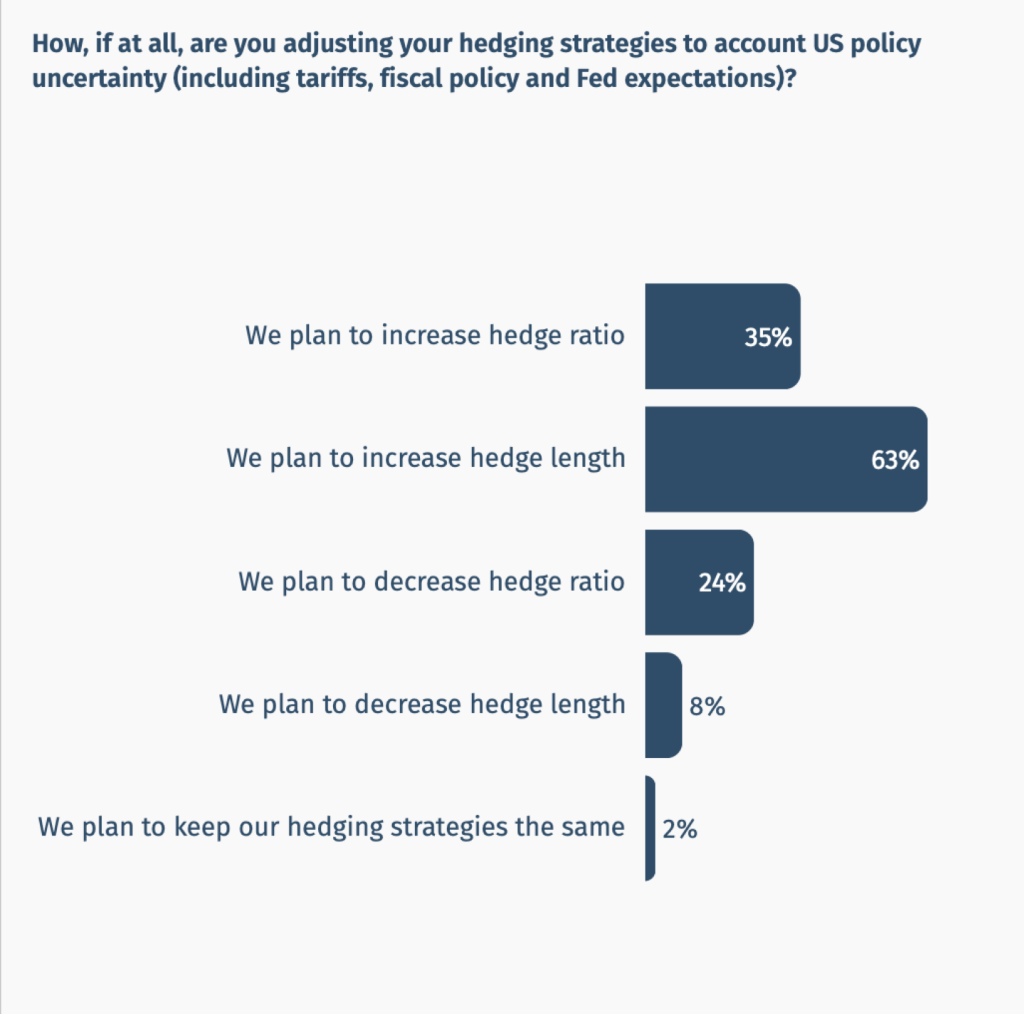
Funds are also changing how they hedge, increasing average hedge ratios from 45% in 2025 to 48% in 2026, and extending tenors from 4.97 to 5.44 months. Looking ahead, 63% plan to extend hedge lengths further in response to US policy uncertainty, while 35% plan to increase hedge ratios. At the same time, 8% would shorten hedge tenors and 24% would reduce hedge ratios, with the divergence on ratios potentially reflecting hedging cost pressures.
However, managers are broadly signalling that they want more of their exposure protected for longer, reducing their portfolio’s dependence on correctly calling how tariffs, central banks and geopolitics will impact currency movements.

Operational challenges expose the visibility gap
Operational pressures in FX are relatively evenly distributed among fund managers, with friction spread across several stages of the FX process. The top challenges cited by fund managers were comparative pricing (24%), forecasting existing currency risk (23%) and fragmented service provision (22%).
This points to a visibility problem, where fund managers are struggling to see if they are getting competitive execution, finding it difficult to build an accurate picture of the exposures they need to manage in the first place, and forced to navigate disconnected providers and systems.
This creates friction for managers. Weak forecasting can make it harder to size and time hedges accurately, limited comparative pricing can reduce transparency at the point of execution, while fragmented service provision can make governance more cumbersome across the trade lifecycle.

Digital and automation systems take the lead
Operating models are changing to support greater efficiency across the FX lifecycle. Funds are now primarily using in-house infrastructure to instruct FX transactions, with half using their own IT systems and 42% using an online user interface. Email and phone use, which stood at 60% and 53% in 2025, respectively, have fallen to 36% and 31%.
At the same time, all funds are now considering automating FX processes. Trade execution (44%) leads the list of automation priorities, followed by risk identification (42%) and full FX workflow automation (41%). This suggests a stronger focus on reducing manual intervention at the point of execution and making the overall FX process more responsive.
AI presents a more complicated picture. While all respondents are either using or considering AI, just 14% say they have adopted it, significantly down from 42% in 2025, and 16% are ‘aggressively looking’ at AI, from 35% the year before. However, half say they are actively exploring AI opportunities, up from 12% last year. This could reflect enthusiasm around AI cooling as fund managers evaluate how the technology can fit into controlled workflows.
This greater scrutiny is reflected in cyber and privacy concerns (31%) around scaling AI as funds evaluate how they can use it safely, while tackling software and bank integration (18%), governance risks (14%) and reliable data (10%).
Looking ahead, AI and automation in FX risk management will need to tackle the visibility gap directly, moving towards end-to-end workflows, reducing fragmented service provision and freeing up time spent doing manual tasks. The aim is to give managers a clearer view of their exposures, easier access to comparative pricing and stronger control across the full FX lifecycle.

A more resilient FX setup
The lesson from 2026 is that FX can no longer sit on the sidelines of investment strategy. Policy uncertainty may be delaying capital decisions, but currency risk does not wait.
FX has to become part of funds’ investment operating models, rather than a separate task. With higher hedging costs, forecasting difficulties and pricing challenges all weighing on managers, resilience will depend on whether the underlying infrastructure can absorb change without creating more operational friction.
This means building systems that support these processes, giving fund managers clear visibility of exposures, transparent pricing, disciplined execution and workflows that can adjust as investment decisions move. Automation is already a key priority for fund managers,, and AI will have a role where governance, integration and cyber controls allow.
The real test of resilience will be whether managers can maintain control of currency risk as market conditions change, with enough flexibility to respond when policy, rates and currency moves alter the investment outlook.