
As of October, 1976, Marvel Comics had primarily used their tabloid-sized “Treasury” format (which had premiered in the summer of 1974) as a vehicle for reprint material. Exceptions to date had included MGM’s Marvelous Wizard of Oz (1975), Marvel Treasury of Oz Featuring The Marvelous Land of Oz (1975), and Superman vs. the Amazing Spider-Man (1976), the first and last of which were co-productions with DC Comics; more recently, the past summer had seen the release of two new 10″ x 13.5” extravaganzas written as well as drawn by Jack Kirby: Marvel Treasury Special Featuring Captain America’s Bicentennial Battles and 2001: A Space Odyssey.
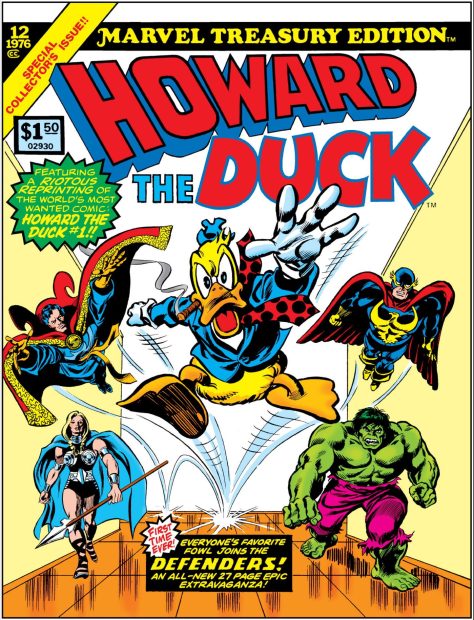
Marvel Treasury Edition #12 was something different. By and large, it was a reprint package, re-presenting the hard-to-find (and expensive) earliest appearances of Howard the Duck. But it was also fronted by a brand-new 27-page story featuring Howard teaming up with the Defenders… something which made it a must-buy for my nineteen-year-old self, despite my already owning all the “old” material in the original editions, not to mention my general overall distaste for comics that combined new and reprinted stories under the same cover (especially when the page count of the reprints significantly exceeded that of the new stuff, as was the case here).
Concerning that last point, however… if I’m going to be completely honest, I probably didn’t make too much of a fuss at the time about having to spend a buck-fifty for one new 27-page story. For one thing, that was still 10 pages more story than I’d find in your standard, regular-sized Marvel comic during this era. For another, I’d acquired enough of a collector’s mindset by then that I’d have figured that MTE #12 would surely be worth at least twice its cover price in no time at all (not that I had any intention of selling it any time soon, if ever, but still).
And finally, I was simply all in on Howard the Duck in the fall of 1976. I’m sure I would have picked up this book even if it hadn’t given me the chance to enjoy one last Defenders story by the trio of talents — writer Steve Gerber and artists Sal Buscema and Klaus Janson — who had, up until two months ago, been that superhero group’s regular creative team… but the fact that it did certainly made me even more enthusiastic about buying and reading it.
So, after taking a moment or two to enjoy the fun cover produced by regular HtD penciller Gene Colan and inker Tom Palmer (with the inevitable touch-ups by John Romita), let’s have a look inside,,,

I’m sharing this Table of Contents (which ran on the ad-free tabloid’s inside front cover) partly so you have a more specific idea of what the package included — but mostly because it’s the only place in the book which provides the creator credits for the story we’re about to peruse. And now you know.


At this point, you’d be forgiven for thinking that this group of wannabe supervillains is almost too lame even to work as a joke. But the next guy up will prove to be rather more dangerous…


Waaaugh, indeed. (For anyone who may not know, Celebrity magazine was a shameless [and short-lived] People knockoff that Marvel had launched in 1975.)

We fans who’d read Howard the Duck #7, released just a week before this, recognized the Parkside Plaza Hotel as the place where Howard and his companion, Beverly Switzler, had been staying while attending (OK, working at) the All-Night Party’s National Convention. But we were surprised to see Howard and Bev being tossed out on their keisters. How dare they treat the party’s brand-new Presidential candidate and his personal assistant in such a cavalier fashion?

Beverly tells Howard that the party’s bigwigs must have assumed that he was rich, and he agrees that’s plausible, asking rhetorically: “Or how could I afford to run, right?” She’s sure the ANP will get in touch once they learn what’s happened, but in the meantime, she and Howard need a place to stay in New York. Beverly has some friends from high school who have a house in Greenwich Village, and she figures they’ll put her and her companion up. “Swell,” Howard says as they board a subway train. “So all we gotta do is get there alive, right?”

Readers who’d been following this feature at least since Howard the Duck #1 would recall Peter Parker’s encounter with Howard and Beverly in that issue; and, of course, anyone who’d missed it the first time was about to get the chance to catch up via its reprinting later in this Treasury.


This gang of four had been the core Defenders lineup throughout the just-concluded Gerber-Buscema run on the book; still, it’s interesting that the latest additions to the non-team’s non-roster, the Red Guardian and Luke Cage, haven’t been included. Maybe our storytellers just wanted to keep things from getting too crowded.

Howard turns on his heel and makes for the exit, but almost immediately runs into an invisible wall. “Please forgive the mystic barrier I’ve erected, my friend,” Dr. Strange asks apologetically.


Dr. Strange confirms Howard’s deduction, then goes on to confide that what he really wants is his guest’s opinion “as a being who also has seen beyond this reality.” The Doc has noticed “an unusual degree of mystical activity” going on as of late, and wonders if Howard has as well. But the Duck is obliged to disappoint his host, confessing, “Closest I ever came to stirring up magic was an act I useta do at birthday parties. Everything else I just kinda got stirred into.”

Strange leads Howard into the darkened room where resides the Orb of Agamotto. He begins to describe how he intends to use the Orb to locate his guest’s other-dimensional homeworld, “and then, by the power of the eternal Vishanti…” But a suddenly apprehensive Howard cuts him off, indicating he’d just as soon the magician “skip the spooky details“…

“Stiga” is a Swedish brand name for products associated with table tennis and other racquet games; Nighthawk’s use of the word as a noun here would appear to refer to a robot ball-launcher that the company may have marketed in the U.S. in the 1970s, but, best as I can tell, only sells overseas nowadays.


A seasoned Marvel Comics reader might well take issue with how Dr. Strange’s abilities are portrayed in this story, asking such questions as: Should he be able to project his astral form after his physical form has been knocked unconscious? And even if he can, how is it possible for him to physically manifest a costume — complete with a (presumably fully operational) Cloak of Levitation — for Howard out of thin air, especially in such a state? But while Steve Gerber might justifiably be dinged for having Dr. Strange’s power levels vary wildly over the course of his Defenders run (mostly for narrative convenience, or so at least it often seemed), I’m inclined to give him a break here. After all, this is a Howard the Duck story first and foremost, and it’s reasonable to expect the “rules” of the Marvel Universe to be a bit more elastic in Howard’s vicinity. Or so thinks your humble blogger, at any rate.


Why Shea Stadium? Well, why not?

Tillie’s supposedly “feminist” shtick is reminiscent of the modus operandi/backstories of a couple of other Marvel characters, Thundra and Red Sonja; the joke in her case seems to be that she’s not conventionally attractive, so who’d ever want to win her for a bride? (No, this bit has not aged well.)


Kyle “Nighthawk” Richmond is, of course, correct. In the Steve Gerber era, the Defenders had indeed become the Marvel team that somehow attracted “weird villains” — maybe not quite as weird as such earlier foes of Howard as the Hellcow, the Space Turnip, or Winky-Man — but close enough that the melding of the two series’ milieus isn’t nearly as jarring as having Howard drop in on the Fantastic Four or Avengers would be.
Meanwhile, back at Dr. Strange’s Sanctum Sanctorum, Howard is successsfully fighting back against Dr. Angst. After freeing himself from his opponent’s needle-and-thread trap, our hero deflects an onslaught of six-ply radial tires via that old standby, the Shield of the Seraphim…

For anyone out there who might still have been thinking that Howard’s Doc Strange duds were simply illusory, this last sequence seals the deal — this duplicate Cloak of Levitation is every bit as potent as the OG one Doc got as a gift from the Ancient One way back in Strange Tales #127 (Dec., 1964). Which might again raise the question of how such a thing could possibly work; though, as we noted before, it’s probably better just to roll with the anarchic absurdity of the whole enterprise than to sweat such details.


Following Howard and Bev’s brief break-up and almost instantaneous reunion in Howard the Duck #6, the idea that he’d up and leave her to return to his native dimension just a couple of episodes later was clearly a non-starter. Still, despite the understated manner in which the moment is played, it’s clearly a major step for the couple’s relationship that he’s blowing off the opportunity to go home for the sake of remaining with her.
Left unanswered at the end of this episode, of course, is the very pertinent question of who hired Dr. Angst to kill Howard in the first place, as well as its natural follow-up: when and how will they try again? (That they will try again obviously goes without saying.) But those answers will have to wait a few weeks, until the release of the 8th issue of the regular monthly Howard the Duck title; for now, at least, our tale is done.
Half a century after its original publication, “The Duck and the Defenders” may not rate as one of the greatest ever stories for either its star or its guest-stars — but it’s still pretty darn amusing, in your humble blogger’s opinion, serving as a diverting detour for the Duck on his road to the White House as well as a fine coda to the Gerber-Buscema Defenders run. Speaking in regards to the latter, Dr. Angst’s “Band of the Bland” (as they’d be retroactively christened when Gerber brought them back in Sensational She-Hulk some fourteen years later) seem like clear forerunners of Mr. Nobody’s Brotherhood of Dada, the supervillain group created by Grant Morrison for that writer’s monumental Doom Patrol run of the early 1980s; as such, their misadventures here offer us a brief glimpse of what Gerber’s Defenders might have eventually evolved into, given enough time… and, perhaps, a more receptive marketplace. But, if nothing else, the non-team would at least be entering the post-Gerber era with their proud non-ranks swelled by at least one new non-member. (As the star of his own feature, Howard definitely counts. Beverly might too — except that if we include her, we might also have to fold in Jack Norriss, and I’d honestly rather not go there.)
The reprinted content that takes up over half of Marvel Treasury Edition #12’s page-count includes Howard the Duck’s first two solo headlining adventures, which ran as backups in Giant-Size Man-Thing #4 and #5, respectively, as well as Howard the Duck #1, all of which were written by Steve Gerber and pencilled by Frank Brunner. But it also includes Howard’s debut appearances as a minor supporting character to 
 Marvel’s premiere muck-monster in Fear #19 and Man-Thing #1, as written by Gerber and pencilled by Val Mayerik — or, rather, it includes the few relevant pages from each of those books that actually feature Howard. Given that our web-footed future super-star literally walks into the story on the fifteenth page of the first comic (see left) and then just as literally falls out of it on the ninth page of the second (see right), these scenes don’t make much sense without some framing material. So that’s what MTE #12 provides, mostly in the form of text… though the whole thing is prefaced by an all-new splash page by Gerber and Mayerik:

I can still recall how startled I was by this page when I first saw it in October, 1976, simply because of how different — and, for my money, better — Howard looked in this piece, which was inked as well as pencilled by Mayerik, as compared to Mayerik’s earlier renditions, which were inked by Sal Trapani. It was then (and remains) a reminder of how much difference an inker can make when it comes to comics art… as well as a taste of what a Mayerik-drawn Howard the Duck might look like. (We’d get a even better idea next summer, when the artist would illustrate Howard’s first Annual, followed half-a-year later by the title’s two-part “Star Wars” parody — but we’ll save further discussion of those for another time.)
In wrapping this up, we should note for the record that the 84-page (counting covers) Marvel Treasury Edition #12 also included such bonus features as an early, unused version of the cover to the yet-unreleased Howard the Duck #8, as well as several illustrated text pieces written by Gerber, mostly in regards to the HtD Presidential Campaign. The whole package was topped off by another all-new piece of artwork that graced the tabloid’s back cover…

…OK, an almost all-new piece of artwork. That circular “Get Down, America!” portrait of Howard was of course lifted directly from Bernie Wrightson’s campaign button design, and dropped into Gene Colan and Tom Palmer’s illustration. Still, I doubt anyone complained. (I know I didn’t.)