

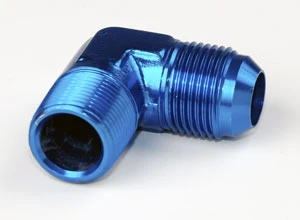

Airplanes rely on a complex network of pipes to carry various substances. Some of them transport fuel or hydraulic fluid, whereas others transport air. Pipes are used to carry these substances from one place to another. Like with most pipe networks, however, fittings are required. Elbow fittings are particularly important because they allow for turned paths.
What Are Elbow Fittings?
Elbow fittings are curved pipe fittings. They are known as elbow fittings because they are shaped like a human elbow. Elbow fittings consist of a threaded tube that bends at an angle in the middle — similar to how a human elbow bends.
Most elbow fittings feature two openings. Rather than following a straight path, they turn in the middle. One opening turns at an angle in the middle before transitioning into the other opening.
Common Types of Elbow Fittings
Elbow fittings are often categorized according to the angle at which they turn. There are 90-degree elbow fittings, for instance, that turn at a right angle or 90-degree angle. There are also 45-degree elbow fittings that turn at a 45-degree angle. There are even 180-degree elbow fittings that feature a U-like shape, allowing them to completely reverse direction.
How Elbow Fittings Work
Elbow fittings work by providing a guided conduit for substances like fuel, hydraulic fluid and air. They can have internal threads, external threads or a combination of both thread types. Regardless, they all have a hollow interior through which substances can flow.
The defining feature of elbow fittings, of course, is their angled design. They aren’t completely straight. Instead, they turn at an angle, such as a 45-degree, 90-degree or 180-degree angle.
One side of an elbow fitting acts as an inlet, whereas the other side acts as an outlet. Fuel, fluid or air will enter the fitting through the inlet side. Upon reaching the bend in the fitting, the substance will change direction based on the angle of the bend. It will then exit the fitting through the outlet side.
Elbow Fittings vs Bending Pipes
Elbow fittings offer a safer and more reliable solution to simply bending pipes. If a pipe is bent with a very small radius, it may restrict the flow of substances. The pipe’s internal passage will become too narrow, which can create a pressure buildup.
Bending can also weaken pipes. The newly formed bends will create weak points. If exposed to stress, these weak points may fail, resulting in leaks. Elbow fittings prevent problems such as these by allowing for a safe and effective directional change without bending pipes.