
Taking Equity In An Acquiring Aggregator: Weighing The Growth Opportunities Against Valuation And Illiquidity Risks

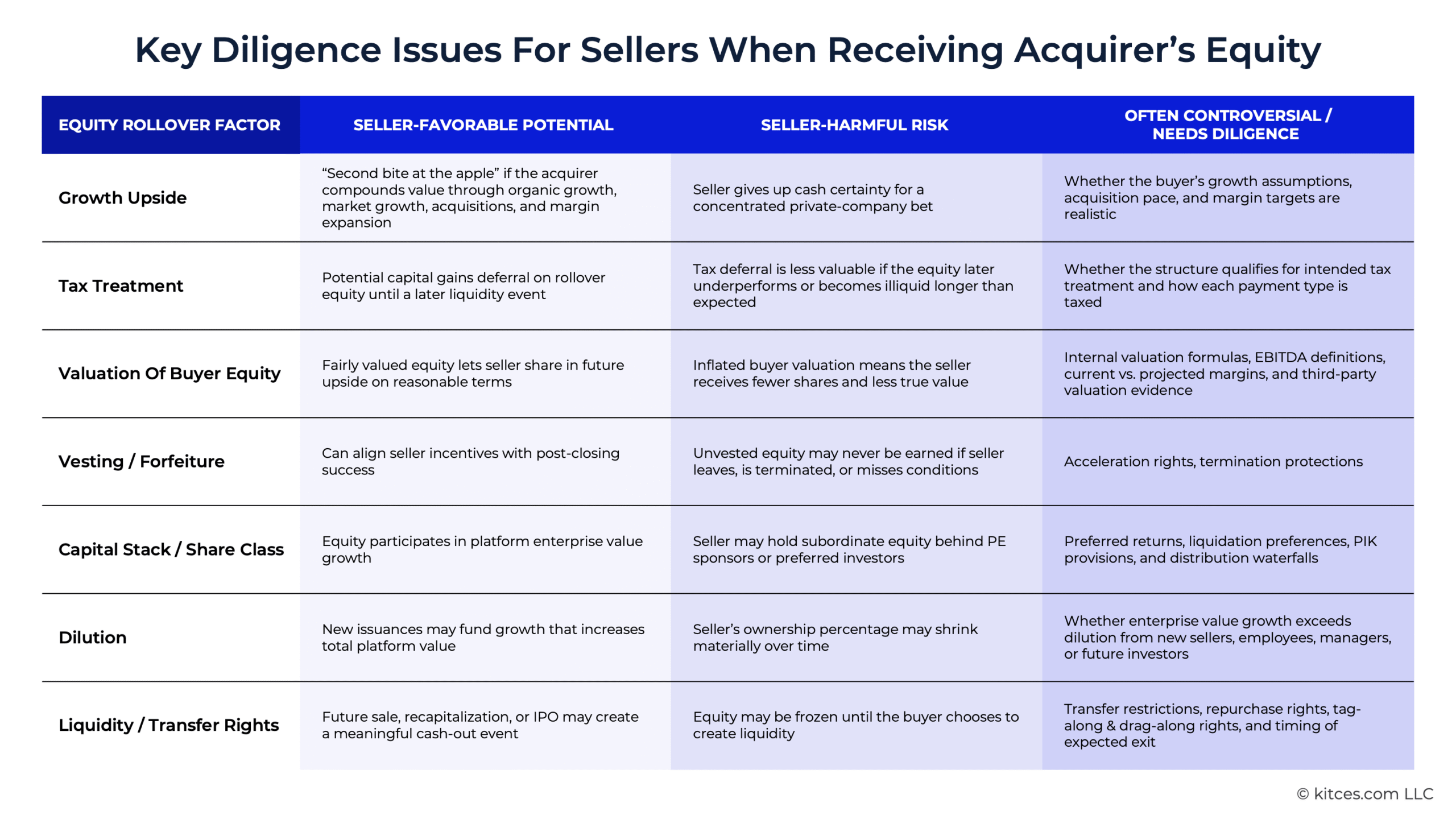
Although many advisors looking to sell their practices are ready to retire and cash in on the enterprise value they’ve spent their careers building, an increasing number of advisors are selling and staying, choosing to sell either because they believe they can grow faster by joining a larger firm with more capabilities or services, or simply because they want to offload many of the operational or compliance headaches that have taken up so much of their time when operating on their own. And in some cases, the seller is simply so upbeat on the potential of the buyer’s continued growth that even though they plan to exit themselves, they want to roll over a portion of their equity into an acquirer for a period of years to have the potential for a second liquidity event (the proverbial “second bite at the apple”), ideally at the acquirer’s higher valuation multiple. Taking equity can also be beneficial for advisors looking to defer a portion of the capital gains taxes associated with the sale of their practice (until the acquirer ultimately exits). Yet the reality is that trading an advisor’s own equity for potentially illiquid and opaque equity in the acquirer’s business presents a unique set of challenges that advisors must carefully weigh, as they can have significant economic consequences for the seller if not everything works out exactly as projected upfront.
In this guest post, Rich Chen, founder of Brightstar Law Group, explores how advisor sellers receiving equity in the acquirer’s firm has become increasingly common, often 25%–40% of the seller’s exit valuation and sometimes as much as 75%, and what advisors should watch out for to ensure they are getting “fair value” and the bundle of rights they are expecting for the cash they’re giving up!
The rising popularity of taking equity in an acquirer’s business appears to be driven in large part by the rapid growth of serial acquirers, aggregators, and other industry “roll-up” models, whose growth rates are often far in excess of what the advisor themselves could otherwise invest in. In other words, why sell the firm and reinvest the proceeds into a balanced portfolio of publicly traded securities that might grow at 8% in the long run, when the advisor can roll equity into an acquirer that will also grow with the market (as its AUM fees grow with rising client portfolios) and its organic and subsequent acquisition growth… potentially driving 15%–25%+ growth returns. In what is admittedly a “risky” small business, but one that the advisor-as-seller who ran their own business for decades may be quite comfortable with. Many buyers, in turn, want advisors (especially those who will continue with the firm post-closing) to take equity in the buyer’s firm as part of the acquisition, because doing so preserves cash and provides more leverage to fund future acquisitions, while also aligning the interests of the selling advisor with the buyer.
The caveat is that while buyers may scrutinize a seller’s firm to determine a value, sellers are often much more limited in assessing the buyer’s business to understand whether the shares they’re receiving are appropriately valued. Firms often use their own internal valuation formulas, that may truly represent a fair market value, or simply a multiple that the firm hopes to achieve in the future, with the risk borne by the seller if that growth, margin improvement, or other goals don’t materialize. Sellers can at least partially protect themselves by asking for more disclosures about the buyer’s valuation methodology, and a representation of the buyer’s most recent external valuation or comparables (and then monitor financials ongoing by requesting information rights), but the seller’s ability to negotiate is often still limited. And even a robust valuation can be undermined by dilution from subsequent acquisitions, management grants, or new capital raises between closing and exit.
In addition, it’s important to recognize that not all equity received is necessarily even saleable. In some cases, equity received from the acquirer while the seller remains working at the buyer’s firm will still have vesting contingencies (that might not be earned, and the buyer might even still have the right to terminate the advisor and end their vesting period). Even if vested, the shares are typically not liquid, not simply because it’s hard to find a buyer for a small minority stake, but also due to the fact that operating agreements often have outright restrictions on transfers, and/or include repurchase rights that themselves might not be the most favorable terms for the seller to be compelled to sell back. And private equity sponsors and other preferred investors often sit ahead of the seller’s equity class in a distribution waterfall, so the proceeds ultimately available to the seller’s shares may be materially less than the headline ownership percentage implies.
Ultimately, the key point is to understand that taking equity in an acquirer’s firm entails a whole separate level of risks and opportunities, beyond ‘just’ the effort of selling the advisory firm itself for a desirable valuation and with appealing payment terms. And while some provisions may be negotiated (if only by adjusting the valuation the seller receives for the buyer’s equity shares), often complex businesses with a wide shareholder base cannot change terms for any one incoming partner… which means sellers must be especially proactive in due diligence to protect themselves and be clear about whether the acquirer’s equity is really a good opportunity.