contrasting ways of creating trust in the pharmaceutical markets of north India – Somatosphere

In many parts of the world, there is an increasing discomfort with middlemen in the healthcare industry (Pearl, 2024). They are characterized as greedy, profit seekers and vilified characters that put money before health and proliferate the markets with fake medicines, putting public health in danger (Kaprove R and M.D 2014, Rowland D 2021, Edema 2025, Patel 2026). Their reputation is laden with an immoral stance, that they profit even at times of dire need such as Covid-19 (Shikha 2024) and that they are responsible for distorting the markets (Dayen 2020). This is primarily because global health imperatives are looked at through a narrow lens by scholars and policy makers, considering mainly the scopes of disbursement, regulation and implementation while missing the various commercial contexts in which they operate (Mosse and Lewis 2006, Bierschenk et al 2002, Knodel 2021, Salter et al 2022).
For example, take this article about how middlemen in the Indian healthcare system are considered dangerous (Singh 2025), in which the author writes, ‘For them (middlemen), medicines, diagnostics, treatment and supplies are not matters of human need but tools for generating profit, with patients reduced to instruments in a larger commercial grid…’ The larger problem with such claims is that there is an inherent discomfort in bringing money and health together because economic value and ethical value are incommensurable (Lambek 2008). In practice, however, any service or commodity pertaining to health, such as sales of pharmaceuticals or seeing a private doctor, is treated commercially, just as any other commodity. Yet in the dominant discourse about healthcare commodities and services, these commodities are held to be the preserve of specialists – doctors and pharmacists – whose moral credentials are presumed to guarantee their proper handling (Peterson 2014). This disjunction between how healthcare should not be commercial and what actually happens in practice hides a range of commercial actors and their everyday activities in hospitals, ports, consultancy offices, clinics, pharmaceuticals’ wholesale and retail marketplaces. Anthropological enquiry into these interstitial spaces, networks and middlemen allows us to understand how the delivery of health care actually happens on the ground with middlemen assuming many roles in the market (Perkins 2024, Barnreuther 2020, Bjorkman 2021). In this paper, I look at the role of middlemen in the pharmaceuticals’ industry of north India. Amidst global fears of fake pharmaceuticals from India, I examine how middlemen create trust with consumers and simultaneously stoke suspicions towards one another. I look at two kinds of middlemen – those operating online and offline – as both have considerable presence in the markets. This paper shows how middlemen simultaneously engage in trust-making as well as trust-breaking practices, whichever suits them in order to sustain themselves in the markets.
Background
The conceptual backdrop and empirical material of this paper comes from my research on Indian pharmaceuticals’ markets from May 2020 to December 2023. I was a research fellow on the project: ‘What’s at stake in the fake: Indian pharmaceuticals, African markets and global health’, that challenges commonplace assumptions about fake drugs as a major threat to public health, and draws on ethnography to ask what claims about fake pharmaceuticals actually do. In this project, by attending closely to questions of practice, I looked at how drugs’ authenticity or fakeness is created in global market nodes and marketplaces. In other words, I locate pharmaceuticals’ circulation as authentic or fake as social, rather than pharmacological, facts. For example, the term –‘substandard’, mainly understood in terms of pharmacological quality in scholarly discussions or public health institutions such as the WHO, had a completely different meaning in the markets. It was often received as ‘sublegal’ by my interlocutors and they argued that it is the quality of the dossier accompanying the approvals for the pharmaceuticals/manufacturing plant by the national drug regulatory authorities that decided whether it was ‘substandard’ or not (Thakur 2023). This observation from the field is pertinent, given the fact that Indian pharmaceuticals’ quality is often questioned globally by public health scholars, policy makers and leading public health agencies, a claim that recent work questions (Hodges and Garnett 2020, Hodges 2019, Hodges and Hornberger 2023). Fakes and middlemen featured together especially because wholesalers, drug regulators, retailers highlighted that it is through brokerage and middlemen that fakes proliferate in the markets.
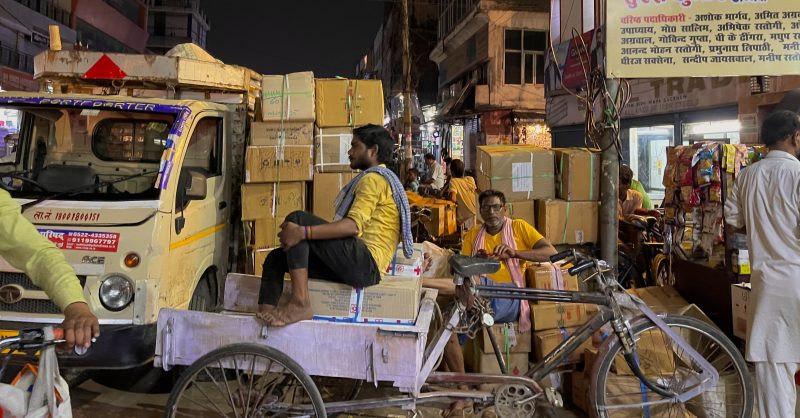
During my ethnographic research, I encountered many middlemen. They were spread out globally (in Africa, USA, China) as channel partners handling multiple pharmaceutical companies; they were carrying and forwarding (C&F) agents handling a state’s logistics of pharmaceuticals for some or many companies; they were wholesalers in markets of Lucknow or they were ‘hawkers’ who bought medicines for smaller villages in or around Lucknow districts for a surcharge of two percent of sales; or they were online app owners who delivered medicines from local storage spaces to individual houses’ doorsteps, especially during Covid-19. In this piece I focus on the pharmaceutical industry of north India and present the accounts of online and offline middlemen and customers, primarily in Lucknow, the capital city of Uttar Pradesh. The city serves as a hub for healthcare services and commodities for other neighboring states. It also hosts a large logistics hub named ‘Transport Nagar’ (Transport city) for the distribution of pharmaceuticals and vaccines to and from Lucknow across the country.
India’s healthcare industry is one of the largest sectors in the country and was projected to reach USD 638 billion in 2025, while the e-health market was estimated to reach USD 10.6 billion in the same year.[1] Privatization and commercialization of health markets are considered the main reasons for the proliferation of middlemen in India (Pitchforth, Bisht and Murray 2012, Hunter 2018). In India’s healthcare industry, there are multiple scales of middlemen that make possible the delivery of everyday health. However, middlemen are not just brokers who make rules and regulations legible as negotiators and translators so that ‘universal outcomes’ are produced at local levels (Mosse and Lewis 2006, Bierschenk et al 2002, Knodel 2021, Hunter 2018). Their work goes beyond bridging institutional gaps, making legible regulatory differences or even monetizing information gaps in the markets.
Shops cannot fly – accountable middlemen
Suketu has had a warehouse for pharmaceuticals’ wholesale for twenty-five years in Lucknow’s medicine market in Aminabad. Like several other wholesalers in this market, Suketu was an apprentice at one of the shops in this market earning very little. But with experience he opened his own shop. This market emerged in the late 1990s when the neighboring city, Kanpur, was no longer the sole logistical hub for pharmaceuticals and medical devices. The warehouses are small and compact, with an office for the president of Chemists’ Association of Lucknow, and most of the people in the market know each other. Retailers and customers often buy in bulk. Suketu is aware of the global fears concerning fakes and middlemen. He shared with me how multinational pharmaceutical companies are trying to introduce blockchain technology and minimize the number of people handling pharmaceuticals so that they are not tampered with, and that packaging will have QR codes to reassure customers. Suketu counters global fears surrounding Indian pharmaceuticals with his local market expertise and his understanding of what customers want from middlemen. He says,
‘People are not concerned whether there are middlemen[2] involved in delivery of pharmaceuticals. They are concerned if middlemen know which medicines are required and they are assured of the quality because we have shops here and we will not run away in a night. We are here to stay.’
As I nudged him more to explain this, he said,
‘We are not just wholesalers or retailers, we are also in a way doctors because we know so much- not just about the trade and ailments, but our clients- should we give a ‘hard dava’ (more potent medicine) to someone because this person also has to take care of an ailing mother-in-law or should we give vitamins because this person does not care enough about his food – we decide all of that. More so in the retail outlets if not here. But some people think that middlemen make money and that’s all they do.’
Suketu’s understanding of clients and what they might require draws on the age-old role of middlemen who bridge gaps through situated knowledge. We can see this in Sidney Mintz’s account of the ‘higgler’ (1956), who takes into account how someone who produces avocados would not be able to sell them directly and understands their perishability. This knowledge comes from working in the markets, and yet it is usually brushed off as insufficiently important to be renumerated. This knowledge also needs to be acted upon swiftly and with discretion in ever-changing contexts (Geertz 1979). Suketu, for instance, knows which client is busy enough to forget what medicines they might require. He also knows which retailer in which part of Lucknow will buy what kind of medicines in bulk, such as protein powders, for example, in areas with lots of gyms.
When Suketu shared with me that he has a shop, he was trying to establish that one of the roles of middlemen entails being available for accountability, that when people are dissatisfied with the product (due to side effects, efficacy concerns, or expiration issues), they have a physical space to return to and complain. He adds that, ‘it is not just about how fast I am able to get this medicine, or how I can trace the journey of the medicine to my shop…’. Quet (2017) argues that within the framework of logistics, changes are not about the physical properties of pharmaceuticals. Perceptions about their value shift each time they move from one point to another. Therefore, what Suketu performs, are everyday acts of creating trust in the pharmaceuticals that he sells. His work entails cultivating trust amongst customers by showing that he can be held accountable when something does not work out. This is an accountability made tangible by his consistent physical presence in the markets.
When Suketu shares that creating trust amongst customers is not about tracing the journey of the medicine, but rather his physical presence, he is also taking a jibe at those who create trust using online platforms. He fuels accusations against his competitors by saying,
‘…even if people buy medicines online, they come to us saying, that time you gave me this medicine, I took it but is not working, you gave us fake medicines!’
Suketu adds, ‘…then when I look closely, I realize it is from an online website and not from us. These online people will spoil our dhandha (business)also.’
For Suketu, middlemen like himself are not the problem. Rather, the problem are online middlemen whom people cannot see, who have no physical shop and are thereby not accountable to anyone. These are the middlemen who are spoiling the business and maligning the reputation of middlemen overall. His emphasis is on people rather than the commodity: clients should be able to know more about where and from whom they are buying their medicines, rather than simply which medicines they are buying.
Money-saving online medicines
India’s e-health market was projected to reach USD 10.6 billion in 2025. And it is further on the rise, particularly after Covid-19, during which e-commerce platforms were available to assist quarantined people. My fieldwork showed that many people now access medicines through e-platforms in India. Multiple platforms sell prescription drugs wherein the customers have to first consult a doctor provided to them by these apps via tele-medicine (free of cost) and then obtain a prescription from them. Alternatively, customers can also upload a valid prescription online onto the app, which is then validated by the online doctor or pharmacist.
Manju works as a household helper in central Lucknow and often prefers online pharmacies for buying products such as infant milk powder for her six-month-old. However, she rushes to a local clinic in case there is any emergency. She shares with me,
‘If I buy milk powder from online pharmacies, they are much cheaper and easier. Sometimes I also speak with someone on the phone who handles these pharmacies and they help me decide which milk powder will be better for the baby if she’s colicky and vomits.’
But she also fears that she might get something harmful for her child from these websites. I ask her if she has had any bad experiences. She denies it but adds,
‘I have not faced any issues with multivitamins, milk powders etc so far. However, when I go to the doctor at the local clinic, she asks me, did you give her this medicine? If yes, where did you buy them from? And always scares me that medicines sold by online vendors are not that great and even by local chemists. I must always consult her in case I want to give something to the baby.’
What Manju shares is certainly a concern about buying from middlemen, whether online or offline. But she has built trust over time through experience. She tells me in a rather low voice,
‘…it is not that I don’t understand what everyone wants to convey. When doctors prescribe medicines, they give me red, yellow, blue pills without sharing what are their names and brands. It is just so that I don’t find out and buy them cheaper online.’
Prabodh, a sales manager of a major online pharmacy, shared that online pharmaceutical websites function as intermediary platforms, charging their own fees and cutting the costs of retailing. Without my bringing up the common concerns about fakes on online pharmaceutical websites, he brought up the aspect of authenticity through commodity tracking. He argues that while people are not visible and shops are not physically traceable, people can trace products on online websites. In his view, this is more important than being able to trace people. He said,
‘Here people get more authentic, more branded stuff than any other local shop. If you come to me bringing any batch of medicine, I can immediately find the details about the distribution chain and find out where exactly the glitch or the mix up happens. We have a full tax support team which includes a doctor, a pharmacist and several other members who are at the beck and call of consumers 24/7 so you can be assured that your health matters to us. And guess what, it is so much cheaper than your local pharmacy guy. That’s why people are switching to online pharmacies. Because they want to know where fake medicines come from (if at all) because only we can track it, we have the purchase bill and the sales bill. Local pharmacies cannot provide that because there are so many people involved in the chain. And most of the people do not even know everyone so there are higher chances of fakes in circulation.’
For Prabodh and several others who run small (in sales volume) apps and platforms in the city for delivery of online sales, their biggest asset is product traceability. And they too survive in the market by arguing that their counterparts – middlemen locally based in Aminabad – are the ones who sell fakes; who do all the milavat (adulteration). In practice, people’s consumption is based on what is convenient for them, just as Manju’s case shows. For example, Shivansh’s father suffers from diabetes and must take medicines daily, so Shivansh buys them regularly in bulk online. This saves him a lot of money. He says that sometimes ‘they have such heavy discounts that I buy a lot of medicines for my father.’ But whenever anyone in his family has a cold or fever, they rush to the nearby pharmacist or clinic and request antibiotics since they have to work seven days a week and missing a day means losing day’s pay. I spoke with several consumers about their pharmaceutical buying practices and found that people rarely ordered medicines that were required ‘immediately’. Given that online delivery takes at least twenty-four hours even in urban areas and since online platforms do not have face to face consultations or prescriptions, most of the customers do not opt for that.
Conclusion
What I have shown through middlemen like Suketu and Prabodh is their constant declaration of superiority and trustworthiness – of not selling fakes – while they cast doubt on others, whether online or offline, as awash with fakes. These declarations are partly driven by the need to establish their own importance in the markets, especially since fakes, greed, and middlemen are constantly associated with each other globally, and partly by the desire to malign their competitor while capturing most of the market.
For middlemen, being able to deliver medicines to people in the remotest locations and in times of dire need also means that they can associate themselves with the virtues of global health (Hodges, Hornberger and Thakur 2026, this issue). Suketu’s friend Naresh, who is also a wholesaler in the Lucknow’s pharmaceutical markets, announced one day, ‘This medicine market will crumble if we middlemen do not work’. Yet, behind Naresh’s confidence, many of my interlocutors detect greed. They sense that people like Naresh are ethically in the wrong since they thrive on the ill-health of people, and on their vulnerabilities especially when they are ready to pay whatever price is required for their health. And yet, none of these same interlocutors believes that people like Naresh should be, or even could be, removed from the markets.
Middlemen present this paradox: they are indispensable outsiders (Bjorkman 2021) who are at the same time actually forming the insides of the markets. Sometimes they build people’s trust in them in an atmosphere that constantly associates them with fakes and danger, while sometimes they stoke fears about other middlemen. By looking at how middlemen make possible the delivery of pharmaceuticals’ in and around Lucknow, I have shown that moving beyond the moralistic stance whether middlemen are good or bad, whether they should be removed or that they are profiting on ill-health of people, yields us a much richer and nuanced understanding of their everyday work in the markets.
[2] In many of these markets, middlemen were not happy when anybody (including me) used the Hindi term for middleman such as bichauliya or dalaal. Those terms are considered pejorative and undignified according to them. However, many of them did not have issues with using the term in English- middleman.
References
Bandora, Rhoda Mkazi. 2026. “The ‘Suitcase Trader’: The Middlemen in the Cosmetics Market of Dar es Salaam, Tanzania, forthcoming, this issue.
Bierschenk T, Chauveau JP, Olivier de Sardan JP . 2002. Local development brokers in Africa. The rise of a new social category. Working Papers of the Department of Anthropology and African Studies, No. 13. Mainz: Johannes Gutenberg University. Available at: https://openscience.ub.uni-mainz.de/server/api/core/bitstreams/afb9e912-4ea9-4b92-93d4-31c52d386a55/content.
Björkman, Lisa, ed. 2021. Bombay brokers. Duke University Press.
Dayen, David. 2020. “Behind the Coronavirus Threat, A Middleman Destroying Prescription Drug Markets”. The American Prospect. https://prospect.org/2020/02/25/behind-the-coronavirus-threat-a-middleman-destroying-prescription-drug-markets/
Desai, Chetna. 2016. “Online Pharmacies: A Boon or Bane?” Indian Journal of Pharmacology 48 (6): 615–16. https://doi.org/10.4103/0253-7613.194865
Edema, Grace. 2025. “Enforce distribution guideline to tackle fake medicines, pharmaceutical group urges government”. PUNCH. https://punchng.com/enforce-distribution-guideline-to-tackle-fake-medicines-pharmaceutical-group-urges-govt/
Geertz, Clifford. (1979) 2023. Sūq: Geertz on the Market. Chicago: Hau Books.
Hodges, Sarah. 2019. “The case of the ‘Spurious Drugs Kingpin’: Shifting pills in Chennai, India.” Critical Public Health 29 (4): 473–83. https://doi.org/10.1080/09581596.2019.1593948
Hodges Sarah and Emma Garnett. 2020. “The Ghost in the Data: Evidence Gaps and the Problem of Fake Drugs in Global Health Research.” Global Public Health. 1103–18.
Hodges, Sarah, and Julia Hornberger. 2023. “The long shadow of fake drugs and the social lives of fake-ness.” Medicine Anthropology Theory 10 (3). https://doi.org/10.17157/mat.10.3.9065
Hodges, Sarah, Julia Hornberger and Nishpriha Thakur. 2026. “Middlemen, fakes and global health: Opening provocations”. Forthcoming this issue.
Hunter, B. M. (2018). Brokerage in commercialised healthcare systems: A conceptual framework and empirical evidence from Uttar Pradesh. Social Science and Medicine, 202. https://doi.org/10.1016/j.socscimed.2018.03.004.
Kaprove, R., & MD. (2014, Nov 30). Insurers’ limited networks distort the marketplace. BuffaloNews.
Knodel, Kathrin. 2021. “NGO Brokers between Local Needs and Global Norms: Trajectories of Development Actors in Burkina Faso.” Cultural Dynamics 33 (4): 298–315. https://doi.org/10.1177/09213740211029683.
Mintz, Sidney. 1956. “The role of the middleman in the internal distribution system of a Caribbean peasant economy.” Human Organization 15 (2): 18–23. https://doi.org/10.17730/humo.15.2.x5k4022515r6068u
Mosse D, Lewis D. 2006. Theoretical approaches to brokerage and translation in development. In: Lewis D, Mosse D (eds) Development Brokers and Translators. The Ethnography of Aid and Agencies. Bloomfield, CT: Kumarian Press, pp.1–26.
Patel, Parthika. 2026. “Delhi Tramadol Premix Interception Leads Police to Illegal Drug Unit in Bihar”. Medical Dialogues. https://medicaldialogues.in/news/industry/pharma/delhi-tramadol-premix-interception-leads-police-to-illegal-drug-unit-in-bihar-166240
Perkins, J.E. (2024), ‘Beware of dalals’: a moral world of health market brokerage in Bangladesh. J R Anthropol Inst, 30: 589-607. https://doi.org/10.1111/1467-9655.14101
Pitchforth, Emma, Ramila Bisht, and Susan Murray. 2012. “Understanding India, Globalisation and Health Care Systems: A Mapping of Research in the Social Sciences.” Globalization and Health 8 (1): 1–15. https://doi.org/10.1186/1744-8603-8-32.
Quet, Mathieu. 2017. ‘Values in Motion: Anti-Counterfeiting Measures and the Securitization of Pharmaceutical Flows’. Journal of Cultural Economy 10(2):150–62. https://doi.org/10.1080/17530350.2016.1258001
Pearl, Robert. 2024. ‘The costly failures of medicine’s middlemen’. Forbes. https://www.forbes.com/sites/robertpearl/2024/10/28/the-costly-failures-of-medicines-middlemen/
Rowland, D. (2021, Jun 07). Pharmacy to eliminate drug middlemen PBMs. News Journal Retrieved from https://www.proquest.com/newspapers/pharmacy-eliminate-drug-middlemen-pbms/docview/2537387129/se-2
Salter, Brian, Yiming Dong, and Benjamin M. Hunter. 2022. “Constructing Healthcare Services Markets: Networks, Brokers and the China-England Engagement.” Globalization and Health 18 (1). https://doi.org/10.1186/s12992-022-00892-8.
Shikha, Swati. 2024. “How Marketing of Untested, Overpriced Treatments of Covid-19 Shows Lack of Oversight”. Outlook India. https://www.outlookindia.com/national/essaying-the-substantial-failure-of-the-indian-pharmaceutical-industry-and-the-indian-government–news-261683
Singh, Aashish. 2025. “The Rising Threat of Middlemen in India’s Health System”. COUNTERCURRENTS.ORG. https://countercurrents.org/2025/12/the-rising-threat-of-middlemen-in-indias-health-system/
Thakur, Nishpriha. 2023. “Sub-standard or sub-legal? Distribution, pharma dossiers, and fake-talk in India.” Medicine Anthropology Theory 10 (3). https://doi.org/10.17157/mat.10.3.7279
TPPF releases healthcare agenda for the 90th legislative session. (2026, Feb 12). Targeted News Service Retrieved from https://www.proquest.com/wire-feeds/tppf-releases-healthcare-agenda-90th-legislative/docview/3303236496/se-2