
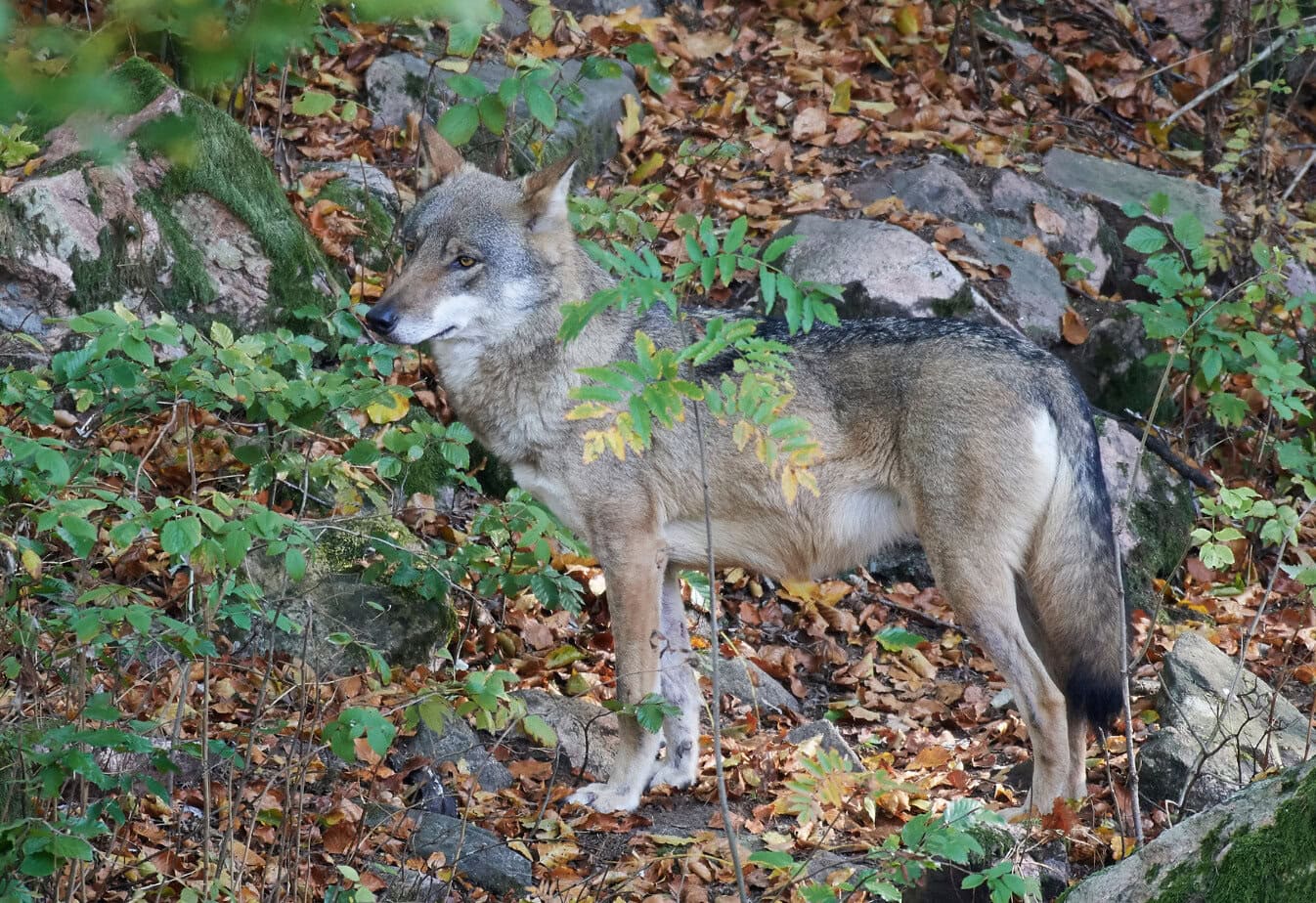
A young wolf was shot dead by Danish authorities after repeatedly coming close to people. Hours later, his body was placed on the grass during a press conference with Denmark’s Minister for Nature and Animal Welfare.
The wolf was killed on 13 August near Nørre Nebel in western Jutland. Authorities had classified him as a “problem wolf” after several incidents in which a wolf came into private gardens and approached people without showing the usual fear of humans.
The Danish Nature Agency searched for the animal for several days. Thermal drones were used to help locate him.
An employee of the agency eventually shot a young male wolf with a rifle from a distance of around 10 metres. Authorities believe he was the wolf responsible for the incidents, although identifying individual wild wolves can be difficult.
Dead wolf displayed in front of cameras
The following day, Minister for Nature and Animal Welfare Christian Rabjerg Madsen held a press conference about the operation.
The dead wolf was laid on the grass beside the press conference as journalists and photographers gathered around.
Madsen said he was “very pleased” that the wolf had been killed and argued that wolves that show problematic behaviour and lose their fear of humans must be removed.
But images of the minister standing near the bloody body caused criticism online and added another question to Denmark’s growing debate about wolves: how should a country deal with a wild predator that has only recently returned?
Wolves returned after around 200 years
For almost two centuries, there were no confirmed wild wolves living in Denmark.
The last Danish wolf had been killed in 1813. Then, in 2012, a dead wolf was found in Jutland. It was the first confirmed wolf in Denmark in 199 years and had most likely arrived from Germany.
Wolves continued crossing into Denmark, and in 2017 the country confirmed its first wild wolf pack in around 200 years.
Their numbers have grown since then. Recent estimates put the population at around 49 wolves in Jutland.
Their return is considered an important conservation development, but it has also created conflicts over livestock and concerns about wolves coming close to people.
Wolves are protected animals, but Danish rules allow authorities to kill individual wolves under certain conditions.
Denmark expanded its definition of a “problem wolf” in April 2025. A wolf can now fall under this definition if, for example, it repeatedly enters populated areas despite attempts to scare it away, comes within less than 10 metres of a clearly visible person despite measures to prevent this, attacks dogs, or repeatedly attacks livestock despite protective measures.
Madsen has also said he plans to discuss wolf protection with European politicians and the European Commission.
20,000 wolves in Europe
The debate in Denmark reflects a wider change happening across Europe. Wolf numbers have recovered significantly after centuries of hunting and persecution.
More than 20,000 wolves are now estimated to live across Europe, with populations established in countries including Sweden, Germany, Italy, Poland, Spain and Romania.
Their return means wolves increasingly share landscapes with farms, villages, roads and people.