All-Star Comics #63 (Nov.-Dec., 1976)

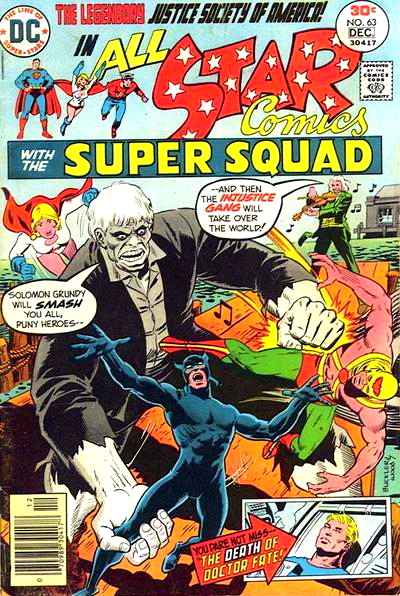
Our half-century-old topic of discussion today picks up its ongoing storyline in the immediate aftermath of the previous issue, So, if you’re not already familiar with what happened in All-Star Comics #62, you might want to go catch up via our post about that one before proceeding, as we’re going to jump right into this installment’s action without worrying about a recap… just as soon as we’ve finished looking at this issue’s cover, that is. (One thing worth noting about said cover is that while it’s clearly dominated by the style of inker Wally Wood, it was actually pencilled by Rich Buckler — an artist who was returning to DC Comics after some four years working primarily for that publisher’s main rival, Marvel.) And now, on with the show…

As detailed in the opening page’s credits box, artists Keith Giffen (layouts) and Wally Wood (finishes) are continuing in their same roles from the last three issues. Elsewhere, however, we have some changes, as the exodus of Gerry Conway, the original guiding force for the revival of All-Star Comics, is now complete. Credited for both plotting and editing the previous issue, he’s now been completely replaced as writer by Paul Levitz (who’d provided the actual script for #62), while Joe Orlando has taken the editor’s chair.
Interviewed in 2002 by Roy Thomas for Alter Ego #14, Paul Levitz explained why he — already the assistant editor of All-Star — hadn’t simply replaced Conway in that role as well:
I talked Joe into editing the book so I could write it. At that point DC had no writer/editors, and God knows I wasn’t competent to be one, anyway. Joe humored me.
Levitz also told Thomas that his getting even the writing gig likely benefited from the recent dismissal of Carmine Infantino as DC’s publisher:
If Gerry had left during Carmine’s run, I probably wouldn’t have gotten the chance; but I had the good fortune to be sucking up far more writing assignments than I should have as he left, and “JSA” was a high priority to me.
Before moving on from this page, we must also make note of an apparent mistake that, having first been made in ASC #62’s “Next Issue” blurb, gets compounded by the Fiddler’s dialogue here: namely, the identification of Earth-Two’s Injustice Society (last seen active under that name in 1975’s Justice League of America #124) as the Injustice Gang — a name which, as a couple of commenters on our issue #62 post pointed out, belongs by rights to an assemblage of Earth-One villains who first banded together in 1974’s JLA #111. If you want to get technical, there’s no reason why the Earth-Two bunch couldn’t have decided to rebrand themselves (it’s hardly as though there aren’t plenty of other names already shared between characters on those two worlds); still, it seems more likely to be a momentary mental lapse on the part of writer Levitz… especially since, as we’ll see, the group’s original moniker gets deployed before the end of the story.

Under the spell of the Fiddler’s music, Wildcat believes he’s fighting an opponent in a boxing match before a cheering crowd. The music, and the trance it induces, continues until Hawkman goes down and doesn’t get up again…

The Fiddler has been a member of the Injustice Society ever since the group’s second outing (in All-Star Comics #41 [Jul., 1948]), and he’d participated in their most recent escapade (as chronicled in JLA #123-124). Solomon Grundy, on the other hand, is a new recruit; though he’d faced the Justice Society on his own back in ASC #33 (Feb-Mar., 1947), as well as in both 1966’s and 1971’s JLA/JSA summer crossovers, he’d never been a team player before this story. His most recent appearance had been in Superman #301 (Jul., 1976) — where, as alluded to in his dialogue in the last panel above, he’d been stranded on the moon… although the script for that story had strongly implied that the satellite involved was the moon orbiting Earth-One (to which Grundy had teleported himself earlier in the story), not Earth-Two. That latter aspect wouldn’t necessarily have been an issue for the Fiddler, whose invention of a “portable vibrator” enabling travel across the dimensional barrier separating those worlds had been established in the very first JLA/JSA crossover, back in 1963 — and, of course, we can easily imagine that the Injustice Society has other resources that could have handled the moon-to-earth part of the trip.


For the record, we’re on page 6 of our story — and that second-from-last panel is the last we’ll see of Solomon Grundy not just for this issue, but for the entire run of this JSA revival series. Which makes you kind of wonder why Paul Levitz opted to include him in the first place. Maybe the young writer was afraid that whoever succeeded Infantino as DC’s publisher would pull him off the book, and he was determined to work in as many of his favorite characters as he could, while he could… though that’s pure speculation on my part.


As previously noted in our ASC #62 post, the idea of modeling the Earth-Two Superman on the eternally-squinting version of the hero’s co-creator, Joe Shuster, appears to have originated with Keith Giffen — though Wally Wood’s legendary mastery of lighting effects (aided and abetted by Carl Gafford’s sympathetic coloring) clearly puts his stamp on the interpretation as well, as is especially evident in the panel above.

A guy on a winged horse, huh? I’d sure like to think that this teaser, combined with issue #62’s scene featuring a guy with a horse doing some shopping in an Egyptian bazaar, was enough to clue my younger self in to the identity of next issue’s Special Surprise Guest Star… but I have no idea, honestly.


Hourman may be able to take comfort in the idea that Kent Nelson laid down his life for a good cause, but Dr. Mid-Nite takes a more melancholy view. “There are no good deaths, Hourman,” says the Justice Society’s resident physician, “no good causes in which to die. In the end, there’s only death… and that’s what we’ve fought so hard to prevent.”
And then, the somber mood is suddenly interrupted:


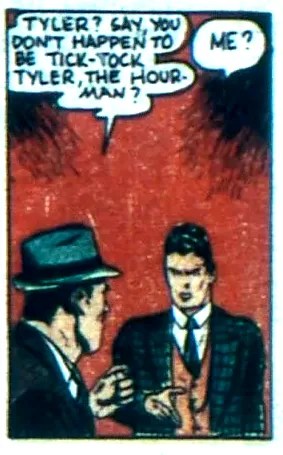
From Adventure Comics #49 (Apr., 1940). Text by Ken Fitch; art by Bernard Bailey.
The Star-Spangled Kid’s addressing Hourman as “Tick Tock” on the above page nods to the latter character’s earliest days, when he was regularly referred to as “Tick-Tock Tyler, the Hour-Man” — and if you think that a superhero who wished to maintain his status as a “mystery man” was asking for trouble by attaching his own actual surname to his costumed identity’s moniker, the people at DC seemed to have caught on to that idea as early as his second adventure, in which a police detective posed the obvious question to biochemist Rex Tyler (see right). (My thanks to my fellow blogger Dan Hagen for this particular nugget.)

Knocked from the sky, Zanadu crashes through the roof of the JSA’s headquarters to land in the team’s meeting room. Once Hourman and the Kid have followed him down, the villain declares that rather than follow through on his original intent to destroy the city, he will focus all of his power on them instead. “Prepare for your death, mortals — and for a scream that will be heard around your puny world!”


If any further proof was needed, the preceding sequence has made it clear that this book’s creative team has received the memo sent by Martin Pasko and Walt Simonson via their spectacular “Doctor Fate” solo story of the previous year. Never again in this series will we see Dr. Fate portrayed as an ordinary ol’ magician in a cape and helmet; rather, he’ll be consistently depicted as he is here: an awesome immortal champion of the forces of Order.

Like the Fiddler, the Icicle has been associated with the Injustice Society (ahem) since 1948’s All-Star Comics #41. As to whether his mysterious associates are fellow veterans, or (like Grundy) brand-new additions — or maybe a mix of both? — well, we’ll just have to wait a couple of months and see.
This was Keith Giffen’s fourth outing as All-Star Comics‘ layout artist — and, as things turned out, his last. By his own recollection (as given to Roy Thomas in Alter Ego #14) the news that he was losing the assignment came while Gerry Conway was still on board as the title’s editor:
Gerry at one point said to me, “Woody’s having so much fun on the book that he wants to do it solo.” But Gerry didn’t throw me into the street. He had something waiting for me, but what was I going to say? Like I felt kind of good. Like, wow, I kind of got Wally Wood charged up. [laughs]
Later in the same 2002 interview, Giffen offered further details about his departure, saying, “Gerry had Kamandi or some other book lined up for me.” But in fact, Giffen had begun drawing Kamandi several months prior to this, while still in the midst of his All-Star run. It seems likely that Giffen was misremembering the circumstances a bit, as his very next gig after ASC would actually be Marvel Comics’ The Defenders — another super-team series, which, beginning with its 42nd issue (arriving in spinner racks in September, 1976) would feature his layouts — as well as the scripts of its new writer/editor, one Gerry Conway.
And, in fact, that’s pretty much how Conway himself remembered things, in his own Alter Ego #14 interview:
I gave Keith the [All-Star Comics] assignment based on his samples. Like Ric [Estrada, Giffen’s predecessor], he had a very strong design/storytelling sense, though his draftsmanship wasn’t as polished as it later became. Nobody would use him, but I thought he’d do a kick-ass job, and I’d like to think I was right. I later brought him over to Marvel*, where he penciled The Defenders for me, I believe.
Keith Giffen would in fact remain on Defenders for a full year — 12 monthly issues — during which time he would indeed develop and grow as an artist. Somewhat ironically, his stint on that book ended up being a good bit longer than that of Conway, who’d be leaving the title after only four issues — and leaving Marvel Comics to return once more to DC, just one month after that — though that’s a topic we’ll need to reserve for discussion in future posts, naturally.
*Actually, Giffen had already drawn a few one-off strips for Marvel before taking on Defenders; but Conway did give him his first regular, ongoing series assignment at the publisher.