Subscribe to our ▶️ YouTube channel 🔴 for the latest videos, updates, and tips.
Division is a way of sharing objects equally or making equal groups. When we divide, we can find how many objects are in each group or how many equal groups can be made. In this lesson, you will learn the difference between sharing and grouping in division, solve simple division problems, and practise using pictures and equal groups.
Equal Sharing:
Example:
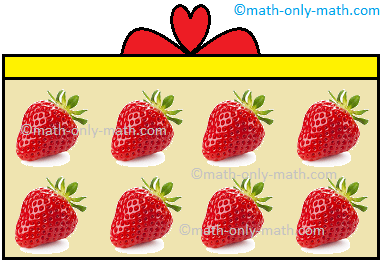
1. Share eight strawberries between four children.
|
|
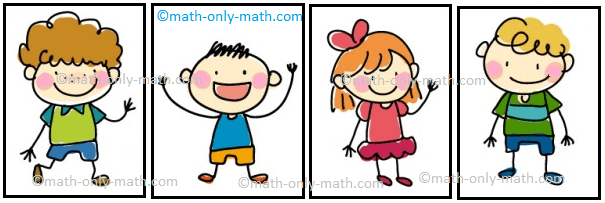 |
Let us distribute strawberries equally to
all the four children one by one.
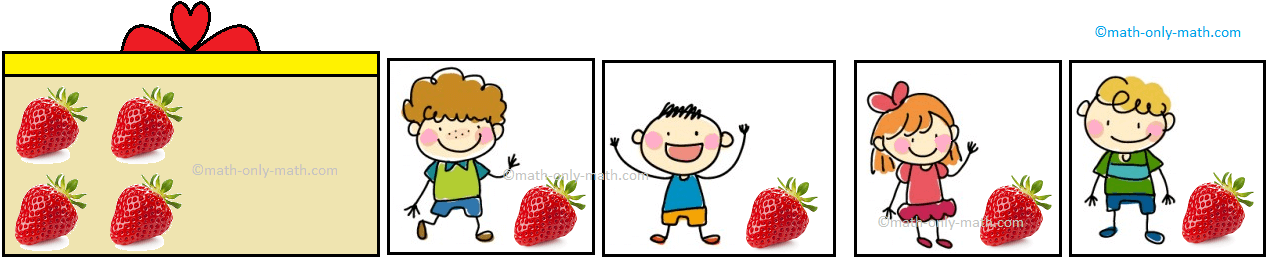
After distributing equally among four
children, four strawberries were left. They can be further distributed among
four children.
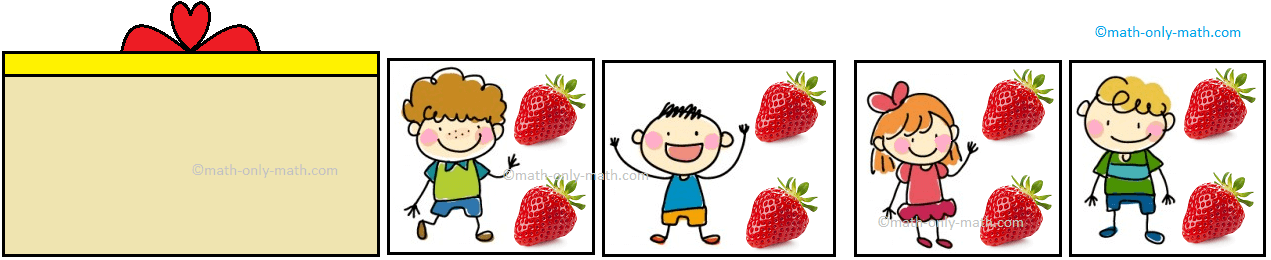
Now, there are no more strawberries left in
the box. Each child got 2 strawberries. So, division is an operation of
repeated subtracted of the same number.
8 – 4 = 4
4 – 4 = 0
Here, we have subtracted 4 repeatedly 2 times
until we reached 0.
Hence, 8 strawberries ÷ 4 children = 2
strawberries for each child.
We can also say that 8 strawberries have
been divided into 4 equal groups of 2.
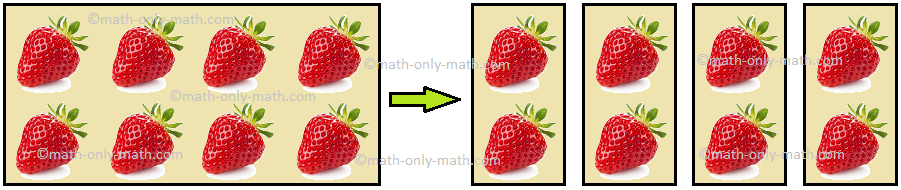
So, 8 ÷ 4 = 2. This is called a division fact.
Division means sharing equally or making equal groups.
Equal Grouping:
Examples:
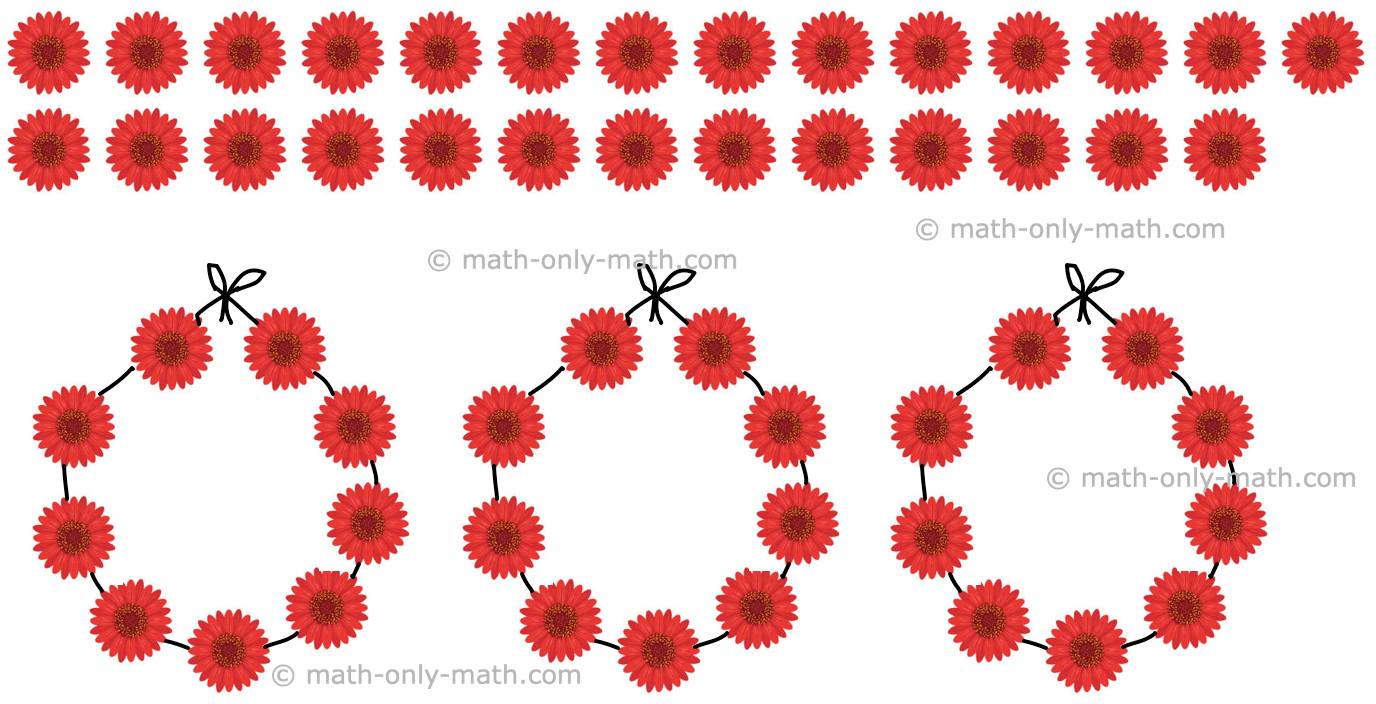
1. Nitheeya has 27 flowers. She wants to make garlands of 9 flowers each. How many garlands can she make?
Solution:
She first puts 9 flowers in 1 garland.
She makes another garland of 9 flowers.
She makes 1 more garland of 9 flowers.
|
27 |
÷ |
9 |
= |
3 |
|
Total number of flowers |
number of flowers in each garland |
number of garlands |
Thus, Ntheeya can make 3 garlands of 9 flowers each.
2. Divide 15 flowers into 3 equal groups. How many flowers does each group contain?
Solution:

Each group contains 5 flowers.
We write 15 ÷ 3 = 5 and read as 15 divided by 3 is equal to 5.
15 ÷ 3 = 5 is a division fact.
÷ is the symbol of division.
From the above examples, we can say that division means dividing or separating into equal groups.
Sharing vs Grouping:
Sharing vs Grouping in Division
Division can be understood in two simple ways: sharing and
grouping. Both use equal groups, but they help us find
different things in a division problem.
| Division Model | What We Know | What We Find |
|---|---|---|
| Sharing | Number of groups | Number in each group |
| Grouping | Number in each group | Number of groups |
Sharing
Example: 12 apples are shared equally among 3 children.
We know there are 3 groups and find how many apples
are in each group.
12 ÷ 3 = 4
Each child gets 4 apples.
Grouping
Example: 12 apples are put into groups of 3.
We know there are 3 apples in each group and find
how many groups can be made.
12 ÷ 3 = 4
We can make 4 equal groups.
Remember: Sharing finds how many are in each group,
while grouping finds how many groups can be made.
Division Vocabulary:
- Dividend – the number being divided.
- Divisor – the number we divide by.
- Quotient – the answer to a division problem.
For Example:
24 ÷ 6 = 4
24 = Dividend
6 = Divisor
4 = Quotient
Play Division Sharing and Grouping Game:
🍎 Sharing & Grouping Game
Learn division by making equal groups. Drag the objects into the correct groups.
- Read whether the question is about Sharing or Grouping.
- Drag each object into a group.
- On mobile, you can also tap an object and then tap a group.
- Make all groups equal, then click Check Answer.
- Complete 10 questions and see your score and review table.
🍎 Sharing & Grouping
🎉 Game Complete!
| Q | Type | Division | Your Result | Correct |
|---|
Printable Division Sharing and Grouping Worksheet:
Use this free printable division sharing and grouping worksheet to practice equal sharing, equal grouping, division facts, repeated subtraction, and picture-based division problems.
Questions and Answers on Division Sharing and Grouping:
I. Divide the following:
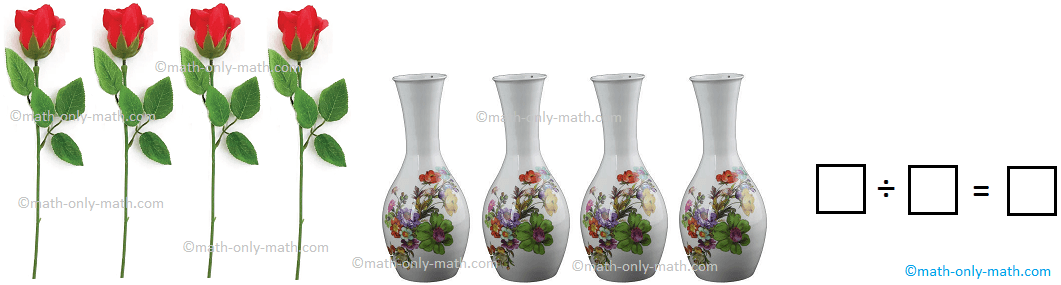
(i) Put flowers in vases equally and write
the division sentence.
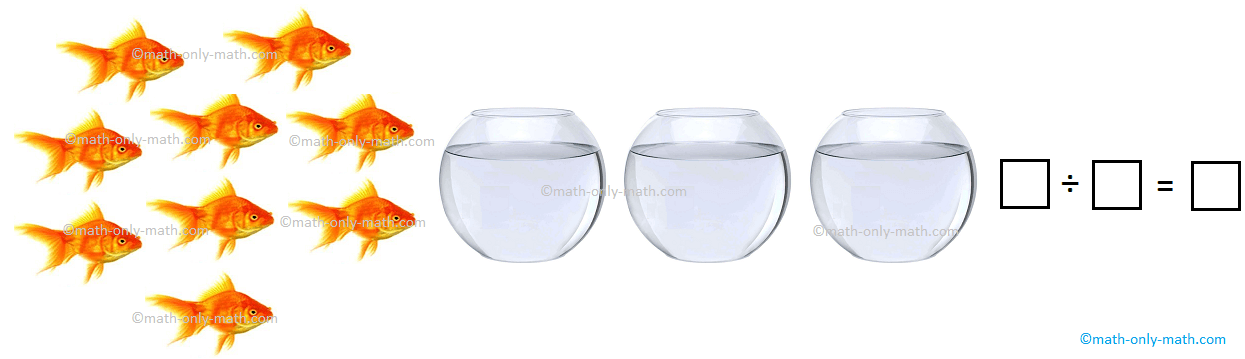
(ii) Put fishes equally in the tanks and
write the division sentence.
Answer:
I. (i) 4 ÷ 4 = 1
(ii) 9 ÷ 3 = 3
II. Make groups of 2 and complete the
division fact.
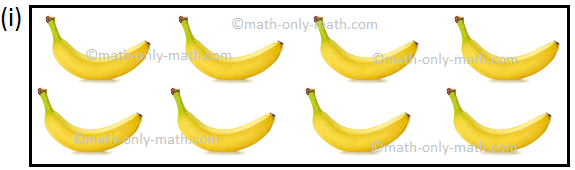
………… bananas have been divided into …………
groups.
………… ÷ ………… = …………
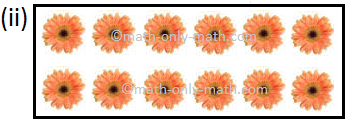
………… flowers have been divided into ………… groups.
………… ÷ ………… = …………
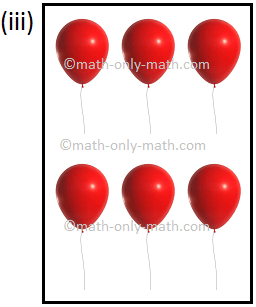
………… balloons have been divided into …………
groups.
………… ÷ ………… = …………
Answer
II. (i) 8 bananas have been divided into 2 groups.
8 ÷ 2 = 4
(ii) 12 flowers have been divided into 2 groups.
12 ÷ 2 = 6
(iii) 6 balloons have been divided into 2 groups.
6 ÷ 2 = 3
III. Divide and complete the division fact.
(i) Distribute 12 candies equally among 4
kids.
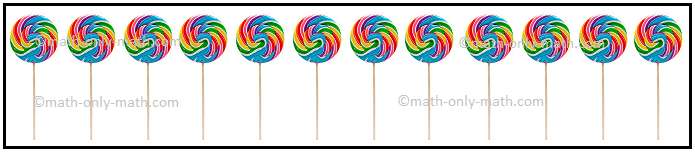
Each kid has ……….. candies.
So, 12 ÷ 4 = …………
(ii) Distribute 18 oranges equally among 3 boxes.
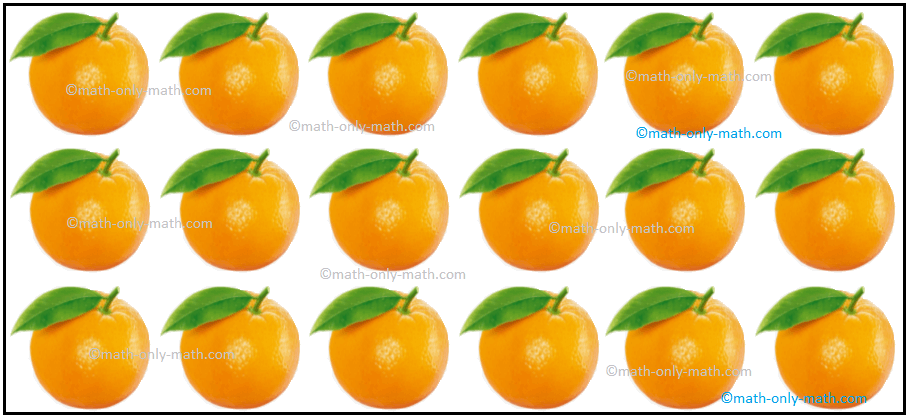
Each box has ……….. oranges.
So, 18÷3 = …………
(iii) Distribute 20 pencils in 4 pencil stands.
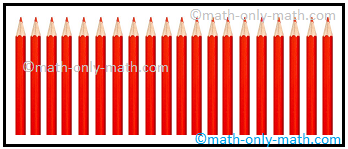
Each pencil stand has ……….. pencils.
So, 20÷ 4 = …………
Answer:
III. (i) 3
(ii) 6
(iii) 5
IV. Divide by repeated subtraction:
(i) 40 ÷ 5
(ii) 64 ÷ 8
(iii) 42 ÷ 7
(iv) 54 ÷ 9
Answer:
IV. (i) 8
(ii) 8
(iii) 6
(iv) 6
V. Look at the picture and fill in the blanks.
(i) 3 girls share 15 dolls equally.
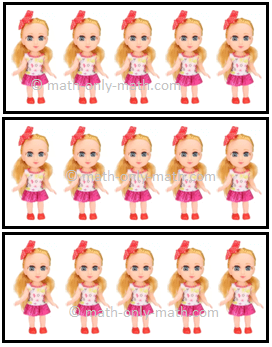 |
We divide 15 dolls into 3 groups. How many dolls are in each group? _____ 15 ÷ 3 = _____ |
(ii) 12 boys are put into 2 equal teams.
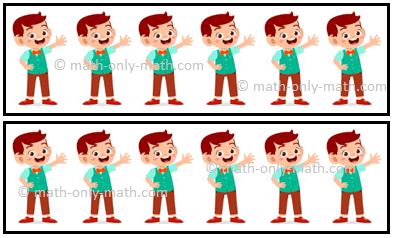 |
We divide 12 boys into 2 groups. How many boys are in each group? _____ 12 ÷ 2 = _____ |
(iii) 24 fishes are put equally into 3 fish tanks.
 |
We divide 24 fishes into 3 groups. How many fishes are in each group? _____ 24 ÷ 3 = _____ |
(iv) 12 flowers are put equally into 3 vases.
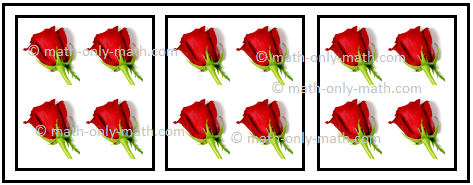 |
We divide 12 flowers into 3 groups. How many flowers are in each group? _____ 12 ÷ 3 = _____ |
Answer:
V. (i) 5, 15 ÷ 3 = 5
(ii) 6, 12 ÷ 2 = 6
(iii) 8, 24 ÷ 3 = 8
(iv) 4, 12 ÷ 3 = 4
VI. Divide 12 bananas into 3 equal groups. Circle the
groups.
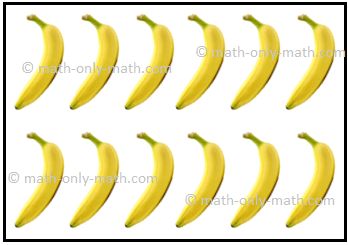 |
How many bananas are in each group? ……………. How many bananas left? ……………. How many groups are there? ……………. |
Answer:
VI. 4, 0, 3
VII. Divide 8 pineapples into 2 equal groups. Circle the groups.
 |
How many pineapples are in each group? ……………. How many pineapples left? ……………. How many groups are there? ……………. |
Answer:
VII. 4, 0, 2
VIII. Divide 9 pearls into 3 equal groups. Circle the groups.
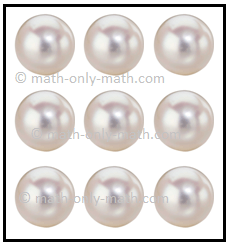 |
How many pearls are in each group? ………… How many pearls left? ………… How many groups are there? ………… |
Answer:
VIII. 3, 0, 3
IX. Divide 16 apples into 4 equal groups. Circle the groups.
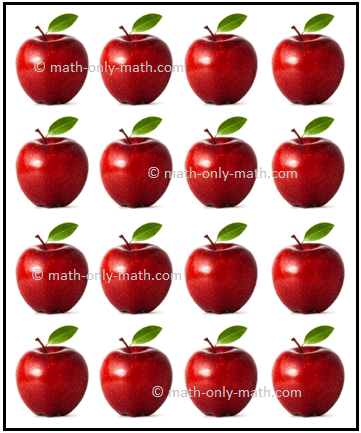 |
How many apples are in each group? ………… How many apples left? ………… How many groups are there? ………… |
Answer:
IX. 4, 0, 4
X. Compare the two groups in each set. Tick the equal groups and cross the ones that are not equal.
Answer:
X. (i) ✗, ✓
(ii) ✗, ✗
(iii) ✗, ✓
XI. Make groups of 3 objects and complete the division sentence.
|
(i) |
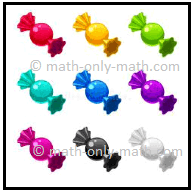 _____ candies have been divided into _____ groups _____ ÷ _____ = _____ |
|
(ii) |
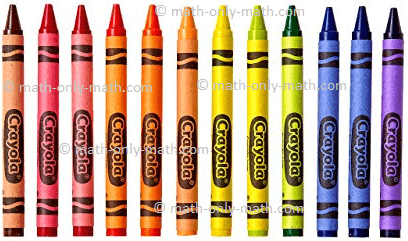 _____ crayons have been divided into _____ groups _____ ÷ _____ = _____ |
|
(iii) |
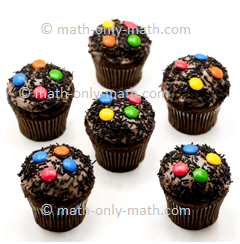 _____ cupcakes have been divided into _____ groups _____ ÷ _____ = _____ |
Answer:
XI.
(i) 9 candies have been divided into 3 groups
9 ÷ 3 = 3
(ii) 12 crayons have been divided into 3 groups
12 ÷ 3 = 4
(iii) 6 cupcakes have been divided into 3 groups
6 ÷ 3 = 2
XII. Make groups of 4 objects and complete the division sentence.
|
(i) |
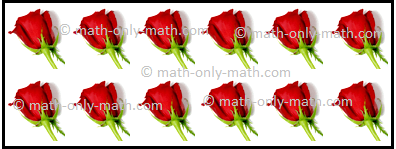 _____ flowers divided into _____ groups. |
|
(ii) |
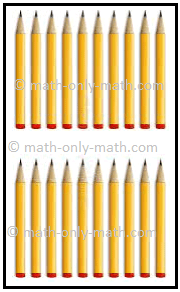 _____ pencils divided into _____ groups. |
|
(iii) |
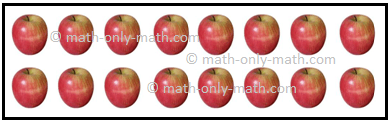 _____ apples divided into _____ groups. |
Answer:
XII. (i) 12 flowers divided into 3 groups.
(ii) 20 pencils divided into 5 groups.
(iii) 16 apples divided into 4 groups.
XIII. Draw and divide 25 fishes in 5 fish tanks.

Answer:
XIII. 25 ÷ 5 = 5
XIV. Draw and divide 15 pencils in 3 pencil holders.

Answer:
XIV. 15 ÷ 3 = 5
XV. Draw and divide 12 apples in 4 plates.

Answer:
XV. 12 ÷ 4 = 3
XVI. Draw and divide 30 flowers in 5 flower pots.

Answer:
XVI. 30 ÷ 5 = 6
Frequently asked questions (FAQs) on Division Sharing and Grouping:
Answer:
Division sharing means distributing objects equally among a given number of groups or people.
Answer:
Division grouping means making equal groups of a given size and finding how many groups can be made.
Answer:
An equal group contains the same number of objects as every other group.
Answer:
A division fact is a mathematical statement that shows one number divided by another, such as 12 ÷ 3 = 4.
Answer:
Repeated subtraction shows how many times the divisor can be subtracted from the dividend until zero is reached.
Answer:
Sharing finds the number of objects in each group, while grouping finds the number of equal groups.
About Author
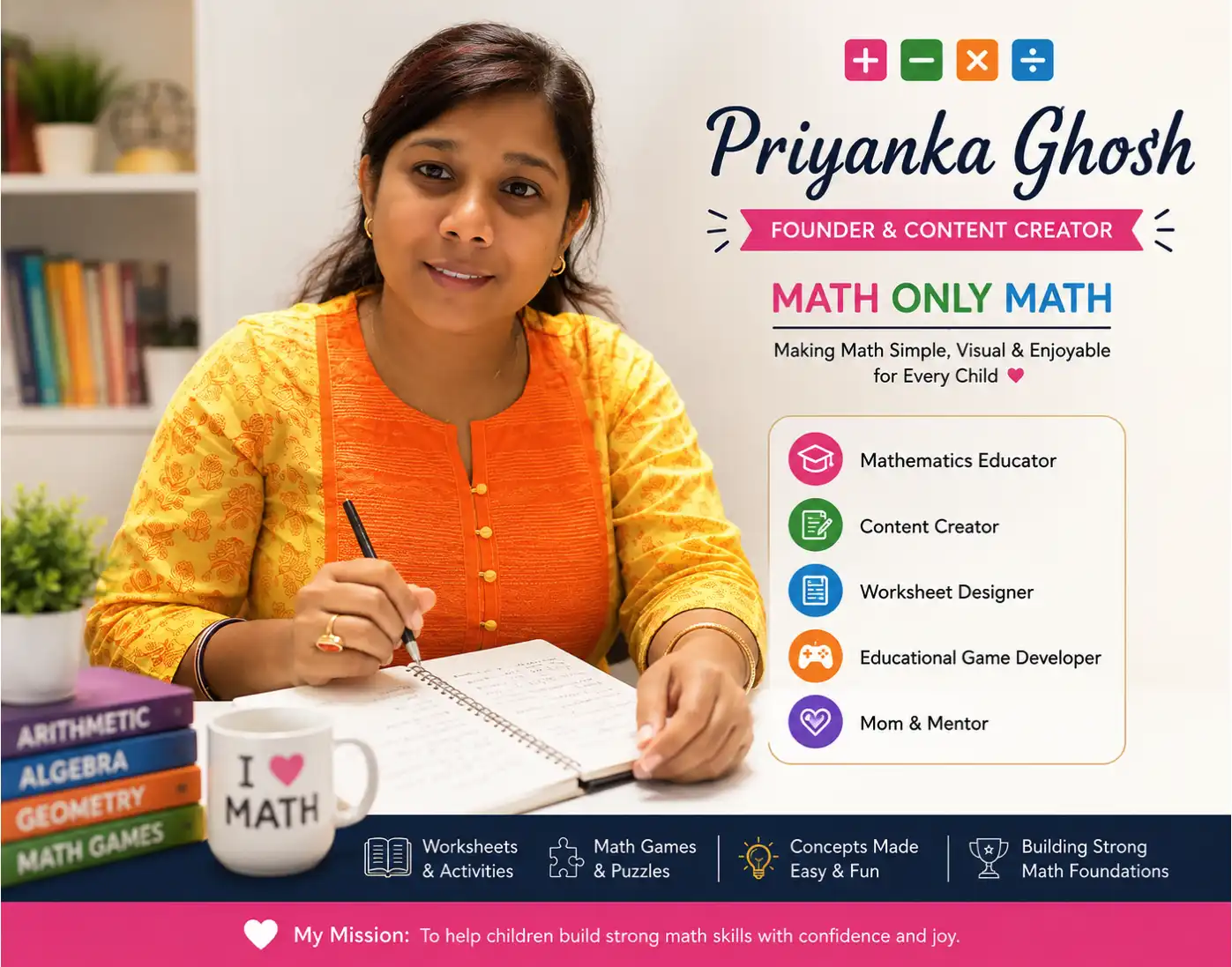
Written by Priyanka Ghosh
Mathematics Educator | Founder of Math Only Math
Priyanka Ghosh has been teaching elementary and middle-school mathematics for over 12 years and specializes in creating simple, child-friendly math lessons and worksheets.
Related Division Pages:
From Division Sharing and Grouping to HOME PAGE
Didn’t find what you were looking for? Or want to know more information
about Math Only Math.
Use this Google Search to find what you need.