Please provide your email address to receive an email when new articles are posted on .
We were unable to process your request. Please try again later. If you continue to have this issue please contact [email protected].
Key takeaways:
There is evidence supporting the lifestyle pillars of medicine that patients should know about, a speaker said.
Being empowered by this information can help them age in a healthy way.
ORLANDO — Data showing the benefits of lifestyle medicine can empower patients to focus on healthy aging, according to a speaker here.
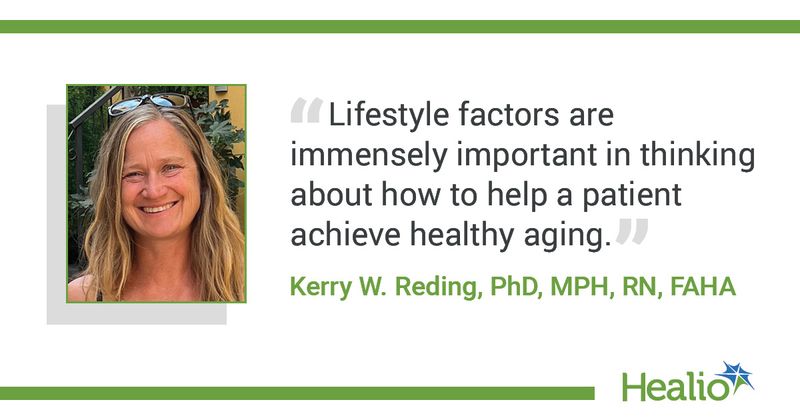
Kerry W. Reding, PhD, MPH, RN, FAHA, a professor of biobehavioral nursing and health informatics at the University of Washington, offered a presentation on what decades of research from the Women’s Health Initiative have revealed about the intersection between lifestyle medicine and longevity at the annual ACLM conference.
Healio spoke with Reding to learn more about longevity for women, the evidence behind lifestyle medicine’s effects on longevity and how that evidence can be translated into practical strategies.
Healio: Why is this an important topic for healthcare providers to know about?
Reding: People seem eager for guidance on how to live longer and healthier lives, but can also be overwhelmed by all the information that comes through our news feeds and our social media, and it can make it challenging to discern what’s truly an evidence-based strategy or recommendation.
I wanted to present on lifestyle factors from the perspective of healthy aging and longevity because there is so much out there that is based on rigorous science and these evidence-based strategies can inform on how people can change their behaviors in order to improve their health span. Also, with the American College of Lifestyle Medicine, it’s really a great opportunity to showcase all the research and literature that show how the six pillars relate to longevity.
I’ve been involved with the Women’s Health Initiative study for about 15 years, and felt it was noteworthy to describe how the WHI has become such a great resource for understanding lifestyle factors in relation to healthy aging and longevity. In part, that’s because the study’s been going on for over 30 years, and along that time, it has been gathering information on people’s lifestyle factors while at the same time going through a rigorous assessment of any chronic conditions or disabilities that have developed in people over time. So, with those two pieces of prospectively collected data, there’s a vast amount of data to use to better understand how lifestyle factors are related to not just longevity but also healthy aging, that concept of being able to thrive in your 80s and 90s while still in good health.
Reding: It is clear that lifestyle pillars impact longevity. We see in particular that physical activity is a notable pillar. From the literature, we see people can cut their risk for early mortality in half through regular physical activity. And what I highlight in my talk is that we see this also in a dose response relationship — so, with the increasing amount of physical activity is an improvement in longevity. The reason that’s important is, one, it shows that any little amount you do is going to improve your longevity. It’s not an all-or-none strategy. It’s like, “Do the best you can, do something every day, and if you don’t hit 10,000 steps, that’s fine, but even reaching 3,000 steps, 5,000 steps is going to be good for your health.” The other part about that dose response curve is that when we see that in in a relationship, we see that it provides some support for a causal relationship, so we have more indication it’s actually the physical activity that is causing longevity to be improved, rather than, “We think there’s other factors at play.”
The other thing that was really interesting to me, I recently met Gianni Pes in Sardinia, and he’s the originator of the blue zones concept. He was circling in blue on a map the areas that had notable longevity. When I talked to him and was curious about his 30 years of research in this area — what were the things that he was personally doing? — physical activity was his No. 1 thing. That felt pretty validating because that’s what I see the data shows, but he really highlighted for me that physical activity is within our control to be able to improve our own longevity.
I’d also say what has shown up in the data is around social connectedness. So, unfortunately in the U.S., [it is] an overlooked factor, but can have a great impact on reducing mortality. I cite in my talk a 91% elevated risk for mortality for people with low social integration in a meta-analysis, and the work done in this seminal paper essentially showed that social isolation is the new smoking. I think that’s something that we could take as a message to Americans to really think about how we could improve our social integration in our day-to-day lives.
In general, I think presenting at ACLM is quite gratifying because it’s an audience that, like me, is really interested in in having this discussion about how lifestyle factors are affecting healthy aging, and we all have the shared goal of bringing that to our patients and then disseminating that information more widely.
Healio: What evidence from the Women’s Health Initiative demonstrates the impact lifestyle medicine has on longevity?
Reding: The WHI collected data on lifestyle and behavioral factors and chronic conditions over its 30 years of existence, and it also conducted a series of clinical trials. There were several different clinical trials, and one of them was a dietary modification trial. That one showed, in particular, that women who were enrolled in the trial that recommended they eat a diet high in fiber — fruits and vegetables — and low in fats, were less likely to die of breast cancer than the women who were in the control group. So, they’ve shown that this pillar of nutrition is impactful for longevity.
They’ve also done some really interesting sets of studies where they’ve investigated the concept of healthspan. They’ve basically created a phenotype of healthy aging. For this, they classified women as those living to age 85 in good health, free of chronic conditions or disability versus those who are either age 85 but not in good health or those who died before age 85. The WHI propsective study has shown a strong relationship between higher physical activity and living to age 85 in good health. So, that’s a compelling way to use the WHI data to understand this concept of healthy aging. This is similar to the concept of the super-ager which has been defined as a person who’s in their 80s and still in great health.
I would say the other piece that has been looked at in relation to the healthy aging phenotype — being 85 and in good health — was a woman’s sense of purpose. Here investigators researched whether or not a person had a sense of purpose and then followed her to determine whether or not she was healthy at age 85, and they saw a strong relationship — again, a dose response relationship — between having a sense of purpose and later achieving age 85 in good health.
Healio: How can that evidence be translated into practical clinical strategies that healthcare providers can offer? Can you describe some of these strategies?
Reding: The first thing providers can do is to assess patients on these six pillars. It starts with better understanding where the patient’s baseline is, and then trying to understand from the patient’s perspective which of the pillars are the highest priority for them. Which ones do they want to make improvements in? Because that’s where we’ll see the most appreciable changes in patient’s lifestyle behaviors.
Then, I recommend providers employ a coach approach. So, that’s either by acting in the role of coach themselves — understanding what the patient wants and learning from the patient’s wisdom, rather than being in the role of an expert talking to someone — or if they want to use the coach approach by literally referring a patient to a health coach. I think that’s a really viable solution when aiming to help patients make these behavior changes on their own because essentially many of us know we want to eat well and exercise, but the how-to can be harder to implement than just saying it. So, I think the coach approach can be a really great strategy for helping patients to achieve the changes that they voice they want to make.
Healio: What is the take-home message here?
Reding: I would want them to see that lifestyle factors are immensely important in thinking about how to help a patient achieve healthy aging. I think a lot of ACLM members are already on board with this concept, but I would hope that the data I provide gives them another tool in their tool chest for how to talk to patients and how to conceptualize this vast area of research in a way that can be conveyed to their patients in a clinic setting.
For more information:
Kerry W. Reding, PhD, MPH, RN, FAHA,can be reached at [email protected].