This Sunday, many Western churches observe All Saints’ Day, remembering generations of faithful people, mostly unnamed. What they knew may still be news to us. The present is once again called unprecedented. Those predicting what comes next remain remarkably confident. Certainty comes easily when we forget how often it has failed us.
The Aztecs may teach us more about the future than those who dismiss the past. For many, Aztec history comes down to human sacrifice and chocolate. Both belong to the story. Neither is enough. Founded around 1325, their capital, Tenochtitlan, became the center of an empire that fell in 1521 to Spanish forces and their Indigenous allies.
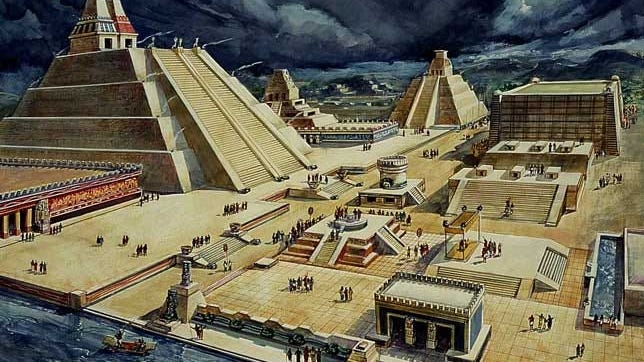
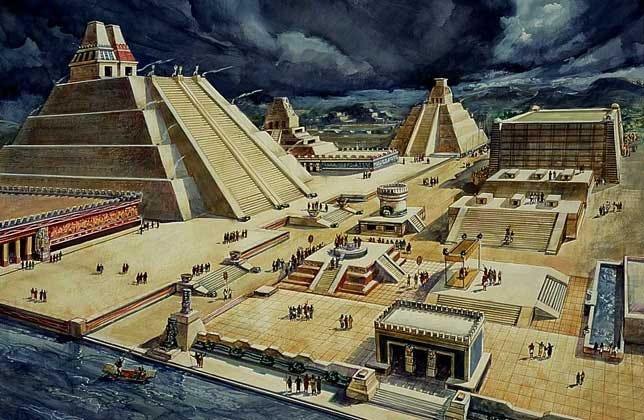
Diego Rivera’s reconstruction, pictured above, presents an ordered world. Its geometry conceals how easily life can go wrong. Aztec thinkers saw the earth as slippery ground.
Tradition says their patron deity, Huitzilopochtli, guided them to an eagle on a cactus at Lake Texcoco. Mexico’s flag shows an eagle with a snake in its beak. The old lakebed now lies beneath parts of Mexico City.
In the Aztec capital, aqueducts supplied fresh water. Canals carried people and goods. Chinampas, raised fields built from lake sediment and vegetation, yielded abundant crops by working with wetland conditions rather than overcoming them. Ingenuity sustained the city. So did conquest and tribute.
Human sacrifice belonged to this world of ingenuity and imperial power. A civilization can make an extraordinary world and then mistake its own arrangements for the conditions of existence. Its achievements become arguments against questioning its demands.
What have we learned to call necessary? A new technology arrives as an option. Soon, keeping a job, getting a service, or keeping up can require it. A choice becomes a condition of participation.
Technological achievement can lend authority to today’s claims of inevitability. Those bearing AI’s costs are told resistance means falling behind. The Singularity is a hypothetical point when technological change outruns human understanding or control. That prospect gives competitive pressure an almost cosmic scale. Who decides what progress requires? Who bears its costs? When does questioning those costs become an offense against the promise?
Aztec teachings emphasized balance: finding one’s footing on slippery earth through habits and obligations sustained with others. In one influential interpretation, teotl was a ceaseless process of sacred transformation, with everything that exists a manifestation of it. Aztec achievements did not make the world any less mysterious.
In Nahuatl, the language of the Aztecs, tlamanitiliztli names a community’s customs and rules, inherited practices shaping communal life. Goodness was associated with what nourishes and sustains human life. This might seem an antidote to technological ambition: preserving what makes life possible.
But sustaining life justified sacrifice.
The Aztecs are easier to judge. Their sacrifices came with rituals. Ours can disappear into phrases like “the cost of doing business.” A clear conscience may owe something to what it has learned not to notice.
A society need not conceal its cruelty if it can teach people to call it necessary. Terrible things can be done out of a sincere commitment to preserving the world. Everything depends on what it means by “the world” and whose existence it considers indispensable.
Sacrifice is easier to recognize when gods demand it than when progress does. Technology’s achievements are real. But two claims often go hand in hand: “These technologies will transform human existence” and “We have no choice but to develop them.” The first invites wonder. The second treats judgment as irrelevant. Speed becomes a virtue when direction goes unquestioned.
We welcome conveniences, forming habits that turn yesterday’s novelty into today’s necessity. Then we ask institutions to restrain the power we depend on. I defend the right to say no, though it’s less trouble to click “Accept.”
Dependence need not settle the bargain. People affected by a technology can shape its purposes and limits, and decide whether to use it. That freedom is harder to exercise when refusal costs something we enjoy.
Aztec sacrificial religion gave the cosmos a claim upon human lives. We need no god to mistake a human arrangement for a cosmic necessity. A civilization’s freedom may depend on its capacity to disappoint its own expectations. No promise of progress cancels the right to say no—or the responsibility to imagine something better.
“Though it be jade it falls apart, though it be gold it wears away,” says a poem attributed to Nezahualcoyotl, poet-ruler of Texcoco, an ally of Tenochtitlan. Even what seems permanent can change. There is still room to choose.
Uncertainty is a promise, not just a problem.
Notes and reading
Why the Aztecs?—The Maya excelled in mathematics and astronomy; the Incas in engineering and imperial administration. The Aztecs bring the coexistence of urban ingenuity, collective provision, and sacrificial obligation into especially sharp focus.
Non-duality—The monistic interpretation of Aztec thought understands nature, human beings, and the gods (tēteoh) as manifestations of teotl, a single sacred reality in ceaseless transformation.
Hierarchy and common provision—Aztec hereditary privilege coexisted with education for commoners, some opportunities for advancement, and shared neighborhood duties.
Empire and its undoing—Aztec expansion and demands for tribute created resentments that helped the Spanish recruit Indigenous allies whose forces were crucial to the conquest. Invasion and epidemic disease were devastating. The empire had accumulated resentments along with wealth.
The Aztecs—Richard F. Townsend (2009, third edition). An illustrated introduction connecting Aztec artistic and urban achievement with imperial power and sacred obligations.
Fifth Sun: A New History of the Aztecs—Camilla Townsend (2019). Drawing on Indigenous histories in Nahuatl, Townsend challenges the reduction of Aztec civilization to brutality and sacrifice, restoring the human complexity of lives before, during, and after conquest.
Utopia for Our Century: A Manifesto of Hope—David Albertson and Jason Blakely (2026). A spirited defense of political imagination against resignation masquerading as realism. Drawing on Thomas More, the authors show how imagining a better world can expose the failures of the one too readily accepted as inevitable. Criticism of modernity becomes an invitation to create, rather than yet another lament.
The Politics of Uncertainty: Challenges of Transformation—Ian Scoones and Andy Stirling, editors (2020). Essays on uncertain futures, whose knowledge counts, and who bears the consequences. Technical expertise alone cannot settle political choices.
Editorial note: I sometimes use AI-assisted tools for proofreading, clarification, and revision. The ideas, judgments, and final wording remain my own.