

Cutting off a rattlesnake’s head still leaves it dangerous. It’s only the beginning of the end. Removing a cancerous tumor does not mean the cancer is cured. Vigilance and follow-through matter because an apparent victory can leave danger intact.
Defeating Trump in the midterms matters only when those who defeat him turn electoral victory into effective restraint. Winning seats is the beginning. Using Congress’s powers to investigate abuses, control spending, and demand accountability is the follow-through. A rebuke at the polls is not yet a check on power.
Losing control of Congress does not deprive the president of means to punish a nation he regards as ungrateful. He remains commander in chief with the machinery of federal law enforcement at his disposal. He retains the power to press for prosecutions, order military action, and invoke emergency powers. Electoral defeat leaves those powers intact.
Herman Melville, among America’s greatest writers, understood the predicament. He unsettles readers’ confidence to provoke greater honesty. How can the best in us serve the worst? How do our dreams become nightmares? How does evil depend on the good? In contemporary terms, how does the president turn our protest to his advantage?
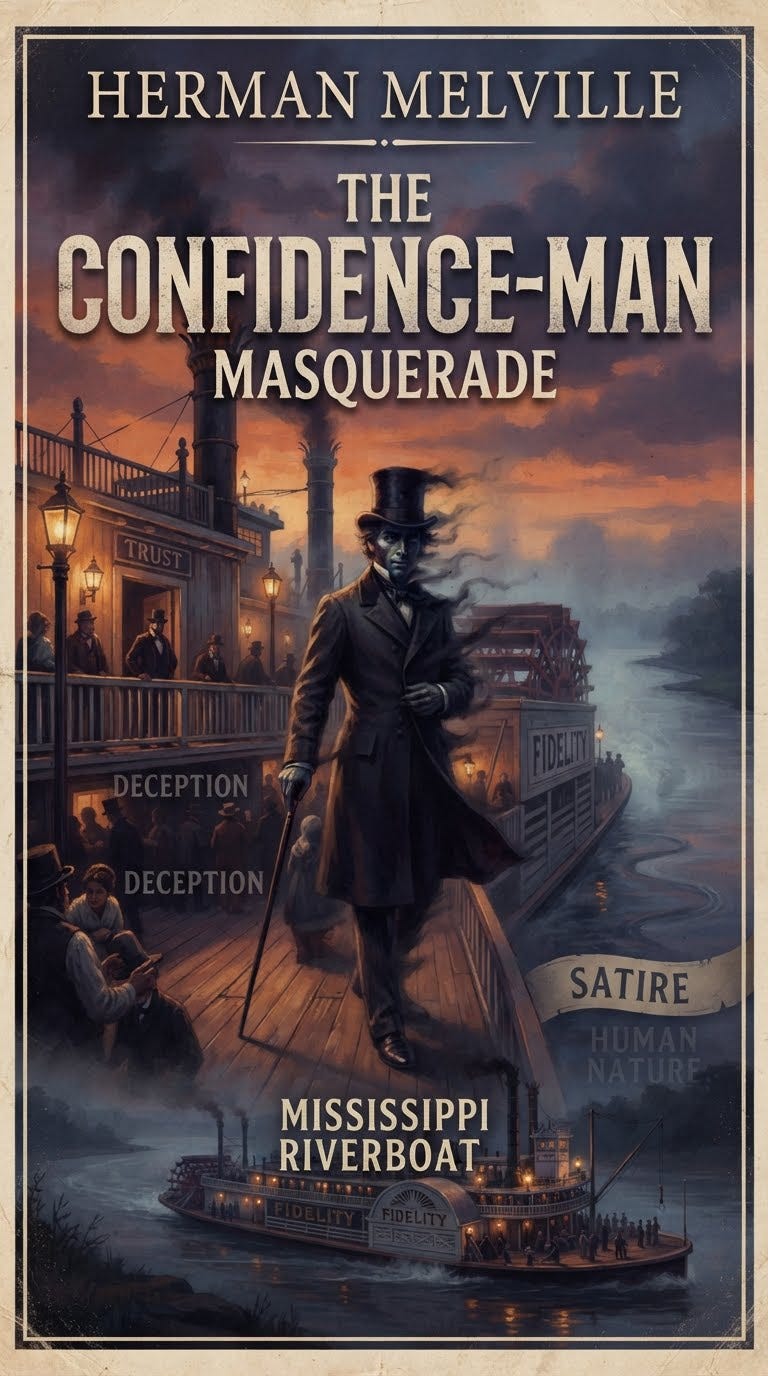
Melville brings to mind Captain Ahab and Moby-Dick. Just as relevant is his last published novel, The Confidence-Man: His Masquerade. Long dismissed as a failure, the book is now widely admired for its irony and ambiguity. Melville offered uncomfortable questions to a nation heading toward civil war.
Set aboard the ironically named Mississippi steamboat Fidèle—“faithful”—the novel gathers a cross-section of America on April Fools’ Day. Figures in successive guises solicit the passengers’ confidence. Their identities remain uncertain. Their appeals take forms suited to their listeners’ desires.
Like a cancer drawing sustenance from the body it damages, the con man feeds upon virtues that make life together possible. Christian faith, hope, and charity become instruments of deception. He borrows the language of goodness to take others’ money and judgment.
The fraud consumes the trust that makes it possible. In the final chapter, the remaining lamp is extinguished, and a bewildered old man is led away into darkness.
But exposing counterfeit goodness does not make goodness counterfeit. The con man wins twice when he leaves us unable to trust anyone. We congratulate ourselves on seeing through everything while he has taught us to expect nothing better. Cynicism is a curious kind of surrender. It prides itself on being too clever to be fooled.
Vigilance must therefore become more than suspicion. Discernment offers no retreat to an imagined place where everyone has taken off the mask. Other people’s masks are easier to spot than my own. It asks for the judgment to live among masks without surrendering to them. Debate becomes pointless when deception is all we recognize in an opponent.
Melville leaves a question that reaches beyond the page. Will uncertainty become an excuse for paralysis, or can we act with conviction, leaving room for something we have yet to understand? I am usually ready to learn something new, as long as it leaves me right.
A snake’s bite reflex can persist after decapitation. Could we be like snakes that still have their heads but have forgotten how to use them?
“Something further may follow of this Masquerade,” the novel concludes—or fails to. Melville promises no hopeful ending. He leaves us something to do. We can question our reflexes, reconsider our judgments, and give one another reason to trust. Something further may follow from that, too.
Cancer treatment aims beyond removing a threat to restoring a life. The work beyond an electoral defeat for Trump must be equally purposeful. Restraining his power matters because it gives Americans room to recover their own power: to judge, to act together, to make public trust worth the risk.
Vigilance protects that possibility. What gives it hope is what we choose to build. Democracy cannot survive on moral instruction alone. Americans must see that democratic government can build housing, repair communities, control borders, create opportunity, and provide basic public services.
Finding our way after Trump will not mean forgetting abuses in the name of national unity. Nor will it mean taking his instruments of power and placing them in supposedly better hands.
It will require recovering distinctions he has worked to erase: between law and command, loyalty and competence, disagreement and treason, enforcement and cruelty, leadership and domination.
America has survived revolution, civil war, Reconstruction, and Vietnam. For 250 years, its promise of equality has advanced through struggle and reversal. Progress has never been inevitable. Neither has defeat.
America will not find its way back. With honesty, accountability, restraint—and a government that actually works—it can find its way forward again.
The best answer to Melville’s prophecy is to prove it wrong.
Notes and reading
The Confidence-Man: His Masquerade—Herman Melville (1857). Penguin Classics edition, edited with an introduction and notes by Stephen Matterson (1990). Matterson’s introduction and notes provide context for Melville’s satire and clarify its literary and religious allusions.
Melville: His World and Work—Andrew Delbanco (2005). A literary biography placing Melville’s moral and religious questions within the promises and contradictions of American life.
“Metaphysics, Money & the Messiah: A Conversation about Melville’s ‘The Confidence-Man’”—Cornel West and D. Graham Burnett. Dædalus 136, no. 4 (Fall 2007), 101–114. An exchange on faith, deception, and the entanglement of spiritual promises with material interests.
“Melville, the Classics, and The Confidence-Man”—Jonathan A. Cook, in the Norton Critical Edition of the novel, edited by Hershel Parker and Mark Niemeyer, second edition (2006). A study of the classical sources behind Melville’s satire.
Editorial note: I sometimes use AI-assisted tools for proofreading, clarification, and revision. The ideas, judgments, and final wording remain my own.


