


Becoming a manager changes the job.
Suddenly, your success isn’t just about what you can accomplish. It’s about whether your team can perform, solve problems, grow their skills, and get the work done without needing you to step in every five minutes.
That is a very different skill set.
And it’s one reason new manager training matters so much.
One of the biggest shifts I see new managers struggle with is moving from doing the work themselves to developing the people who do the work.
You don’t need to have every answer. In fact, you shouldn’t.
Your job as a manager is often to ask better questions, create clarity, remove obstacles, provide feedback, and help your employees figure out what comes next.
That’s where coaching comes in.
I’ve used coaching throughout my HR career to help employees close skill gaps, work through challenges, build confidence, and prepare for what’s next. I’ve also worked with countless managers who needed to learn that coaching isn’t another meeting to add to the calendar.
It’s a management skill.
And the GROW model gives managers a simple framework for putting that skill into practice.
What Is the GROW Model?
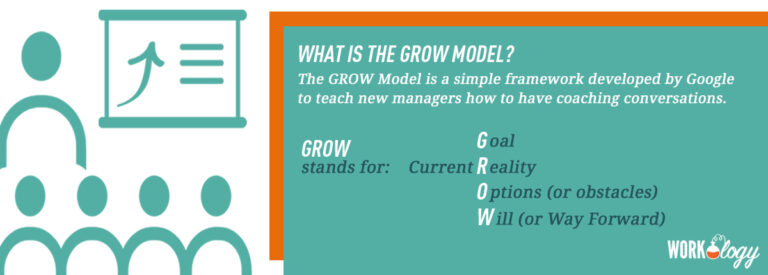
The GROW model is a coaching framework that helps managers structure productive conversations with employees.
GROW stands for:
- G: Goal – What do you want to accomplish?
- R: Reality – What’s happening right now?
- O: Options – What could you do?
- W: Way Forward – What will you do next?
The framework is intentionally simple. That’s a good thing.
New managers don’t need another complicated management model to memorize. They need practical tools they can actually use when an employee walks into their office with a problem, misses a goal, wants to grow their career, or isn’t sure how to approach a situation.
The GROW model gives you a place to start.
Why Should Managers Use Coaching?
Let’s talk about one of the biggest management traps: becoming the answer machine.
An employee comes to you with a problem. You immediately tell them what to do.
Problem solved, right? Maybe.
But if you do that every time, you can accidentally train your team to bring every problem back to you.
That’s not empowerment. That’s dependency.
Good coaching helps employees develop the ability to think through problems, evaluate options, make decisions, and take ownership of their work.
It also gives managers an opportunity to understand what’s actually getting in the way.
Sometimes the employee needs a skill.
Sometimes they need clarity.
Sometimes they need a resource.
Sometimes there’s a process problem that has nothing to do with the employee at all.
And sometimes they just need someone to ask, “What do you think we should do?”
That question can be surprisingly powerful.
How the GROW Model Works
The GROW model can be used for career development conversations, performance coaching, problem-solving, goal setting, and everyday management conversations.
Here’s how each stage works.
1. Goal: What Do You Want to Accomplish?
Start by getting clear about the desired outcome.
What does the employee want to accomplish? What does success look like?
This is where managers can help employees turn a vague concern into a specific goal.
For example: “I want to get better at presenting.”
That’s a good starting point, but it’s not yet a particularly useful goal.
You might ask:
- What specifically would you like to improve?
- What would being better at presenting look like?
- What presentation skill would make the biggest difference for you?
- When would you like to feel more confident doing this?
- How will you know you’ve improved?
The goal should ultimately be clear enough that both the manager and employee understand what they’re working toward.
And remember: the employee should have a voice in the goal.
Coaching isn’t the manager handing an employee a goal and calling it development.
2. Reality: What’s Happening Right Now?
Now it’s time to understand the current situation.
This is where managers need to resist the urge to jump straight into solution mode.
Ask questions. Listen. Get curious.
What’s working? What’s not? What has the employee already tried? What obstacles are they experiencing?
Try questions like:
- What’s happening right now?
- What’s getting in the way?
- What have you already tried?
- What’s working?
- Where are you getting stuck?
- What do you think is contributing to the problem?
- What support do you need from me?
This step is important because managers don’t always have the full story.
The problem you think you’re solving may not actually be the problem.
3. Options: What Could You Do?
Now it’s time to explore possibilities.
This is the brainstorming portion of the conversation.
And here’s another place where new managers can accidentally take over.
If you immediately tell the employee what you would do, you’ve skipped the coaching.
Instead, ask:
- What options do you see?
- What else could you try?
- What have you considered?
- What would happen if you tried that?
- Who could help?
- What resources are available?
- What’s the simplest next step?
You can absolutely contribute ideas as the manager. Coaching doesn’t mean sitting silently while an employee figures everything out.
But start with their thinking before you give them yours.
You may be surprised by what they come up with.
4. Way Forward: What Will You Do Next?
This is where the conversation becomes action.
The employee should leave the conversation knowing what they’re going to do next.
Ask:
- What will you do?
- What’s the first step?
- When will you do it?
- What support do you need from me?
- What might get in the way?
- When should we check in again?
- How will you know you’ve made progress?
Don’t let a coaching conversation end with “I’ll think about it.” That’s not a plan.
Turn the conversation into one or two specific actions with a timeline and clear ownership.
And then follow up.
Coaching without follow-up is just a really nice conversation.
A Simple GROW Coaching Conversation Example
Let’s say an employee tells you: “I don’t feel confident leading meetings.”
Instead of responding with, “You need to speak up more,” you could walk them through the GROW framework.
Goal:
“What would you like to be able to do differently when you’re leading a meeting?”
Reality:
“What happens today when you feel uncomfortable or lose confidence?”
Options:
“What could you try before or during your next meeting?”
Way Forward:
“Which of those ideas are you going to try in your next meeting, and how can I support you?”
Now you’ve moved from giving advice to developing the employee’s ability to solve the problem.
That’s the difference.
When Should Managers Use the GROW Model?
You don’t need to schedule a formal coaching session every time you use GROW.
In fact, the framework can be particularly useful during everyday management conversations.
Use it when an employee:
- Is struggling with a problem
- Wants to develop a new skill
- Is preparing for a new responsibility
- Needs help setting a goal
- Is working through a performance challenge
- Wants to explore a career goal
- Is feeling stuck
- Has an idea but doesn’t know where to start
- Needs to take more ownership of a problem
It can also be useful during regular one-on-ones.
Instead of every one-on-one becoming a status update, managers can use coaching questions to help employees think, grow, and take ownership.
Coaching Isn’t the Same as Avoiding Accountability
This is an important distinction.
Coaching is not an excuse to avoid difficult conversations.
If an employee has a performance problem, the manager still needs to address it.
If expectations aren’t being met, the manager needs to be clear about those expectations.
If there is misconduct or a policy issue, that requires appropriate action.
And sometimes the manager needs to make the decision.
Good coaching and good accountability can exist together.
In fact, the best managers know when to coach, when to teach, when to give direct feedback, and when to make a decision.
That’s why becoming a manager is so much more complicated than learning how to delegate work.
What Great Managers Do Differently
The GROW model is one tool. It isn’t a replacement for good management.
Managers who effectively coach their teams also tend to build several other skills:
They listen before they solve.
They don’t assume they know what’s happening before hearing the employee out.
They create clarity.
Employees understand what success looks like and what is expected of them.
They develop people instead of creating dependency.
The goal isn’t to make yourself indispensable. It’s to make your team more capable.
They give feedback regularly.
Performance conversations shouldn’t be saved for the annual review.
They remove obstacles.
Sometimes the manager’s most important contribution is getting something out of the employee’s way.
They know when to coach and when to lead.
Not every situation requires a coaching conversation.
They follow up.
Development doesn’t happen in one conversation. Managers have to keep showing up.
New Managers Need More Than a Title
One of the mistakes organizations make is promoting someone into management because they’re great at their job and then giving them a laptop, a new title, and absolutely no management training.
Please don’t do that.
Being a great individual contributor doesn’t automatically teach someone how to coach, delegate, give feedback, manage performance, navigate conflict, document effectively, or have difficult conversations.
Those are skills.
And skills can be learned.
That’s why I believe manager training should begin before or immediately after someone steps into a management role, rather than waiting until there’s a problem.
Managers need practical tools they can use in the moments that matter.

Build Better Managers With Practical Training
If you’re responsible for developing new managers, don’t make them figure it out as they go.
Our Manager Essentials Minicourses are designed for new and soon-to-be managers who need practical training on the skills they actually use every day, including feedback, documentation, coaching, delegation, and conflict.
The courses are short, focused, and designed to fit into a busy manager’s schedule. Each topic gives managers a practical framework they can take directly back to work.
Because management training shouldn’t just teach managers what good leadership looks like. It should help them actually do it.
And if you’re building a broader manager development program, Workology offers additional management training programs and courses covering essential skills for managers and HR leaders.
The goal isn’t to create perfect managers.
It’s to give managers the tools, confidence, and support to lead people well.
Because your employees shouldn’t have to learn management by being managed badly.
Final Thoughts
The GROW model is simple, but don’t confuse simple with easy.
Good coaching requires managers to slow down, listen, ask thoughtful questions, and resist the urge to immediately jump in with the answer.
That’s a skill worth developing.
When managers coach effectively, employees have more opportunities to build confidence, solve problems, develop new skills, and take ownership of their work.
And when you develop better managers, you’re not just helping individual leaders.
You’re building stronger teams.
That’s what good manager training should do.


