ELB readers might know that I tend to blog a decent amount about federal courts issues in election law more generally, and standing issues in election law more specifically. Standing in People Not Politicians v. Onder was certainly an issue. The Supreme Court’s decision included the footnote, “We conclude that at least one of the applicants has standing on appeal.”
Given that the Court offered five pages of reasoning in a unanimous* decision, it is no surprise it took three days to get the opinion out the door. Getting nine justices to agree, especially given that every line with respect to Purcell will receive intense attention in the years ahead, is a challenge. But at least some felt compelled to include this line, especially as one judge at the court of appeals specifically raised it. (The majority in the Eighth Circuit included a conclusory statement that the organization had standing on appeal.)
The standing issues are tricky, but there are, in my view, at least four plausible bases for standing.
1. The referendum proponents had standing in state court to challenge the Secretary of State’s decision that the referendum petition was invalid. State law clearly empowers the proponents to do so. This comports with, in a way, Berger, and 8-1 decision back in 2022, which recognized that the state could create a right to intervene in a case that a federal court would recognize. Likewise, the state can designate who will represent its interests in federal court–typically, the state itself. But sometimes relators may do in certain election cases (per Lance v. Coffman).
But does that mean state law empowers the proponents to do so here? The crucial example the other way is Hollingsworth v. Perry, which Judge Stras cites in his opinion in the Eighth Circuit. There, California initiative proponents share an injury with everyone else, a generalized grievance.
While the proponents (or under state law, any citizen) might have had standing in state court to defend the referendum’s ability to get on the ballot this November, and while that could perhaps translate to federal court, the crucial difference is that in federal court, everyone agreed the ballot measure would appear in November. Instead, proponents wanted to also defend the current effect of the law, which is to say, the 2025 map did not take effect because of the referendum. Judge Stras saw that as a generalized grievance. Proponents argued that this interest was part and parcel of their right under state law. This is a messier issue, and certainly one that turns on both a dispute about state law and how far federal law could go to recognize the injury.
2. The proponents separately might claim that they have an interest to defend a judgment that will be effectively undermined in a collateral federal court proceeding. This was not litigated (to my knowledge), but I have been puzzling over it the last few days. That is, the federal court judgment would effectively undermine the victorious judgment they received in state court. A federal court judgment would basically supersede, in a collateral proceeding, the state court judgment. That collateral proceeding would entitle them to participate for the risk that the federal court would turn their state court injury into a loss.
It is something like ASARCO, a Supreme Court case that recognized that even though plaintiffs would have not had standing in federal court in an original proceeding, they have standing on appeal from a state court judgment, because it is that judgment that creates the injury. Taxpayers generally bring “generalized grievances” in federal court, which is not a recognized injury-in-fact. Some states allow taxpayers to bring claims. And if a taxpayer petitions for certiorari from a state supreme court judgment, then that taxpayer does have appellate standing, because the injury arises from the adverse judgment.
Likewise, it would be possible to think that the federal court order, which superseded their victorious judgment in state court, created such an injury as to permit appellate standing.
Possible to think. Again, this is a novel and challenging issue. Unlike Hollingsworth, there is a parallel proceeding with a favorable judgment for the proponents here.
3. One of the proponents also raised the issue that he has already mailed in his absentee ballot. The district court’s injunction would end up requiring the state to revert to the 2025 map, resort the voters, and send the voter a new ballot. There is a non-trivial risk that the voter would be disenfranchised out of this process–because the state accidentally tries to tabulate his first ballot, the state rejects his ballots because it accidentally determines he attempted to vote twice, the state fails to send a second ballot, or other meaningful election administration disruptions that increase the risk of disenfranchisement. Non-trivial risk, but, of course, the degree of risk is a material issue to determine whether it is an “imminent risk” or a speculative one for standing purposes.
Even beyond that risk, however, the voter would have to go through the steps of casting a ballot a second time in order to make his vote effective. That is certainly a burden, even if a relatively small one, but enough likely to trigger an injury. Indeed, drawing from DHS v. League of Women Voters, decided just days earlier, such an injury is cognizable:
To start, we consider the likelihood that this Court would reverse. At least one of plaintiffs’ members (J. Doe 4) is registered to vote in a State (Louisiana) that used the modified SAVE program. She has demonstrated that SSA records do not accurately reflect that she is now a naturalized citizen. Supplemental Decl. of J. Doe in No. 25–cv–3501 (D DC), ECF Doc. 16–3, ¶¶2, 14. Had the modified SAVE program not been set aside, she likely would have been required to provide additional proof of citizenship. Such a “need to take . . . affirmative steps to avoid risk of harm . . . constitutes a cognizable injury” supporting standing. Meese v. Keene, 481 U. S. 465, 475 (1987).
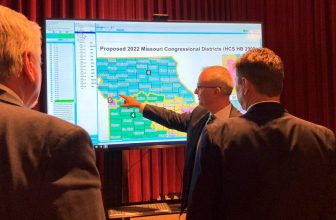
4. One of the proponents is also a voter, and he would be in one district under the 2022 map and another in the 2025 map. This case was messy–Judge Stras saw nothing in the record that indicated such, nor did the majority in a footnote (n.11), and it wasn’t until the reply to the Supreme Court that there was a clear identification in the record about his location. (A separate blog post about extremely fast moving election law cases with literally no trial court hearing or meaningful opportunity to develop the record might be forthcoming….) If he were in the same districts, this would flunk Gill v. Whitford, but, on this demonstrated fact, it would appear to passing muster, as this is usually all that’s required in the run-of-the-mill redistricting dispute.
*
Four reasons, at least. It’s possible the record was too underdeveloped for the Court to reach consensus on an approach. Or that there were competing theories about how to get there. (4) might have been the easiest, especially given that two opinions on the Eighth Circuit seemed to think it was a factual, not a legal, problem. And (3) appears to track a very recent Supreme Court decision. But perhaps there was enough uncertainty among the justices to punt on the questions and to resolve the issue as quickly and amicably as possible.
I am grateful to Sam Bray and Will Baude for feedback on this topic.
*Some might argued that the opinion is not unanimous because it is possible some justices silently dissented. To me, I interpret silence as acquiescence, because, in my view, there are no abstentions in judicial decisionmaking. Bush v. Palm Beach Canvassing Board and Purcell v. Gonzalez were, likewise, unanimous, in my view.