Iterate Like It’s Debate Club.
As my teams go about their work these days, I observe how often they turn to Claude or Grok for assistance almost immediately. Throughout their work, they continue to partner with these non-human assistants, relying on them to do much of the cognitive work and following development. It makes me squirm with discomfort, and yet I see the benefits.
AI-generated responses to queries are impressively researched, thoughtful, and even presented artistically. Attractive tables with comparisons, anticipated consequences, and alternatives to consider yield distribution-ready reports. It makes us look like we’ve done a ton of homework. Indeed, it may have done a better job than we normally have time to do even if we had the skills, resources, and wisdom to do it.
What’s The Matter?
My worry is that just as our muscles weaken without exercise, our minds risk growing lazy and dependent on AI, ultimately leading to diminished capacity. Already, I see AI dependencies. Additions? I don’t know what lies at the end of this road, but I’m pretty sure that’s not a place where I want to end up.
My spelling abilities have dwindled just from knowing any wild guess will be sufficient to summon any correction needed. I don’t even make very serious efforts anymore. They aren’t needed. It feels like a waste of time to set and think through until the correct spelling occurs to me (if it ever will). What do I remember from these moments? I remember I don’t really need to learn the spelling of troublesome words. Future guesses will always be sufficient. Diminishing mental capacity? Sure enough. It’s not fiction. It’s happening.
So, Doom And Gloom?
No, no. There’s a bright side. A very bright side.
When I’m designing, and as I ask our designers to do, I always plan for multiple passes. Iterations. First ideas that seem to sparkle in the sun nearly always tarnish quickly after we’ve let them rest for a bit and then question them afresh and consider alternatives. In the Successive Approximation Model (SAM), we require of ourselves a minimum of three unique designs, deliberately tossing aside approaches we began to love while we try for something quite different.
The result of design iterations is always a significantly improved design ready for verification with a few learners (and probably some important modifications resulting from their input) before final buildout begins.

Image provided by Allen Interactions.
Now with AI, I find that I’m not only iterating but also thinking on a higher plane because I’m admittedly eager to find faults in AI’s work. It’s both fun and productive. And no hurt feelings. It’s just as way back in high school debate club when we did our best to take and defend opposing positions to see which would survive. With AI’s growing experience, I find it using my own past positions as justification for its design notions. In a sense, it creates a healthy forum for questioning one’s own postulates and either reaffirming them, modifying them, or building on them. All within typical project time limits and constraints. Great stuff! It’s truly challenging us to work our brains and get smarter!
A Word Of Caution
Iterating with AI can consume a lot of time and, if we’re not careful, easily overtake the advantages of its assistance. The work moves quickly at first, but then getting AI to refine nuances and produce the final product can take many frustrating, time-consuming corrections. If something can go wrong, it tends to.
The iterations we value are not those kinds of corrections, but rather the ones in which we are thinking through alternative approaches. Once we’ve decided on the approach we want, it’s best to stop trying to get AI to make all the final adjustments to its richly formatted documents or code. Just take the closest AI-generated output and modify it unassisted. Reserve as much of your time for concept and design development as possible, and you’ll come out ahead.
Happy Outcomes On Multiple Fronts
I’ve not yet seen AI, even with its access to vast resources and history of prompted refinements, generate instructional designs I’d want my name on. While AI-generated designs do get better over time, notably so, we always find critical omissions, misinterpreted or inappropriately applied axioms, lack of psychological sensitivity, and other faults.
I often find impressive jargon from AI that doesn’t say anything meaningful. Little depth. For the less inexperienced designer, it can provide the appearance of proficiency and some impressive presentation slides. Even for the expert designer, there’s the temptation to just go with unexamined AI-generated content and designs. Good enough, right? Most organizations can’t (or at least don’t) examine their training closely. They don’t discriminate between training that has the power to upskill performance and that which presents pretty content. So, good enough. But not for learners.
Expertise Pays Off Like Never Before
What’s really wonderful is that with AI facilitation, creative experts can design and build learning experiences they’ve only been able to imagine, knowing they wouldn’t have the time or resources to pursue. We can now refine interactions, develop adaptive learning paths that individualize in much greater depth than just selecting which module to branch to next. We can, for example, sense and respond to how learners are feeling.
For example, we can now seriously take on the challenges of:
- Performing continuous assessment, with personal baseline and population comparisons.
- Prompting and assisting in ways differentiated by how individual learners have been reacting.
- Encouraging those with low self-efficacy and challenging those with spuriously high self-efficacy.
- Addressing not only competency but also performance confidence at the same time.
- Providing spaced practice that adjusts in real time to workflow needs.
- Truly accepting the assignment of bringing each learner to the joys of proficiency.
Partnering with AI can facilitate almost every task in the production of great learning experiences to varying degrees. As we move from developing a relationship with the organization and people to be trained to launching learning experiences, AI can assist in increasing ways, as suggested below:
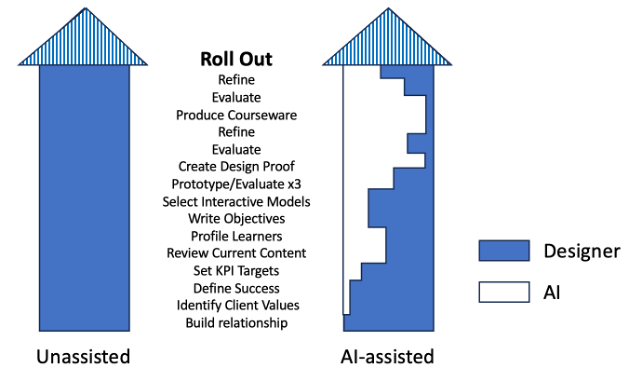
Image provided by Allen Interactions.
New Risks And Opportunities
I’m seeing a temptation to just let AI create the training. There are plenty of vendors trotting out the polished hyperbole, “Generate great elearning literally in seconds.” Much of it, in my opinion, doesn’t even qualify as elearning, let alone “great” elearning. I’ve seen demos of their tools, one of which even generated a course on instructional design for me, stating the essential characteristics of effective elearning well and then proceeding to violate almost every one of those characteristics in the course it generated!
AI will continue to get better over time, but we’d be missing perhaps the greatest opportunities we’ve ever had for digital instruction if we didn’t use our own, uniquely human abilities to lead, refine, and generate instruction that has that critical human element. We are needed now, as much as ever. And have thankfully lost many excuses for not producing great learning experiences that waste not one moment of a learner’s time.