
Listen to this article
Estimated 4 minutes
The audio version of this article is generated by AI-based technology. Mispronunciations can occur. We are working with our partners to continually review and improve the results.
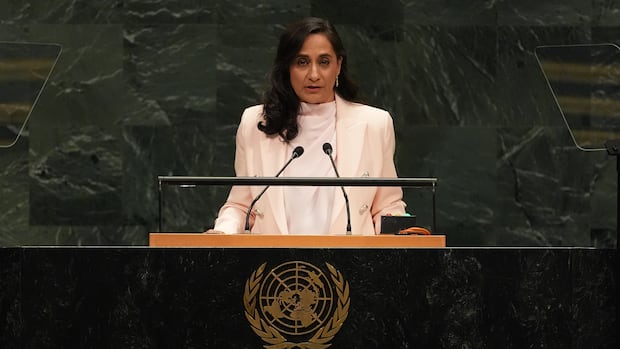
Foreign Affairs Minister Anita Anand says Canada’s foreign policy is guided by establishing autonomy in strategic fields to limit superpower coercion, along with aspirations to lead middle powers.
“Great powers are walking away from global economic co-operation, dismantling economic integration,” Anand said Saturday in Canada’s annual address to the United Nations General Assembly.
“In the face of this rupture, Canada’s goal is to achieve greater strategic autonomy,” she said at the green marble dais.
Anand’s speech echoed Prime Minister Mark Carney’s rhetoric over the past year about middle powers forging deeper ties and working with countries on shared goals, including states that aren’t close partners.
She said that involves emerging technologies, critical minerals, defence production and energy — as well as the rule of law and respect for sovereignty.
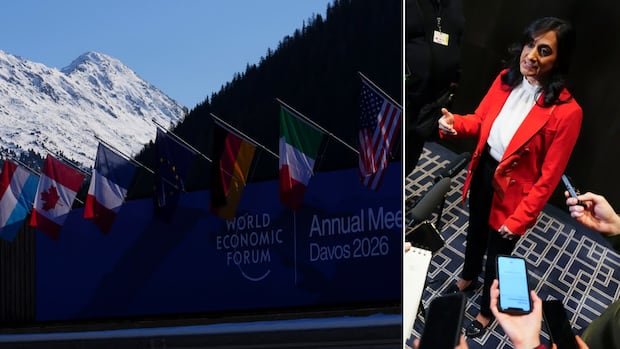
Chief political correspondent Rosemary Barton speaks with Foreign Affairs Minister Anita Anand about her trip with Prime Minister Mark Carney to diversify Canadian trade ahead of Davos and the international response to his speech to the World Economic Forum. Plus, retired Dutch admiral Rob Bauer, who chaired the NATO Military Committee, discusses U.S. President Donald Trump’s threats to annex Greenland, what tension remains in the alliance and how far the deal with NATO will go to subdue Trump’s desire for the U.S. to own the Arctic island.
“We are facing serious challenges in the global order,” Anand said.
“We will lead other middle powers to act collectively and decisively, because middle powers are playing a key role in building the framework for the new international order — which is being established as we speak.”
Anand used an analogy that she said comes from her roots in rural Nova Scotia.
“The tide does not wait; you must move with it.”
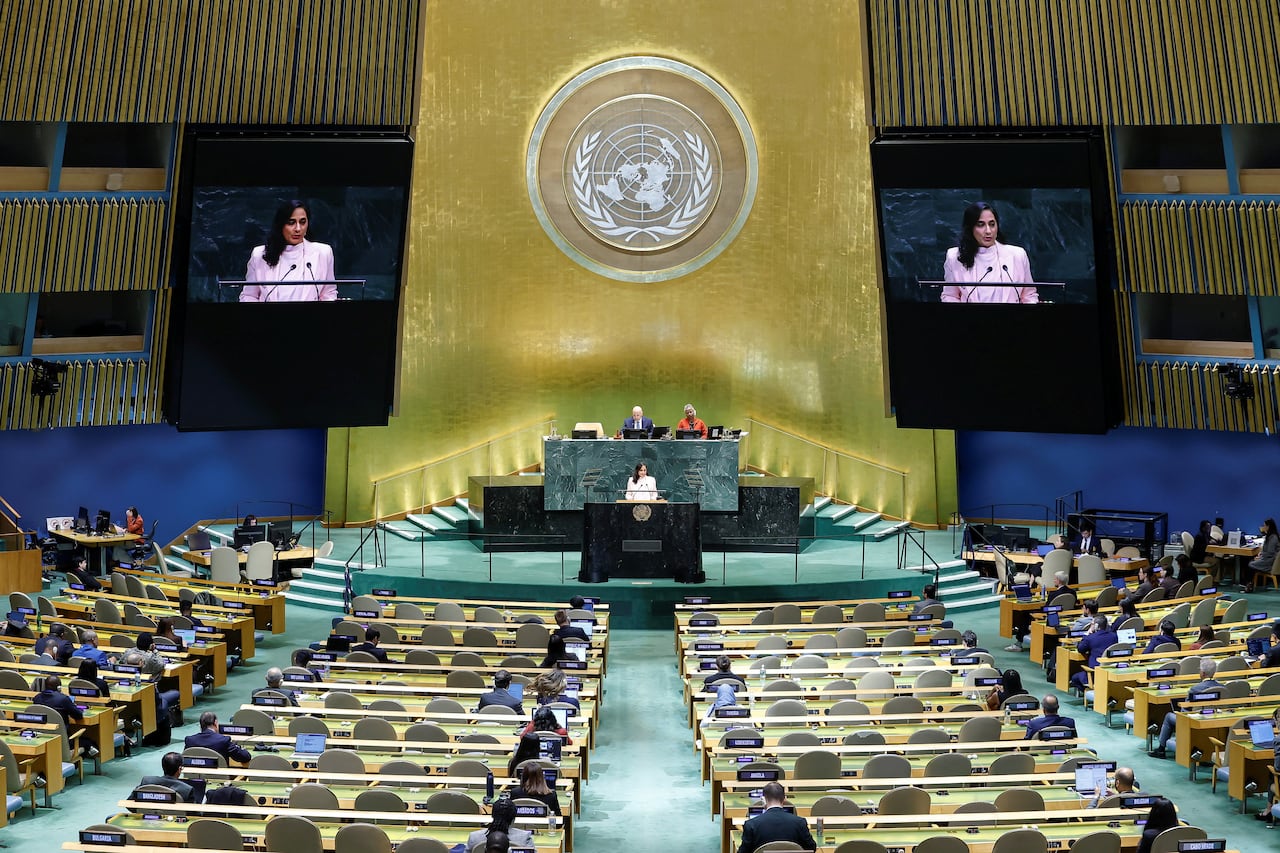
Anand said state sovereignty “has been treated with disdain” but that Canada will defend that principle, and work toward stability and common rules.
She said that is why Canada is calling for a just peace in Ukraine, self-determination for Palestinians and Israelis, and an end to hate-based violence.
“We were tragically reminded of the scourge of antisemitism again when a gunman carried out an attack on a synagogue in Belleville, Ont.,” she told the UN.
“Canada is an open, pluralistic society, with a public square full of robust and civil debate. Our success is underpinned by this civility, by our democratic institutions and by respect for our differences,” she said.
For the second year in a row, Anand spoke instead of Carney, who was at the UN from Monday to Wednesday but whose officials said he could not deliver Canada’s address due to scheduling issues.
The UN schedules foreign ministers later in the rotation during the annual high-level week, with weekday, daytime speeches reserved for heads of state and government. Anand spoke late Saturday afternoon.
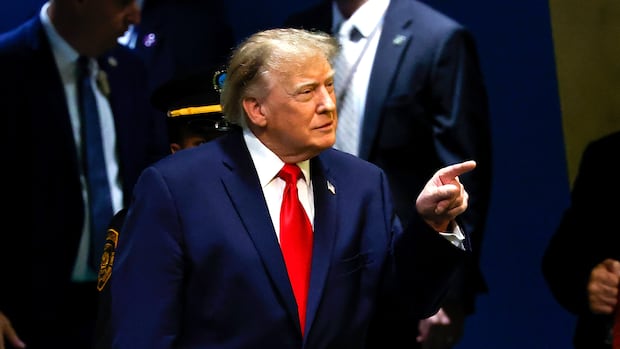
U.S. President Donald Trump delivered a boastful, combative speech to the United Nations General Assembly in which he mused over ‘annihilating’ Iran and even hinted at U.S. regime change in Cuba, prompting the Cuban delegation to walk out.
Anand also voiced support for the NATO alliance, amid an increase in warnings from European leaders about Russian hybrid attacks. She cited a recent defence agreement between Denmark, its autonomous territory Greenland and U.S. President Donald Trump.
“This agreement is yet another reminder that North America and Europe are stronger together. And as a founding member of NATO, our commitment to the transatlantic alliance is ironclad,” Anand said.
To that end, Anand reiterated work being done to better secure the Canadian Arctic, saying this is occurring in lockstep with Indigenous Peoples.
Anand said Canada supports the International Criminal Court amid Washington’s quest to dismantle the institution. Her comments come as Canadian critics argue Ottawa is not calling out American coercion, including the sanctioning of a Canadian judge for her work at the ICC.
She reiterated Canada’s bid for a seat on the UN Human Rights Council, through a vote expected in one year.
Anand said Ottawa is pursuing “values-based realism” while advocating for democracy in Iran, the return of Ukrainian children kidnapped by Russia and work to end Haiti’s gruesome gang crisis.
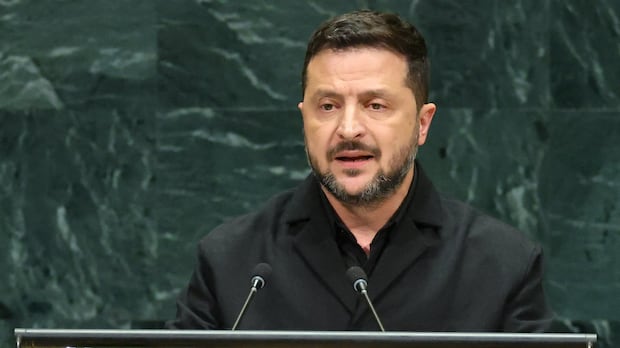
After nearly five years of war, Ukraine’s President Volodymyr Zelenskyy addressed the UN General Assembly in New York, laying out Kyiv’s strategies to drain Russian resources and end the conflict.
Her speech mentioned gender equality, LGBTQ+ rights, Sudan’s civil war, Hamas attacks on Israel, Israeli settler violence against Palestinians and safe approaches to artificial intelligence.
Anand also said Canada is ready to work with whoever UN members elect as their next secretary general, referring in French to the role in the masculine and feminine titles.
That comment followed the Trudeau government calling for a woman to be the next secretary general, in September 2024. The Carney government has not repeated that call.