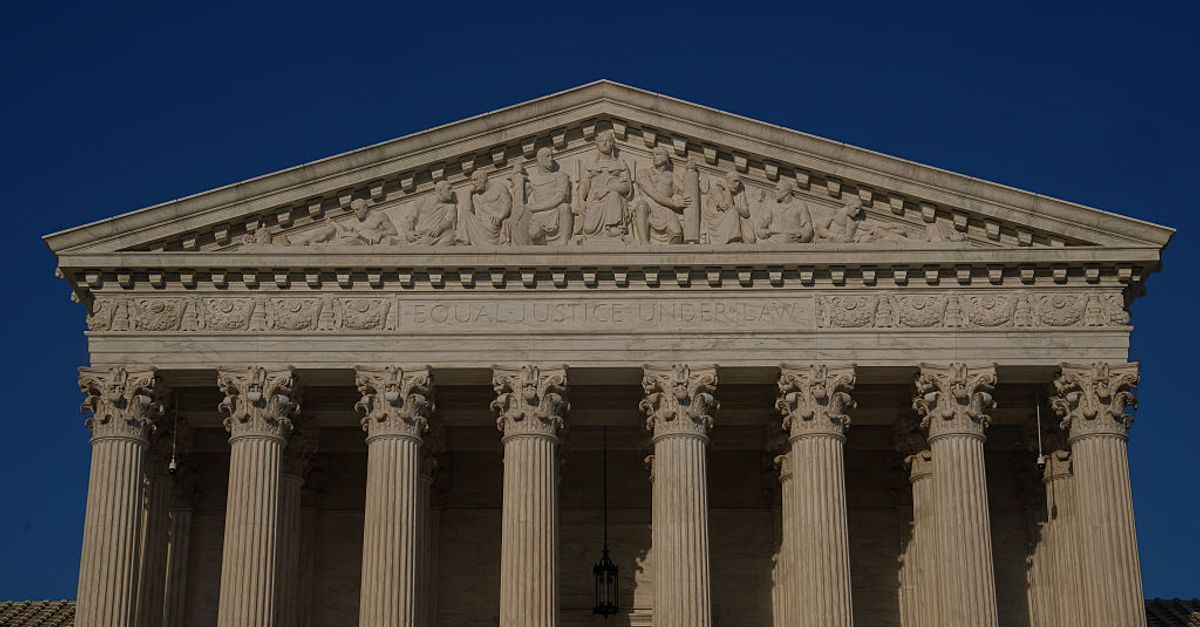
Telling the justices that it had been deprived of “an essential tool to remove certain aliens, including some of the worst criminal aliens,” the Trump administration came to the Supreme Court on Thursday afternoon. Specifically, U.S. Solicitor General D. John Sauer asked the court to clear the way for the government to deport noncitizens to countries that are not identified in their removal orders – a procedure known as “third-country removals.”
The 42-page filing was the third time that the Trump administration has asked the Supreme Court to intervene in the battle over third-country removals. Sauer told the justices on Thursday that “[t]he latest order” by U.S. District Judge Brian Murphy barring the third-country removals “rests on the same fundamentally flawed legal premises as the previous rulings.” Sauer also asked the court to enter an “immediate administrative stay” – an order that would allow the government to continue deportations while the justices consider his request.
Justice Ketanji Brown Jackson, who has initial responsibility for emergency appeals from the U.S. Court of Appeals for the 1st Circuit, from which the case hails, directed the immigrants in the case to respond to the government’s request by 4 p.m. EDT on Monday, September 28.
The dispute began last year, in the wake of a Jan. 20 executive order in which President Donald Trump instructed the Department of Homeland Security to take “all appropriate actions” to remove noncitizens who were in the United States despite having orders to deport them.
That order prompted DHS to issue internal guidance in February instructing a division of U.S. Immigration and Customs Enforcement to determine whether undocumented immigrants who had received deportation orders but had not yet been removed because of the possibility that they would be tortured if they were returned to their home countries could instead be removed to a different country. Additional guidance issued the following month indicated that before immigrants can be removed to a country that is not specifically identified in their removal orders and that has not assured the United States that the immigrants will not face torture, DHS must follow a series of procedures: It must notify the immigrants of the planned removal, give them a chance to “affirmatively express” fear that they will face torture, and – if needed – conduct a screening to determine the likelihood that they will indeed be tortured.
In March, four immigrants with removal orders went to federal court in Massachusetts, where they argued that they feared being removed to a country that was not identified in their orders.
Murphy issued an order that barred the government from deporting the immigrants and others like them to third countries without first providing their lawyers and them with written notice of the third country to which they might be removed, as well as a “meaningful opportunity” to challenge that removal. DHS should also, Murphy instructed, decide whether the immigrants’ fears of torture were “reasonable,” rather than whether it is “more likely than not” that they will be tortured. If immigrants cannot make that showing, Murphy added, DHS must give them at least 15 days to seek to reopen their immigration proceedings.
Sauer went to the Supreme Court for the first time, asking the justices to put Murphy’s order on hold while the government’s appeal moved forward. Over a dissent by Justice Sonia Sotomayor that was joined by Jackson and Justice Elena Kagan, the court on June 23 granted that request.
Sauer returned to the court for the second time one day later, asking the justices to “clarify[]” that, in the wake of their first order, the Trump administration could move forward with the deportation of eight men being held on a U.S. military base in Djibouti after Murphy had ruled that efforts to remove them to South Sudan violated his order.
On July 3, the court issued a brief opinion in which it indicated that its June 23 order paused Murphy’s order “in full” – and also applied to his later order regarding the South Sudan deportations. Kagan wrote a brief concurring opinion, in which she indicated that although she disagreed with the court’s decision to pause Murphy’s order, she did “not see how a district court can compel compliance with an order that this Court has stayed.” Sotomayor again dissented, joined by Jackson.
When the case went back to the lower courts, Murphy issued a final judgment in the immigrants’ favor and threw out the third-country removal policy. He ruled (among other things) that before immigrants can be removed to a third country, they have the right to “meaningful notice” and a “meaningful opportunity” to contest removal to that third country on the ground that they have a reasonable fear of being persecuted or tortured there.
On Friday, the U.S. Court of Appeals for the 1st Circuit largely upheld Murphy’s ruling, and on Wednesday it dissolved the March 16, 2026, order that put Murphy’s ruling on hold while the government appealed.
The Trump administration then came to the Supreme Court for the third time on Thursday afternoon, asking the justices to intervene. Sauer wrote that the reinstatement of Murphy’s order has “created substantial logistical problems with ongoing removal operations—including the cancellation of flights—and led to added expense, potential diplomatic issues, and the inability to remove dangerous criminals.”
Sauer contended that Murphy and the court of appeals had “simply relied on the same meritless grounds on which” the earlier order in the immigrants’ favor was based. “The courts,” he said, “again disregarded multiple jurisdictional bars that preclude” courts from reviewing an immigrant’s “claims of persecution or torture except in a petition for review from a removal order. And they again rejected the government’s reliance on countrywide assurances that particular nations will not torture or persecute anyone.”
If the third-country deportation process is delayed, Sauer said, “the consequence … is that the government will often need to restart the entire removal process afresh, freezing things as the government attempts to rework arrangements with foreign countries.”