Please provide your email address to receive an email when new articles are posted on .
We were unable to process your request. Please try again later. If you continue to have this issue please contact [email protected].
Key takeaways:
More than 23% of adults with HCV infection who initiated DAA therapy had no follow-up test.
Improving testing and combining prescription and laboratory data could help monitor HCV elimination progress.
Approximately one in four adults with hepatitis C virus infection who initiated treatment with direct-acting antivirals did not undergo follow-up RNA testing, according to a research letter published in JAMA Network Open.
However, 90% of that unmonitored population had been prescribed at least 56 days of DAA therapy, potentially leaving cured individuals unaccounted for and highlighting a notable gap in HCV surveillance efforts.
Data derived from Symum H, et al. JAMA Netw Open. 2026;doi:10.1001/jamanetworkopen.2026.21736.
“Measuring care outcomes is essential to monitoring progress toward hepatitis C elimination,” Hasan Symum, PhD, of the CDC’s division of viral hepatitis, and colleagues wrote.
More than 95% of people with HCV who are treated with DAAs achieve sustained virologic response, or cure, with no detectable HCV RNA at least 12 weeks after completing treatment, according to the researchers.
Documentation of DAA initiation also has been used to monitor HCV treatment success.
To better understand HCV care outcome measures, Symum and colleagues used the HealthVerity database to analyze longitudinal laboratory results, pharmacy claims and insurance enrollment information for more than 4.5 million U.S. adults who underwent at least one HCV antibody, RNA or genotype testing between Jan. 30, 2019, and June 30, 2022.
Analysis included 91,491 individuals (53.2% men) who ever had HCV and were insured. Of those, 82,422 individuals (90.1%) received at least one HCV RNA test.
Sixty-two percent (n = 51,068) of those tested had initial HCV infection. More than one-third (39.9%) achieved viral clearance, 35.7% initiated treatment and 26.1% had viral clearance after treatment initiation.
Of those with initial infection, 38.3% did not undergo follow-up RNA testing. More than three-quarters (78.4%) had no evidence that treatment was initiated.
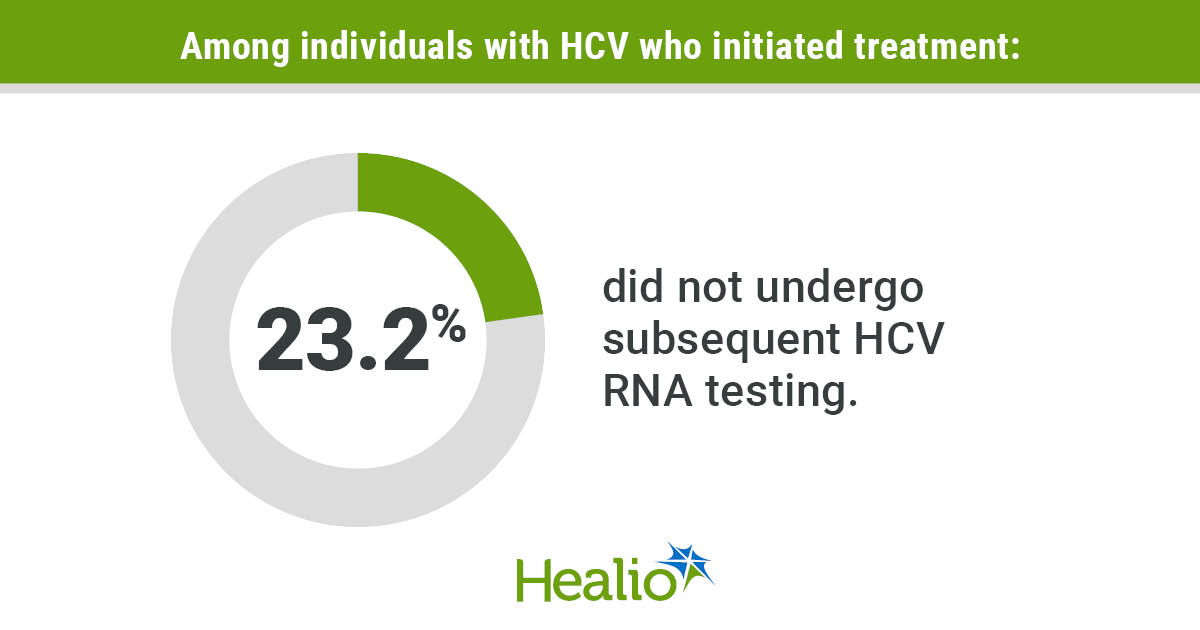
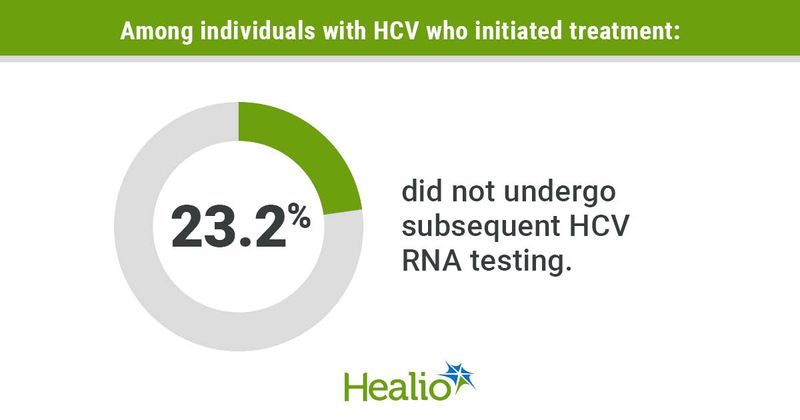
Of the 18,246 individuals who did initiate treatment, 73.2% had a negative follow-up test result, 3.7% had a positive result and 23.2% had no evidence of testing.
However, 90.8% of those with no follow-up testing had been prescribed at least 56 days of DAAs and “likely achieved treatment-induced viral clearance,” Symum and colleagues wrote.
Of the 32,822 individuals who did not start treatment, 21.3% had a negative follow-up test result, suggesting spontaneous clearance or undocumented treatment, according to the researchers. Nearly one-third (32.1%) had a positive results and 46.7% had no follow-up test.
Symum and colleagues acknowledged several study limitations, including the possibility that insurance claims were not filed for treatment, potential misclassification of infection status or outcomes, and exclusion of individuals with unstable insurance coverage.
“Our findings suggest that improving follow-up RNA testing and integrating laboratory and pharmacy data will enhance accuracy and bridge gaps in hepatitis C testing and treatment,” they wrote. “However, when only one data source is available, viral clearance or treatment initiation can serve as reasonable substitutes for measuring viral clearance after treatment initiation.”