2026 Chess Olympiad Round 9: Uzbekistan Beats U.S. To Take Sole Lead; Chinese Women Lead After Revenge Vs. Armenia

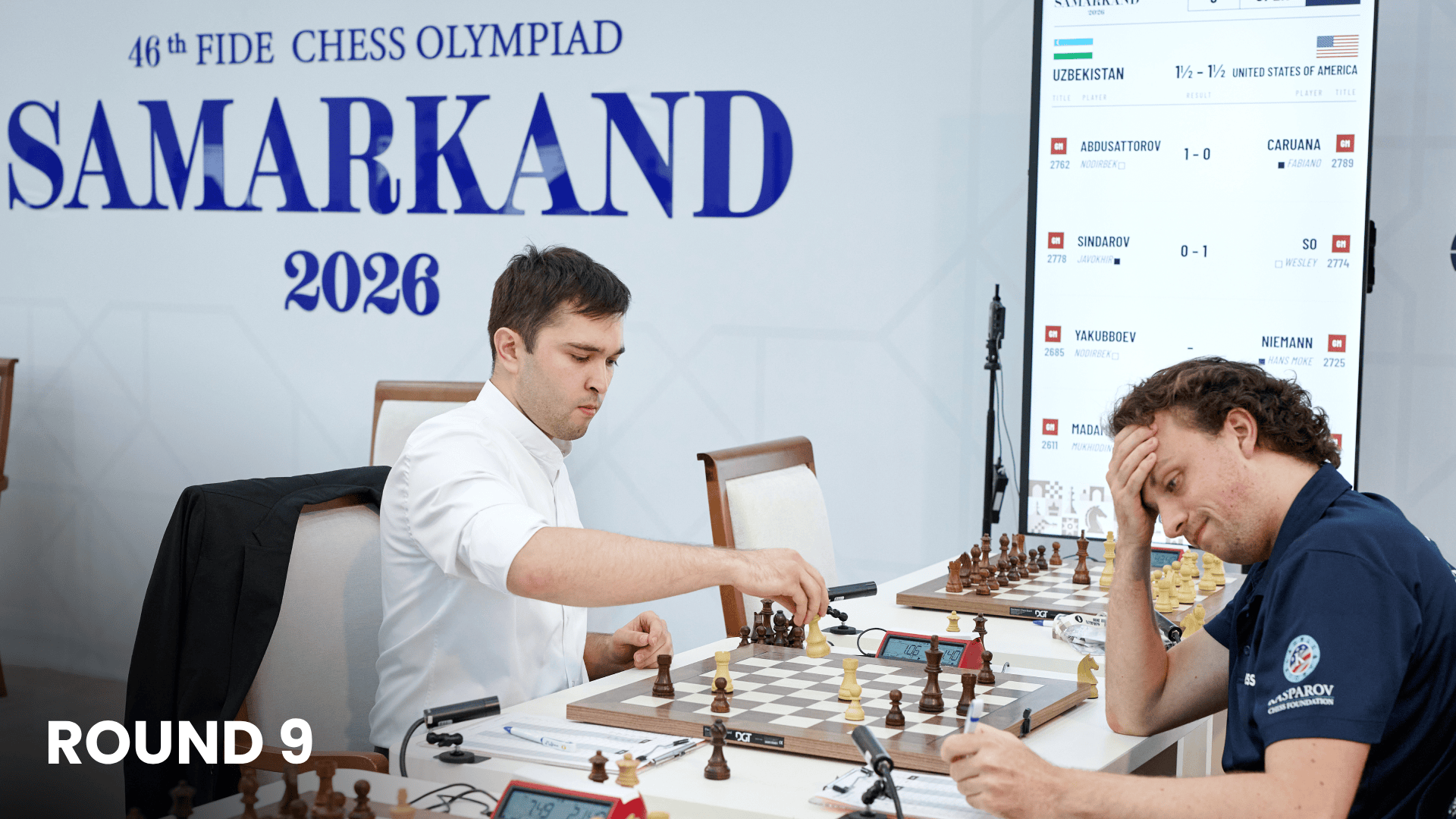
In a day full of miracles and turnarounds, Uzbekistan has regained sole lead of the 46th Chess Olympiad 2026 after beating top seed U.S. in round nine. GM Wesley So beat World Championship Challenger Javokhir Sindarov on board two, but the Nodirbeks won on boards one and three. GM Nodirbek Abdusattorov beat GM Fabiano Caruana and GM Nodirbek Yakubboev defeated GM Hans Niemann, with a draw on board four. There are three teams a point behind: India (after beating Germany 2.5-1.5), Uzbekistan 2 remarkably (after upsetting the Netherlands 3.5-0.5), and Armenia (after scoring 2.5-1.5 against Azerbaijan).
China leads the 2026 FIDE Women’s Chess Olympiad by two points after GM Zhu Jiner and IM Lu Miaoyi gained revenge over Armenia for a loss at the 2024 Olympiad. China’s job isn’t done yet, as it faces defending champion India in Saturday’s penultimate round, with GM Divya Deshmukh and IM Vantika Agrawal having given India a 3-1 win over Uzbekistan. Kazakhstan and Mongolia are also tied for second after making a 2-2 draw where only a late win for IM Alua Nurman saved Kazakhstan.
Round 10 is on Saturday, September 26, starting at 6:15 a.m. ET / 12:15 CEST / 3:45 p.m. IST.
Open: Uzbekistan Is Back On Track For Gold
Uzbekistan convincingly defeated the top seed in round nine, but each of the top four matches featured shocking developments.
Round 9 Results | Open Top 10
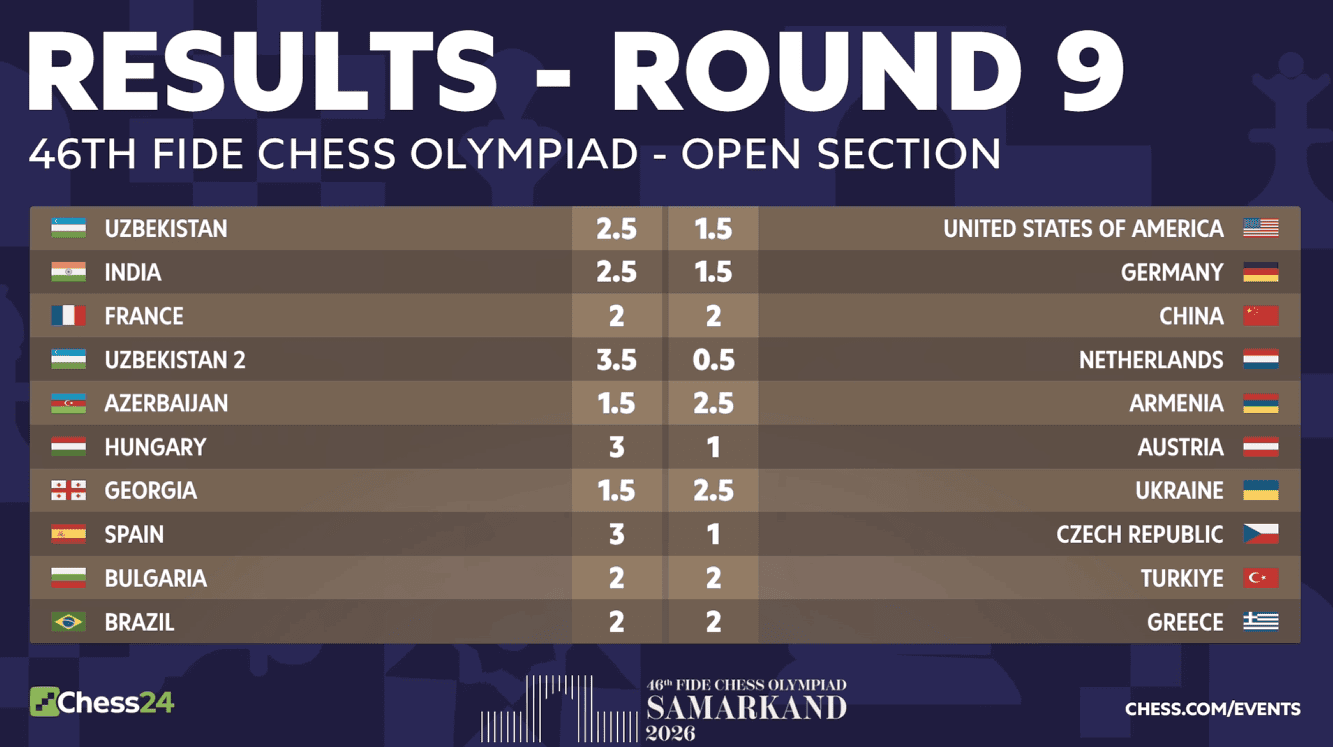
Two Uzbek teams are in the top four as we head into the last two rounds of the tournament.
Open Standings After Round 9: Top 20
| # | Seed | Fed | Team | Games | + | = | – | MP | TB1 | TB2 |
| 1 | 3 | Uzbekistan | 9 | 8 | 0 | 1 | 16 | 292.5 | 26.5 | |
| 2 | 2 | India | 9 | 7 | 1 | 1 | 15 | 262 | 23 | |
| 3 | 30 | Uzbekistan 2 | 9 | 7 | 1 | 1 | 15 | 249.5 | 24 | |
| 4 | 10 | Armenia | 9 | 6 | 3 | 0 | 15 | 241 | 23.5 | |
| 5 | 4 | China | 9 | 6 | 2 | 1 | 14 | 260.5 | 24 | |
| 6 | 5 | Germany | 9 | 7 | 0 | 2 | 14 | 254 | 23 | |
| 7 | 9 | France | 9 | 5 | 4 | 0 | 14 | 248.5 | 24 | |
| 8 | 13 | Spain | 9 | 7 | 0 | 2 | 14 | 239.5 | 24.5 | |
| 9 | 12 | Ukraine | 9 | 7 | 0 | 2 | 14 | 233 | 23.5 | |
| 10 | 8 | Hungary | 9 | 6 | 2 | 1 | 14 | 196 | 19.5 | |
| 11 | 1 | United States of America | 9 | 6 | 1 | 2 | 13 | 259.5 | 23 | |
| 12 | 7 | Azerbaijan | 9 | 5 | 3 | 1 | 13 | 243.5 | 23.5 | |
| 13 | 19 | Greece | 9 | 6 | 1 | 2 | 13 | 240 | 23.5 | |
| 14 | 14 | Turkiye | 9 | 6 | 1 | 2 | 13 | 240 | 23 | |
| 15 | 23 | Romania | 9 | 4 | 5 | 0 | 13 | 235.5 | 24 | |
| 16 | 6 | Netherlands | 9 | 6 | 1 | 2 | 13 | 233.5 | 22 | |
| 17 | 17 | Croatia | 9 | 6 | 1 | 2 | 13 | 230.5 | 24.5 | |
| 18 | 37 | Lithuania | 9 | 6 | 1 | 2 | 13 | 226.5 | 24 | |
| 19 | 28 | Bulgaria | 9 | 6 | 1 | 2 | 13 | 216.5 | 22.5 | |
| 20 | 15 | Serbia | 9 | 6 | 1 | 2 | 13 | 208.5 | 22 | |
| 21 | 24 | Argentina | 9 | 6 | 1 | 2 | 13 | 208 | 23.5 | |
| 22 | 31 | Brazil | 9 | 5 | 3 | 1 | 13 | 194 | 21.5 |
The fatigue and nerves really started to show in round nine as we saw a number of unexpected, match-deciding results, including the case of a player winning from a losing position to stay in contention for gold.
We start with the central match, Uzbekistan vs. U.S., which ultimately went the Uzbeks’ way thanks to the pair of Nodirbeks. The only draw on four boards was GM Levon Aronian vs. GM Mukhiddin Madaminov in a solid Italian Game, and the first decisive mistake came from the American side in Yakubboev vs. Niemann on board three.
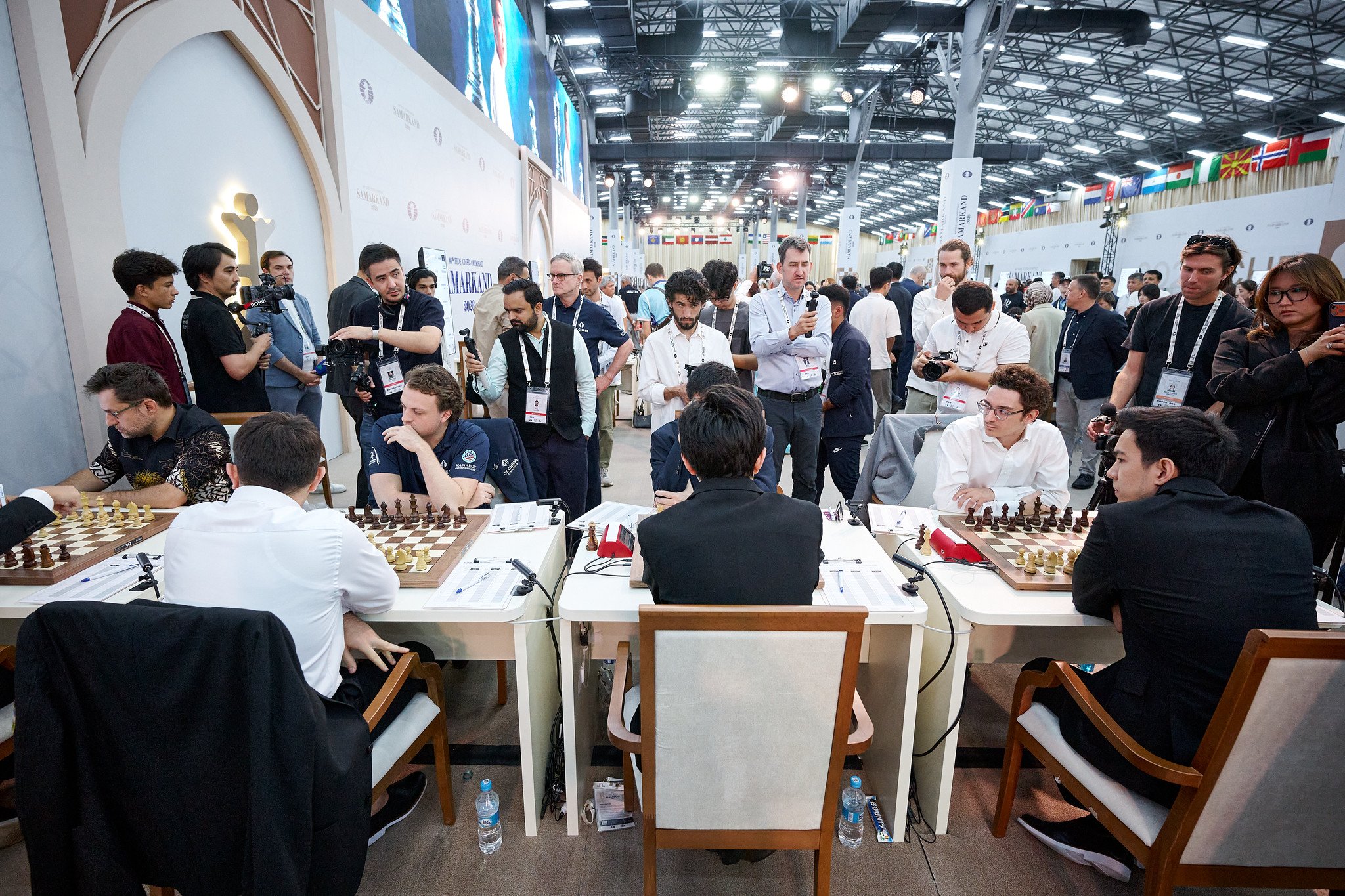
Finding himself in an unpleasant endgame, the American played an inventive bishop sacrifice that the computer marks as a clean loss of a piece for no compensation. But it ended up working, and he came agonizingly close to holding a draw and thus holding the match. The final mistake was 50…h4?, allowing the crushing 51.g6!, forever relegating the black king to the back rank. Using checkmating motifs, White won the c-pawn and later found a tactic to win a whole rook, and at this point Niemann resigned.
On the other two boards, it looked like So had chances to score the equalizing point against Sindarov on board two, while Abdusattorov vs. Caruana was an equal endgame on board one. A sharp Sicilian battle between So and Sindarov led to a better endgame for the American, and he converted it with his trademark accuracy. The sweet 40.Bb4! was a beautiful counter-pawn sacrifice to decide the game, eventually, with two rooks on the seventh rank.
Although it finished before Niemann’s game, Caruana’s collapse in an equal rook endgame on move 39—with one minute as he approached the time control—may be considered the match-losing mistake. Caruana’s decision to keep all four rooks on the board may have been a case of overpressing, as 39…Rxe3 would have simplified; keeping the four rooks only helped Abdusattorov weave a mating net after sacrificing a pawn.
“He underestimated the danger in the rook endgame and made a mistake,” said Abdusattorov, while also mentioning that “it’s already very unpleasant.”
Abdusattorov, who is the best player on board one with a performance of 2880, told Chess.com’s FM Mike Klein it was his second win against Caruana in classical chess, and the last time was at the 2022 Olympiad. He seems to just have that aura in Olympiads.
“I beat him only at the Olympiads, while I lost to him three times in other tournaments,” says Nodirbek Abdusattorov after a win vs. Fabiano Caruana on board one.#ChessOlympiad pic.twitter.com/SzCriApfRc
— chess24 (@chess24com) September 25, 2026
While Uzbekistan won their match, their co-leaders Germany lost to India. With draws on the top three boards, it was GM Alexander Donchenko vs. GM Gukesh Dommaraju on board four that decided the match, and for a long time Donchenko had Gukesh on the ropes. This was the greatest turnaround of the round, as Gukesh transformed a losing position into a winning one—with help from his opponent, of course.
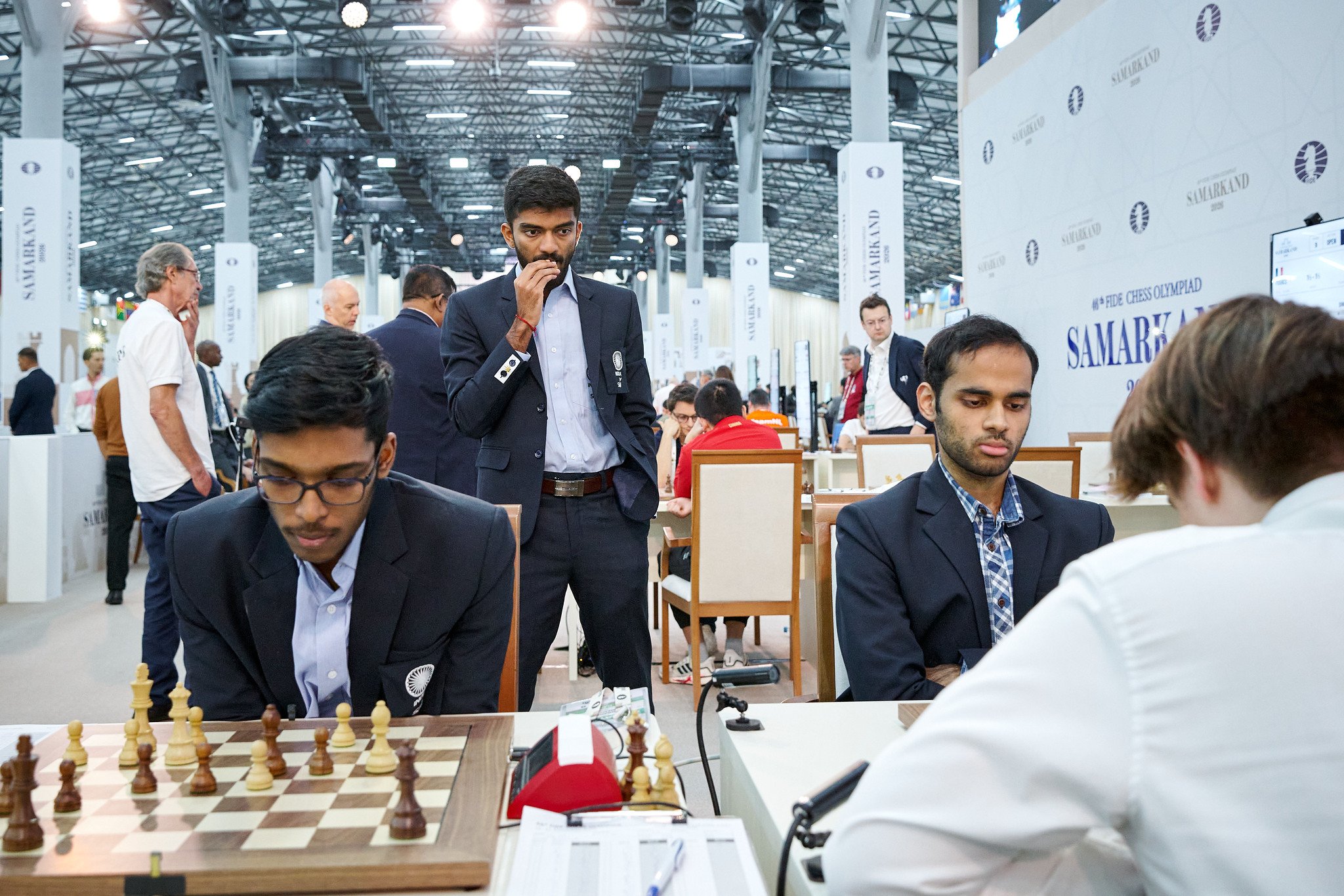
Gukesh told FIDE that his 45…h3!? was the beginning of the turnaround. “I thought this …h3 was a very practical try because I’m tempting him to take the h3-pawn, which he actually did,” said Gukesh. After White won the pawn, the black pieces swarmed in, and Gukesh got to finish the game with a brilliancy: 51…Nf4!!, leaving both knight and queen hanging.
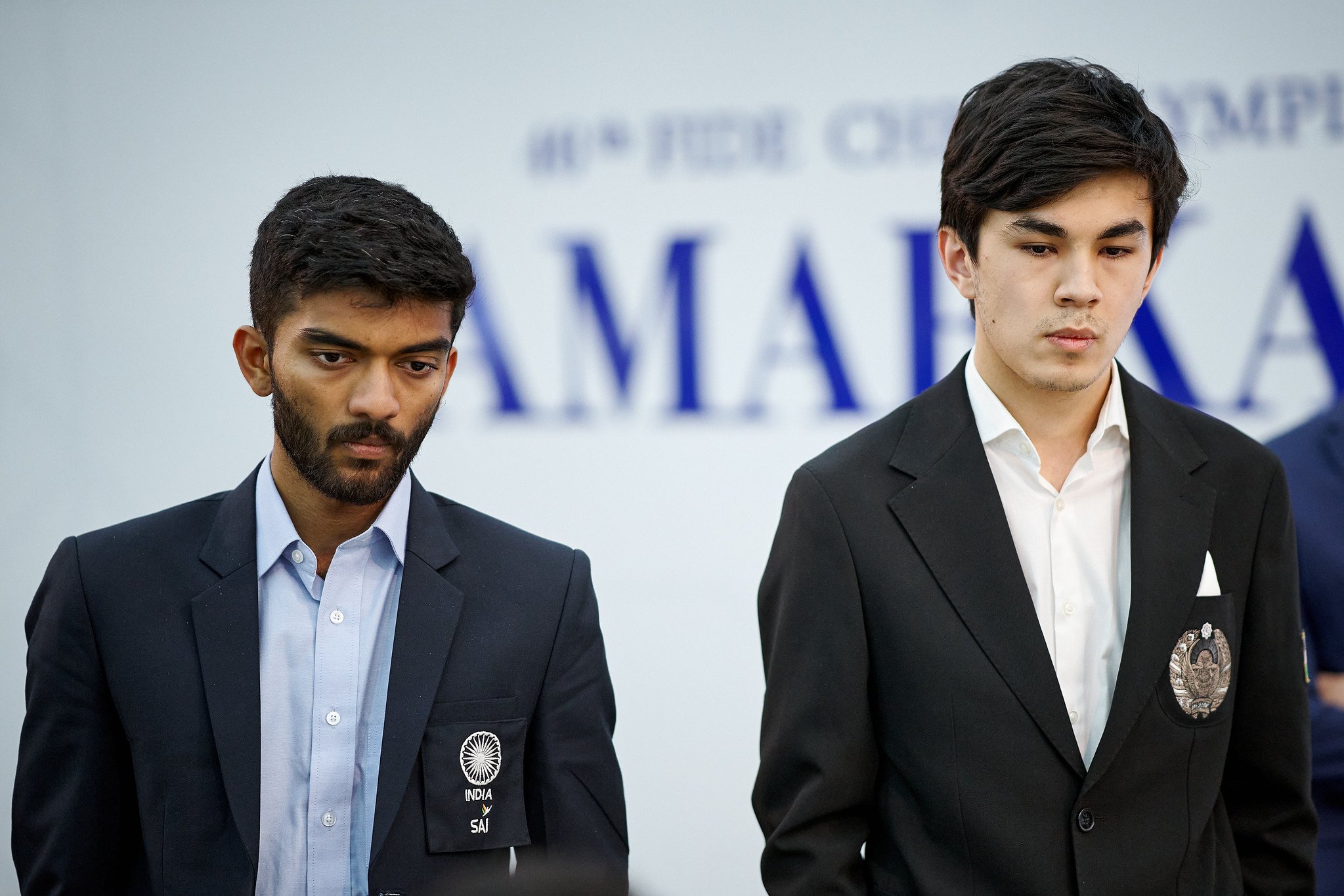
France looked on pace to upset China this round, with draws on three boards but GM Maxime Lagarde with a winning advantage against GM Wei Yi on board two. The Chinese super-GM found a brilliant piece sacrifice for a miraculous perpetual check with his two rooks; and though the Frenchman gave his queen to keep the game going, there was no hope of winning. Lagarde told Chess.com, “I was completely winning; I just completely forgot his tricks. He managed to find a very nice defense… [and] I’m very disappointed for the team.”
The Netherlands (sixth seed) was thrashed 3.5-0.5 by the second Uzbek team (30th seed). Everything went right for the latter with GM Jakhongir Vakhidov (2527) upsetting GM Anish Giri (2757) on board one, GM Mukhammadzokhid Suyarov beating GM Loek van Wely on board three, and GM Ortik Nigmatov also beating GM Erwin l’Ami on board four.
All this while GM Jorden van Foreest played what the commentators called his immortal game, on board two against GM Abdimalik Abdisalimov—and even that game ended in a draw, yet another result going Uzbekistan’s way. Despite the result of that game and the match, we still awarded Van Foreest the Game of the Day.
GM Mikhail Tal reportedly said that when one embarks on a sacrificial attack, the good news is that the opponent can only take one piece at a time. Van Foreest showed this principle in action as he left all three of his minor pieces in the air in a tremendous display of creativity. GM Rafael Leitao analyzes the game below.

Even with that draw, Van Foreest still leads with the top performance on board two with a 2877 TPR, followed by Wei at 2802.
Vakhidov’s win against Giri was simply a model game for how to outplay two knights with the pure bishop pair. The Dutch grandmaster collapsed rather easily after White won control of the a-file.
Finally, Armenia defeated Azerbaijan 2.5-1.5 when GM Gabriel Sargissian converted a pawn-up endgame against GM Rauf Mamedov on board four, with draws on the other boards.
In the penultimate round, we will see Armenia vs. Uzbekistan and Uzbekistan 2 vs. India on the top two boards. This pairing leaves open the possibility of Uzbekistan vs. Uzbekistan 2 in the last round, if they make it through—in other words, Uzbekistan beating Uzbekistan!
Round 10 Pairings: Top 10 Open
| # | Seed | FED | Team | Pts. | MP | Res. | : | Res. | MP | Pts. | Team | Fed |
| 1 | 10 | Armenia | 23½ | 15 | : | 16 | 26½ | Uzbekistan *) | ||||
| 2 | 30 | Uzbekistan 2 | 24 | 15 | : | 15 | 23 | India | ||||
| 3 | 12 | Ukraine | 23½ | 14 | : | 14 | 24 | China | ||||
| 4 | 5 | Germany | 23 | 14 | : | 14 | 24 | France | ||||
| 5 | 8 | Hungary | 19½ | 14 | : | 14 | 24½ | Spain | ||||
| 6 | 19 | Greece | 23½ | 13 | : | 13 | 23 | United States of America | ||||
| 7 | 23 | Romania | 24 | 13 | : | 13 | 22 | Netherlands | ||||
| 8 | 7 | Azerbaijan | 23½ | 13 | : | 13 | 22½ | Bulgaria | ||||
| 9 | 14 | Turkiye | 23 | 13 | : | 13 | 23½ | Argentina |
Women: China Takes 2-Point Lead Into Clash With India
India and China scored big wins in round nine, while some of their key rivals were held to ties.
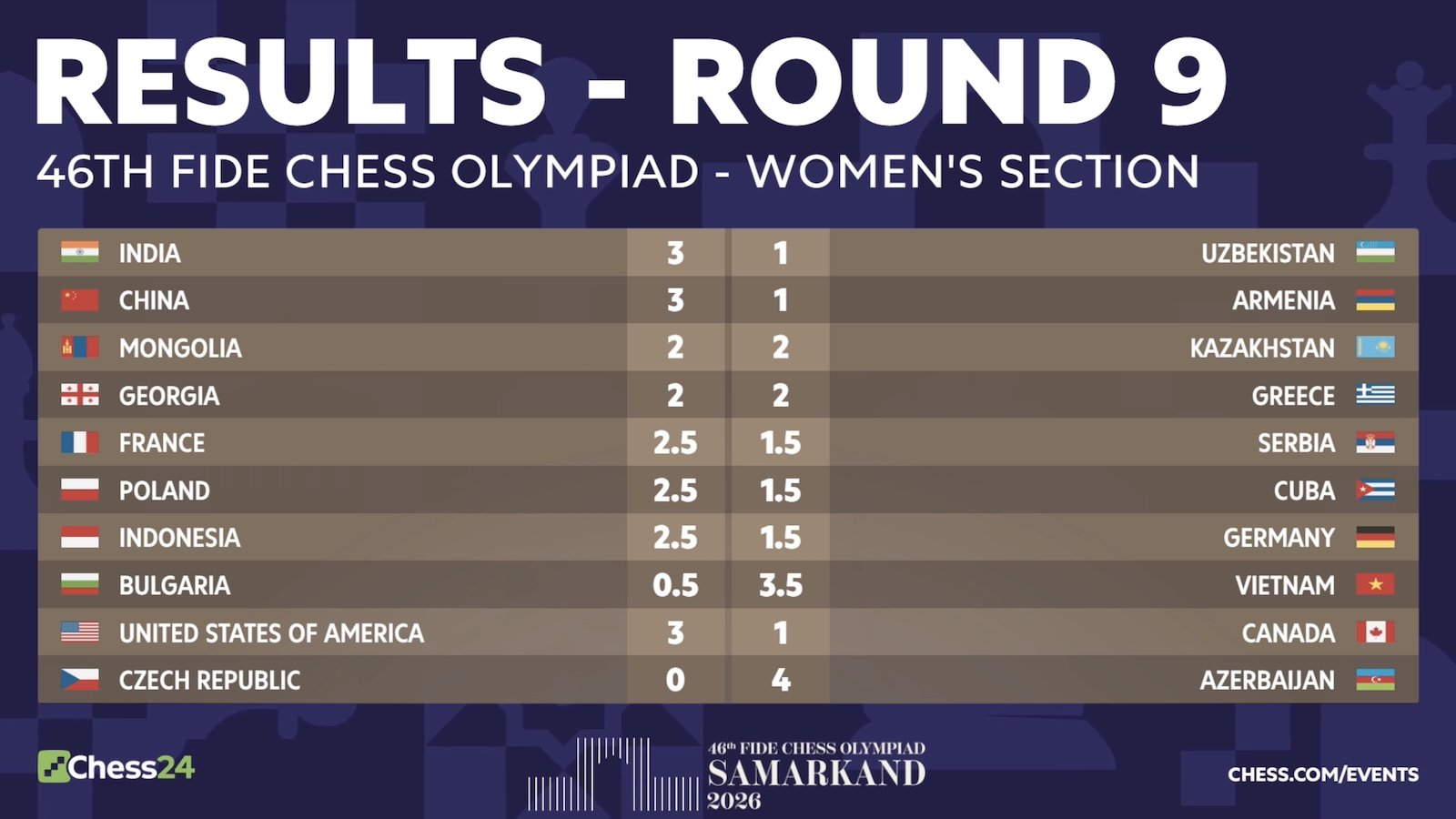
China has opened up a two-point lead over India, Mongolia, and Kazakhstan.
Women’s Standings After Round 9: Top 20
| # | Seed | Fed | Team | + | = | – | Points | TB1 | TB2 |
| 1 | 4 | China | 8 | 1 | 0 | 17 | 299 | 28 | |
| 2 | 1 | India | 7 | 1 | 1 | 15 | 305 | 27 | |
| 3 | 3 | Kazakhstan | 6 | 3 | 0 | 15 | 274 | 24.5 | |
| 4 | 15 | Mongolia | 7 | 1 | 1 | 15 | 243.5 | 23.5 | |
| 5 | 8 | France | 7 | 0 | 2 | 14 | 262.5 | 26.5 | |
| 6 | 16 | Armenia | 7 | 0 | 2 | 14 | 250 | 23.5 | |
| 7 | 9 | Poland | 7 | 0 | 2 | 14 | 245.5 | 23.5 | |
| 8 | 21 | Vietnam | 7 | 0 | 2 | 14 | 234 | 25 | |
| 9 | 35 | Indonesia | 7 | 0 | 2 | 14 | 219.5 | 24.5 | |
| 10 | 24 | Greece | 6 | 2 | 1 | 14 | 206 | 23 | |
| 11 | 5 | United States of America | 6 | 1 | 2 | 13 | 258 | 25.5 | |
| 12 | 2 | Georgia | 5 | 3 | 1 | 13 | 255 | 24 | |
| 13 | 20 | England | 6 | 1 | 2 | 13 | 248 | 26.5 | |
| 14 | 7 | Azerbaijan | 6 | 1 | 2 | 13 | 248 | 25 | |
| 15 | 13 | Uzbekistan | 6 | 1 | 2 | 13 | 247 | 24 | |
| 16 | 39 | Peru | 6 | 1 | 2 | 13 | 234 | 25 | |
| 17 | 23 | Romania | 6 | 1 | 2 | 13 | 224.5 | 25.5 | |
| 18 | 12 | Netherlands | 5 | 3 | 1 | 13 | 220 | 23.5 | |
| 19 | 25 | Slovenia | 6 | 1 | 2 | 13 | 217 | 24 | |
| 20 | 22 | Israel | 6 | 1 | 2 | 13 | 202 | 23.5 |
China had what on paper was a dream pairing for the final stages of the Chess Olympiad—against 16th seed Armenia—but in round five in 2024 the team faced the same opponent and lost, with Zhu and Lu both losing in a costly 2.5-1.5 defeat.
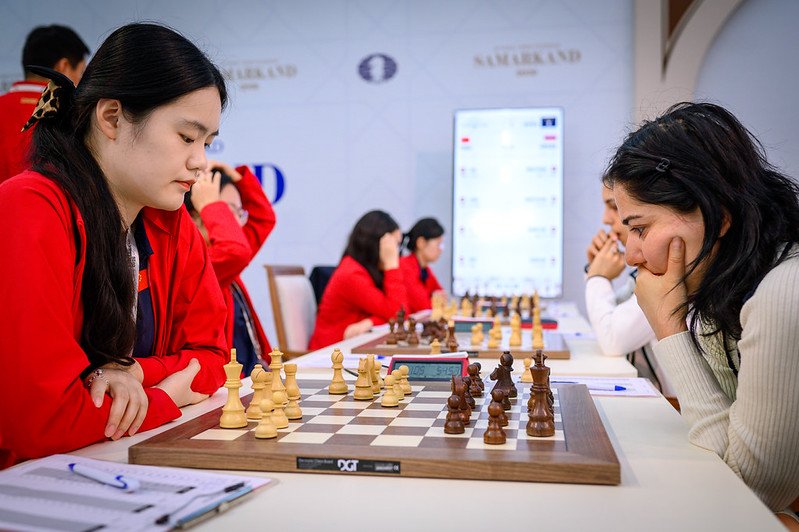
It turns out they would get perfect revenge, with Zhu and Lu this time clinching a 3-1 win for China. Zhu beat the same opponent she lost to in 2024, IM Lilit Mkrtchian, and is world number-two on the women’s live rating list. With a 2645 performance, she is dominating the race for individual gold on board one. She could play calmly against Armenia, since Miaoyi was winning early on against GM Elina Danielian, with the 16-year-old telling Klein the key moment was 16.g4!, when Black couldn’t take on d4.
“I’m very excited!” says Lu Miaoyi about playing for China, the current Women’s #ChessOlympiad leaders https://t.co/4F9AFmheGs pic.twitter.com/fag6LHvcCU
— chess24 (@chess24com) September 25, 2026
By the end of the day, that match win put China two points clear at the top with just two rounds to go, but in round 10 they could be caught by their opponent, top seed India. The defending champion could even afford a draw from IM Savitha Shri as the team wrapped up a 3-1 victory over host nation Uzbekistan with wins for Vantika and Divya.
The latter overcame IM Gulrukhbegim Tokhirjonova in a complex battle, despite missing the first chance for a spectacular knockout blow.
Understandably, after such a long and complex game, Divya was almost sleeping at the end…
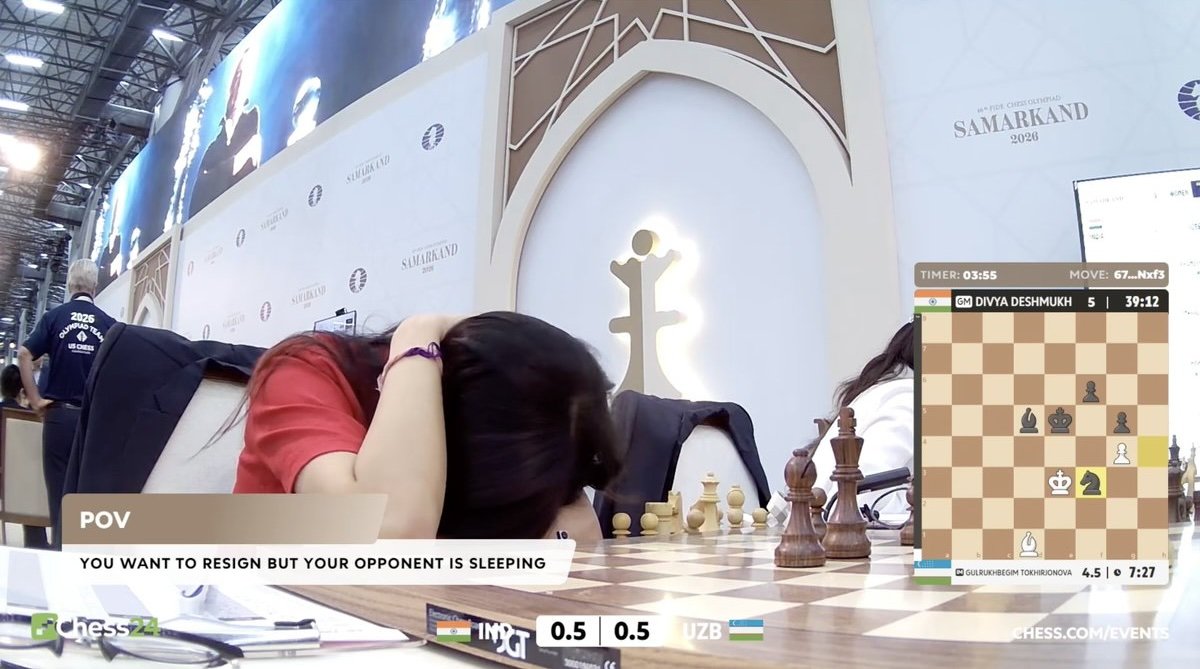
…and politely declined interviews, though she did stop to sign autographs for fans.
Two teams had a chance to stay within a point of China, but they canceled each other out.
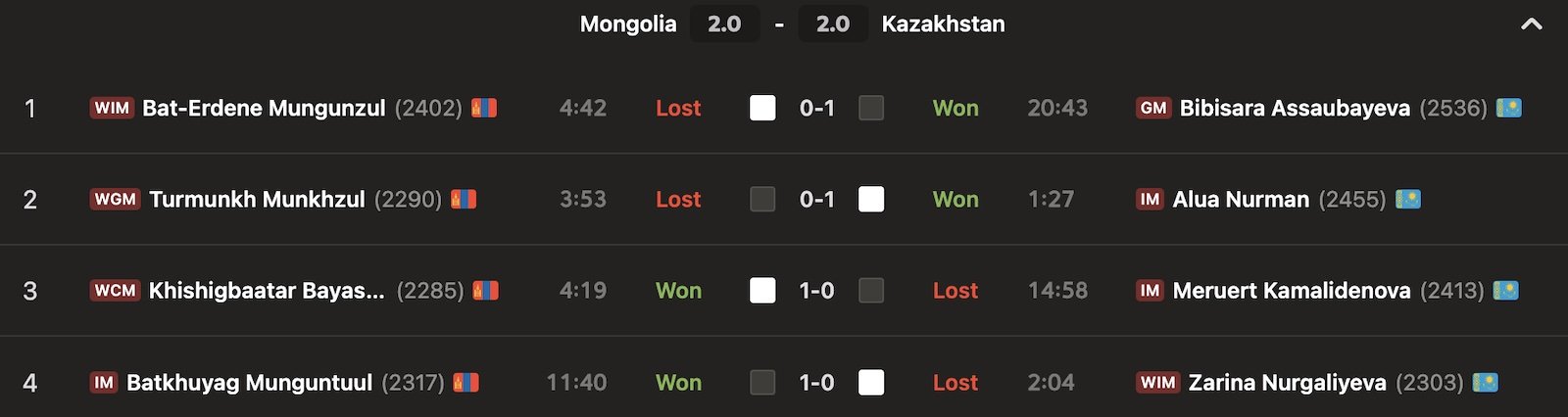
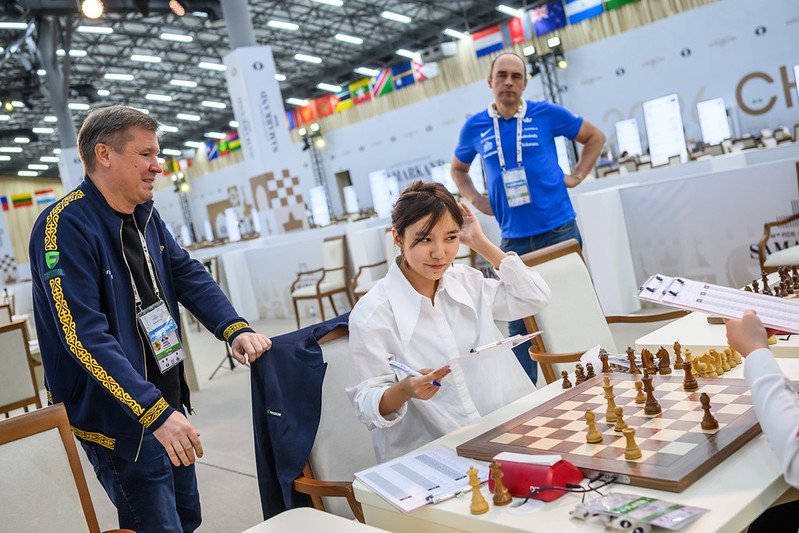
Fifteenth seed Mongolia nearly pulled off an upset—and a fifth win in a row after losing to India—when they opened up a 2-0 lead, but GM Bibisara Assaubayeva ground out a win on top board before IM Alua Nurman, leading the race for individual gold on board two, managed to win a seemingly dead-drawn endgame against WGM Turmunkh Munkhzul. She finished in style.
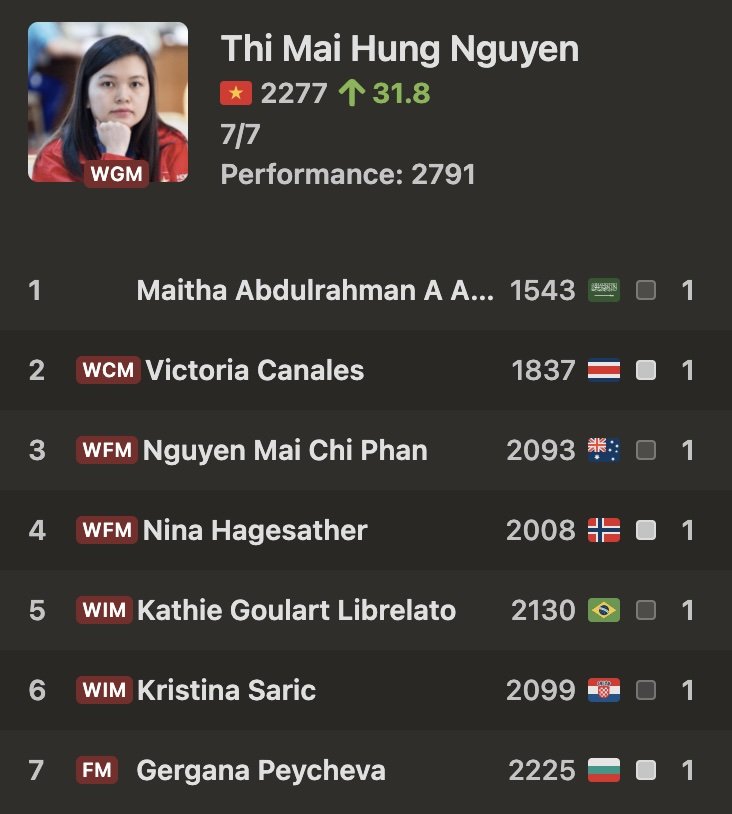
Six teams are on 14 points, three points off the lead, including some surprises. 21st seed Vietnam scored a 3.5-0.5 win over Bulgaria, with WGM Thi Mai Hung Nguyen continuing a perfect score that means Shri is currently only looking at a silver medal on board five.
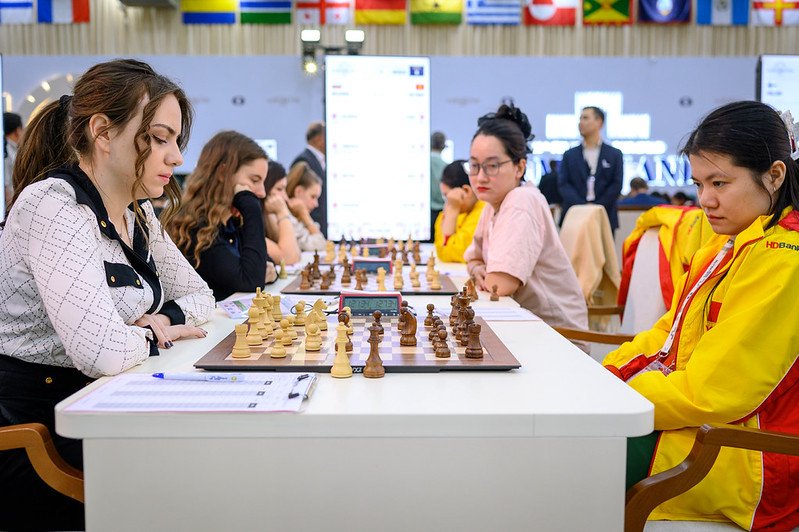
35th seed Indonesia, meanwhile, defeated Germany 2.5-1.5, including a spectacular win for 20-year-old WIM Laysa Latifah over GM Elisabeth Paehtz. Here are the final stages.
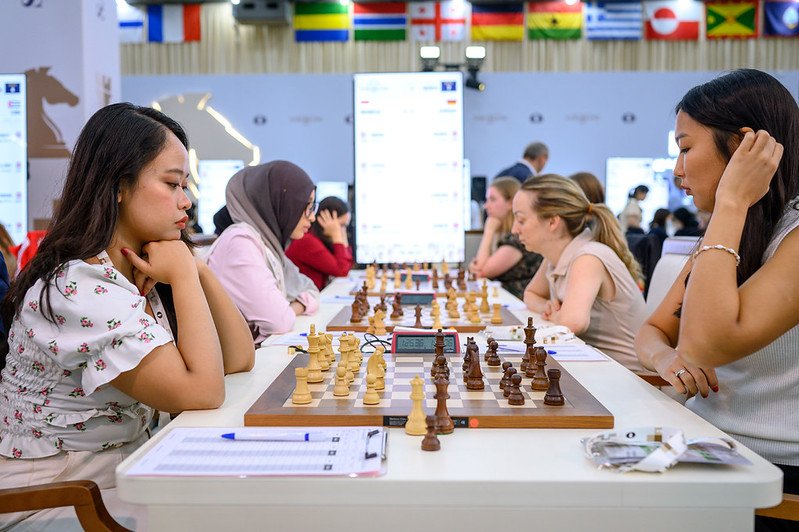
Twenty-fourth seed Greece came very close to a win over second seed Georgia, in another match where all four games were decisive.
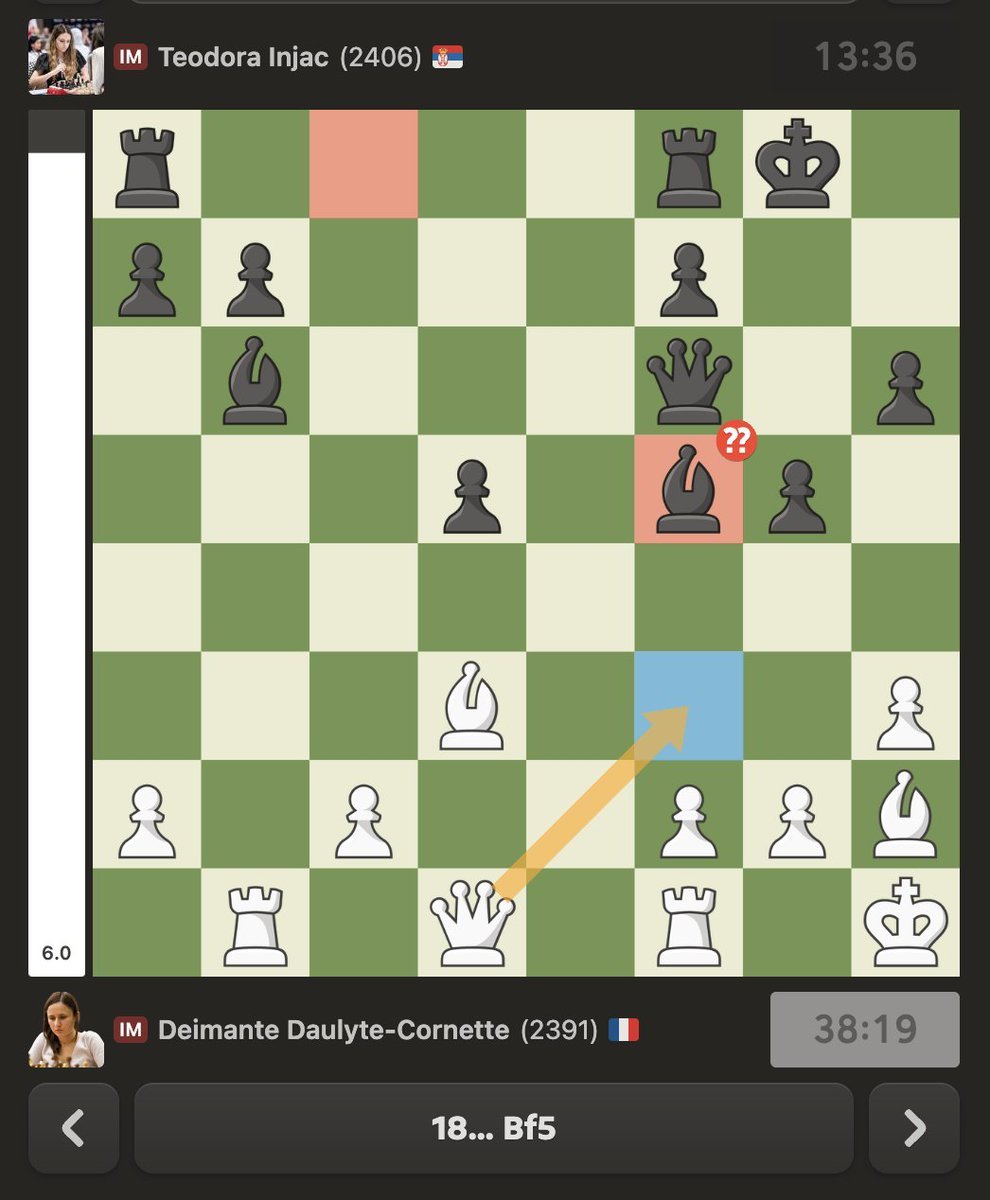
Those teams are joined by Armenia and two pre-tournament medal hopefuls—Poland, who scraped a 2.5-1.5 win over Cuba, and France, who also won 2.5-1.5 after they got an early boost against Serbia thanks to a horror blunder on top board.
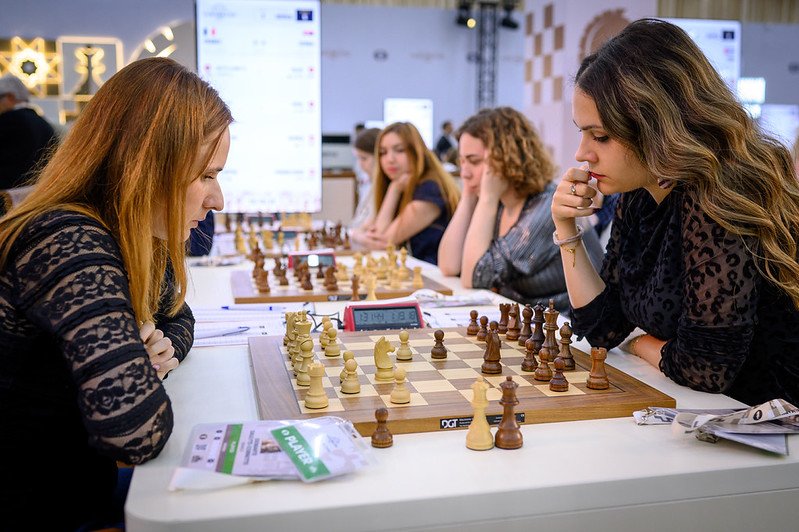
Among the teams on 13 points, four points behind China, are Georgia, after that draw with Greece, and the U.S., which won the local battle against Canada 3-1. IM Carissa Yip, who inflicted a first loss of the event on WGM Maili-Jade Ouellet, joked that the U.S. team had switched their focus to North America.
USA’s Carissa Yip after a win over Canada’s Maili-Jade Ouellet: “Now that we’re no longer fighting for gold we have to fight for at least no. 1 in North America! Hopefully we’ll win this match [they did] & it’ll be a huge victory for us in that competition!” pic.twitter.com/TY9sES9JIo
— chess24 (@chess24com) September 25, 2026
Another team in that group is England, which beat Estonia 3-1 and can celebrate possessing the youngest women’s grandmaster in chess history after 11-year-old FM Bodhana Sivanandan picked up her third WGM norm.
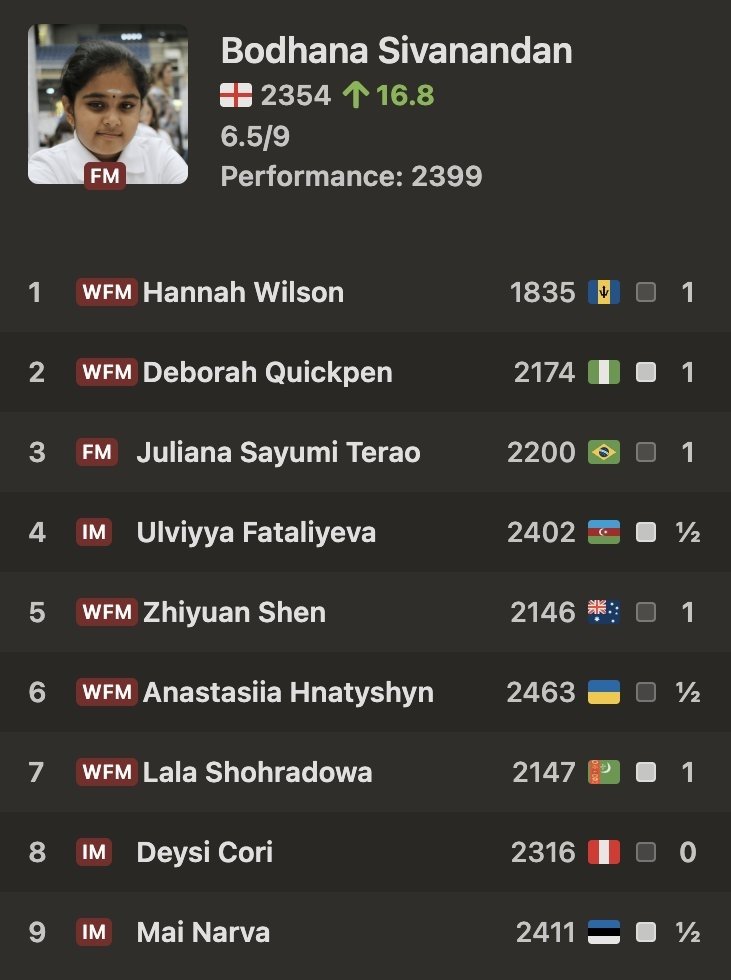
Of course Sivanandan’s aspirations go far beyond women’s titles, as she’s one of the world’s top prodigies, male or female.
Saturday’s round 10 will be absolutely huge. If China beats India, the gold medal will likely be decided with a round to spare, but if India wins, anything could happen in the final round. A tie in that match, and China will know another tie in the final round would also give them the top spot.
Round 10 Pairings: Women’s Top 10
| # | Seed | Fed | Team | Pts | MP | Res | : | Res | MP | Pts | Team | Fed | Seed |
| 1 | 13 | Uzbekistan *) | 24 | 13 | : | 13 | 25 | Peru | 39 | ||||
| 2 | 4 | China | 28 | 17 | : | 15 | 27 | India | 1 | ||||
| 3 | 3 | Kazakhstan | 24½ | 15 | : | 14 | 26½ | France | 8 | ||||
| 4 | 15 | Mongolia | 23½ | 15 | : | 14 | 23½ | Poland | 9 | ||||
| 5 | 24 | Greece | 23 | 14 | : | 14 | 23½ | Armenia | 16 | ||||
| 6 | 21 | Vietnam | 25 | 14 | : | 14 | 24½ | Indonesia | 35 | ||||
| 7 | 20 | England | 26½ | 13 | : | 13 | 24 | Georgia | 2 | ||||
| 8 | 22 | Israel | 23½ | 13 | : | 13 | 25½ | United States of America | 5 | ||||
| 9 | 7 | Azerbaijan | 25 | 13 | : | 13 | 24 | Slovenia | 25 | ||||
| 10 | 12 | Netherlands | 23½ | 13 | : | 13 | 25½ | Romania | 23 |
Colin McGourty contributed to this report.
The 46th FIDE Chess Olympiad is a massive team event for national federations that takes place every two years. In 2026 it’s being held in Samarkand, Uzbekistan, with 11 rounds that run September 16-27. In Open and Women’s sections, teams of five players compete in a Swiss system, with each match played over four boards. There are two match points for a win and one for a draw, with board points taken into account only if teams are tied. Players have 90 minutes per game, plus 30 minutes from move 40, with a 30-second increment per move.
Previous coverage: