Welcome to the Workology Podcast, a podcast for disruptive workplace leaders. Jessica Miller-Merrell, founder of Workology.com, as she sits down and gets to the bottom of trends, tools, and case studies for the business leader, HR, and recruiting professional who is tired of the status quo. Now, here’s Jessica with this episode of Workology.
Jessica Miller-Merrell: Welcome to the Workology Podcast, sponsored by Ace the HR exam, and UpSkill HR. These are two courses that we offer for certification and recertification for HR leaders. You can learn more about those at Workology.com. This interview was recorded during the World at Work Total Rewards Conference in San Antonio, Texas. I met so many smart people during the conference, and I’m thrilled to be able to highlight their expertise on this podcast. If managing employee benefits feels complex, try doing it across borders, cultures, and compliance frameworks. Global benefits are no longer just about offering competitive packages. They’re about creating consistency, equity, and flexibility for a workforce that’s more distributed than ever before.
I’m your host, Jessica Miller-Merrell, and today we’re diving in on what’s next with global employee benefits trends. From navigating regional regulations to meeting rising employee expectations around well-being, flexibility, and total rewards, HR leaders are being asked to think bigger and smarter and on a global scale. So let’s get into it.
Before I introduce our guest for today, I do want to hear from you. Please comment “podcast” on my pinned post over on Instagram. It’s @WorkologyBlog. You can ask questions, leave comments, and make suggestions for future guests. I want to hear from you.
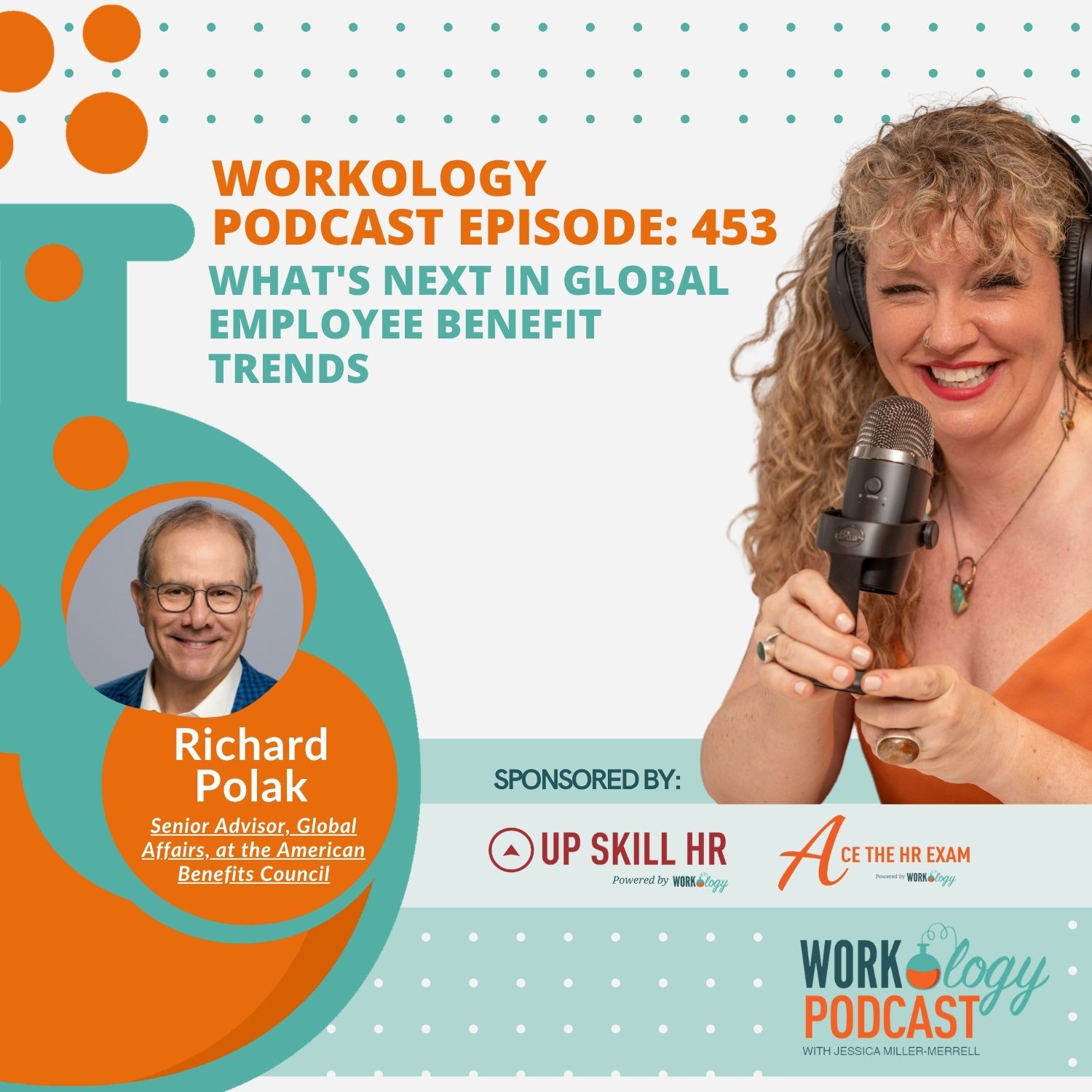
Richard Polak is a global advisor for the American Benefits Council, where he works closely with multinational employers on a wide range of global benefits, human resources, and labor-related initiatives. With more than 35 years of consulting experience, Richard has helped organizations navigate the complexities of managing a global workforce—from selecting international locations and increasing productivity to designing competitive and compliant benefits programs across regions. His deep expertise spans global HR strategy, workforce planning, and total rewards. Richard has served as a subject matter expert for SHRM’s Global Profession in Human Resource Management learning system and is a frequent speaker at international conferences. He’s also curated and produced a leading HR conference in Europe for more than 25 years, bringing together global leaders to discuss emerging workforce trends. Richard holds a bachelor’s degree in business management and mathematics from Alfred University and has pursued continued studies at Columbia University, the New School for Social Research, and UCLA.
In addition to his work in HR, he is a published playwright with seven productions staged internationally, reflecting his creative approach to storytelling and communication. At Total Rewards, Richard presented a session titled “Global Benefits in Motion: What’s New, What’s Now, and What’s Next.” And that is why I want to sit down with him and talk about this topic. Richard, welcome to the Workology Podcast.
Richard Polak: Thank you. Thank you for having me here.
Jessica Miller-Merrell: I know we’re talking about global benefits, but I really can’t—I’m just in awe that you are a published playwright with seven productions that have been staged internationally. Like, that is amazing. Absolutely.
Richard Polak: Thank you.
Jessica Miller-Merrell: Before I just go totally sideways on the podcast and talk about, you know, plays and production, let’s talk about the big picture with global benefits. What is happening right now? And what do you feel like the biggest shifts are that HR leaders need to be paying attention to?
What Are the Biggest Global Employee Benefits Trends?
Richard Polak: Well, similar to what they’re paying attention to in the United States, the same applies globally in one specific area. In fact, there’s an expression: “When the US sneezes, the rest of the world catches a cold.” And our healthcare system is a cold, and the US is sneezing, and we’re sick, and we’ve passed that, sadly, along to the rest of the world. Now, I wouldn’t say specifically the rest of the world’s problems are ours, but the rest of the world does look to the United States for direction. And the cost of healthcare has become a big issue elsewhere. This year, I guess if you average out the inflation numbers, it might be 9 to 10% estimated in the United States. In Singapore, it’s 15%. In Brazil, it’s 12%. In France, it’s 8%. So, on and on. And there, the numbers are skyrocketing. A subsequent question you may ask: do I see this ending anytime soon? It’s a question of how we’re going to pay for it versus is it going to slow down. And not necessarily because anybody has a real issue with it—and there are some, because we have a completely different culture in healthcare, really, than elsewhere, in that it’s profit-making. And that in itself will increase cost because of more profits. But there’s technology, there’s the aging workforce, there’s genomics coming, there’s GLP-1s, and so on. And those are going to skyrocket the cost of healthcare in the future, sadly.
Jessica Miller-Merrell: So we’re going to talk about some of those things a little bit later in the podcast itself. I want to switch gears a little bit and go to organizations who might be expanding internationally, especially for the first time. When we did our prep call, you talked about Employer of Record or EOR solutions as a smart entry point for employers who are looking to expand internationally. Can you walk us through that model and why it makes sense despite the added costs, and what risks it might help mitigate?
How EOR Solutions Help Companies Expand Internationally
Richard Polak: Okay. Well first, most US employers, when they expand internationally, for good reason or not—although one was not, and I’ll tell you that in a minute… But good reason or not, it’s usually an English-speaking country: UK, Canada, and Australia, for example. And that makes a lot of sense; you want to have a comfort level. When I say sometimes not, it’s because I remember a CEO said, “I’m going to move my headquarters to Paris,” because he liked French food. There was no business reason behind that, and he wasn’t in the food business. But that’s very unusual.
So in expanding internationally, they generally start small—the smart CEOs—because you don’t know if it’s going to succeed. If you’re going to do so and you’re going to hire employees, which you’re going to need to do if you’re going to expand internationally—I’m not even going to get into what you need to do legally to do that—but you’re going to hire a local Brit in Britain, right? And the best way to do that, really—the most prudent way, it’s not always the least expensive, but prudent way—is to do it through an EOR, Employer of Record. And the reason for that is they’re completely set up. They are the employer. These employees report to you, but as far as legals are concerned, they report to the EOR, and the employee benefit program is provided by the EOR.
The mitigation of loss is that, let’s just say you hire one employee in the UK, and then the dependent has some sort of chronic condition, whether it’s a spouse or a child. And in your employment contract, which is required almost everywhere outside the United States, it states you’re going to provide that individual and their family with a competitive employee benefit program, which will include medical and so on and so on. You’ve promised that, and that’s a binding contract, and there is no way out of it, particularly outside the United States. Outside the United States and California, there’s no way out of it. And then you find out later that the spouse or the dependent has some form of chronic condition that will not be eligible to meet the medical underwriting requirements for health insurance. And now you’re on the hook. And then there’s a million-dollar claim—and more than that, perhaps—that you have to pay. So EORs have employee benefit packages already in place, they have the employment contracts already in place, they have everything set up for you to be successful. There’s about a 25% increase in costs in doing so, but it’s well worth the risk mitigation, as you said.
Jessica Miller-Merrell: Absolutely. And in the example that you provided, that could be incredibly costly just in benefits alone. I mean, we’re not talking about setting up the legal entity and taxes and all those other things that could go wrong and sideways.
So staying on the topic of global expansion, what are some of the most common mistakes companies make when they try to scale benefits across borders without the right infrastructure in place?
How to Build a Global Employee Benefits Strategy
Richard Polak: Well, the most common is they won’t have any form of philosophy as any basis for growth or expansion, particularly for benefits. You need a philosophy statement. Philosophically, that means global unity, perhaps, but not global conformity. I see this mistake happen quite a bit where the US employer says, “We have X number of weeks of vacation; that will be the foundation of the holiday amount or the leave amount across the world.” And it’s a huge mistake because you can never be right with that number. You’re either going to be too high or too low. And then you go to countries like France and they say, “Well, what do you mean, two weeks vacation? Ha! You obviously don’t know what you’re talking about; we get six weeks here,” right?
Or another one I love, but I hate, is when they’ll announce unlimited vacation time in the United States, right? These employers announce it, and then in France, they take unlimited vacation time, and they’re entitled to unlimited vacation time. So these are really big mistakes some employers can make.
Jessica Miller-Merrell: For the employee that maybe is US-based, but their company is in Britain or France or something like that, that’s great because they get the six weeks of vacation.
Richard Polak: Well, they get that anyway, yeah. Four of it is required by law.
Jessica Miller-Merrell: Amazing. You also touched on—I think on our prep call, we talked a lot about HR technology, which is not surprising—the growing accessibility of digital platforms. I wanted to ask you: how are tools like HRIS systems changing the game for maybe smaller organizations, say under 5,000 employees and below, when managing a global workforce?
How HR Technology Is Changing Global Benefits
Richard Polak: Okay. Well, it’s changing in both, but now the smaller employers have the benefit of enjoying platforms that were formerly not even available to them. So 5,000, some even 75 or 100, you have those toys available. You can get a digital platform, digital enrollment, AI helping them with their health—all the tools that a large employer would get, you can get now with these smaller digital platforms. When I say smaller, it means in fact they’re often better because they’re newer and they’re built on a framework that’s much stronger and newer. So they even provide better services faster, and so on. So that’s that.
Jessica Miller-Merrell: A lot of your HRIS systems—here’s kind of how I see things happening: they start out in the SMB, like the small market, so maybe it’s 50 employees or up to 250, and then they gradually start to move upstream. I feel like Workday is kind of the exception to this because they kind of started out for enterprise. But like you said: new infrastructure, new models, new code that hopefully supports the organization and the employee experience the right way. And then they move larger and larger to those larger organizations.
Richard Polak: Well, that’s what the intent is for those that are starting out—the startups in that space. But no, even one of the startups starting out real big, they got 11 major multinationals to sign up in advance. Wow. And they’re taking the bull by the horns; they’re doing really well. And they don’t want smaller companies as clients.
Jessica Miller-Merrell: The HR tech ecosystem for startups, and for those who are primary VC-backed, is really fascinating to me in how they operate, grow, and scale.
Richard Polak: Yeah, and there’s actually not enough of them even here at World at Work. They should be having booths here because a lot of firms could really use their services. I think I know—I’ve been walking around.
Jessica Miller-Merrell: Yeah. So, like, notice to any HR tech company: there are a lot of other conferences outside the usual that I attend. I was talking to Ben Eubanks, who is around here at the conference, and he was talking about ATD as a great conference for talent development. We have World at Work, and I know there’s a number of compensation conferences that I had never heard of that people were talking to me about yesterday. So broaden your horizons, and there are a lot of different kinds of people to engage with in our space.
We’re going to take a reset here. My name is Jessica Miller-Merrell, and you’re listening to the Workology Podcast. It’s powered by Ace the HR Exam, and UpSkill HR. Today I’m talking with Richard Polak. He’s a senior advisor for global affairs at the American Benefits Council. We’re talking about global employee benefits trends.
So let me talk trends. Lifestyle Spending Accounts (LSAs) are gaining traction globally. What makes them so effective, and how can companies implement them in a way that resonates across different cultures and regions?
How Lifestyle Spending Accounts Support Global Employee Choice
Richard Polak: Well, they are growing, and they should be, because they’re offering employees choice. And if you’re looking at the future, employees want more choice. You can see all the surveys now on what’s happened since COVID, when they were able to work from home. “Wow, I like this,” they’re saying, “I want to do more of it.” Even employers are finding that when they require them to go to work—or those even requiring them to go two days of work, which they’re trying to do anyway to get them in the office… I personally don’t understand that. It’s irrelevant, unless you’re a manufacturing facility and you have to make widgets. Of course, they have to be making widgets. But any kind of professional organization can succeed greatly by having them work from home, sometimes even more than having somebody—which I did for years—with an hour-and-a-half commute each way. That was before there was—that was when there was AM radio, actually! That was the only thing we could listen to, and the only reason we listened to that was to find out where there was a car accident we could avoid to get to work faster.
So LSAs are real important for the future. The downside for an LSA is they haven’t yet become tax-effective. It’s almost no different than giving you $500 cash and then saying go spend it where you want. This is another means of doing so, and you can do it in a marketplace; you can use it for almost anything you want to do. What it does is help the employer give the employee something extra that they wouldn’t normally get in their compensation.
And most important, I think—and all benefits, we forget what they’re for—is to increase engagement and productivity. Because if your employees go, “Wow, my company gave me X,” or “a life insurance program that’s four times my earnings instead of two times,” which is really inexpensive to do, they think, “They must really care about me.” And you need in this environment, more than ever—where there’s more distrust not just among employers, but among ourselves—to find a way that they feel that they are trusted and loyal employees, and we want to do what’s best for you.
Jessica Miller-Merrell: And I think that’s a good point to just reintroduce: benefits are there for employee engagement and productivity. I don’t necessarily think we always think that way. And when you look at—I think the most recent Gallup results show that employee engagement is dwindling, but manager engagement is like the worst that it’s been in, I don’t know, 25 years. I will add the correct research in the show notes of that so that everybody has it. But that was what was most interesting to me: it’s managers as well as employees, but more so managers. So communicating that benefits are a benefit to remind our employees and managers that “you have this” is really important.
Richard Polak: Yeah, and that will increase productivity, which is more important than the cost savings you might have if you cheapen your benefit program.
Jessica Miller-Merrell: Yeah. And encouraging them to use it, because some folks don’t know that they have certain programs. If maybe you offer some sort of virtual—like if they’re working from home, a stipend for equipment for the office, right? Or some wellness package. Not everybody uses all of those. I know even for myself that happens. So communicating to people and being like, “Hey, here’s all the benefits we have, and here’s how to take advantage of them,” is really important.
Richard Polak: And if you’re going to encourage them to use it… I learned this during COVID, because I was skeptical of what was going to happen after COVID and all kinds of predictions. “If employees aren’t going to work, if they’re not going to the doctor, they’re going to get sicker.” And then two years after COVID is over, all the cancer and big claims are going to come up. And I was wondering to myself, “Hmm, we’re human beings; we have our own way of repairing ourselves. Will this really happen?” And the fact of the matter is, it did. I mean, claim costs skyrocketed after COVID because people weren’t taking care of themselves preventatively.
So if you’re going to invest in anything for your employees—and this is across the board around the world—very targeted, very specific preventative well-being programs are key. I was at a conference last week—the Conference Board does a conference every year, and it’s its 26th year in San Diego—and an employer got up and said, “We just wasted $40 million.” “Well, how could you do that?” “Because we put it all in our well-being program, and then we did a survey afterwards and found out the employees don’t value it and aren’t using it. So we spent all that money.” Those were the exact words out of the benefit manager’s mouth: “We spent and wasted $40 million.” Wow.
Jessica Miller-Merrell: So survey your people! Find out what they want.
Let’s talk about something I’m seeing a lot in the news, and it seems to be a trend: GLP-1 drugs. They’re getting a lot of attention worldwide. What impact are they having on employer-sponsored health plans, and what should organizations be thinking about regarding cost versus care?
What Impact do GLP-1s Have on Employer-Sponsored Health Plans?
Richard Polak: Okay, well, this is a very interesting drug. I don’t know in my lifetime, other than penicillin—but that even came before I was born—that there’s ever been a drug quite like this that may have additional corollary effects to help a person’s health that go way beyond weight loss. We still don’t know that entirely, but the early indications are it will reduce your blood pressure, it will reduce chances of a heart attack, and it will reduce Alzheimer’s. All these are preliminary studies that are coming out now. So it’s an expensive drug. That price will come down.
By the way, if you want to get it in China, I think it’s $200 a month—not that you’re going to get it from China. But a different culture has a different look at these drugs. They want to lose weight, not necessarily because they have an obesity problem in their country, but because it’s more attractive. Thin is in. Thin is starting to become in all over the place, and it’s very helpful for that to happen.
The downside of GLP-1s, other than the cost at this point, is that we’re just using them right now for obesity, and if you go off the drug, you’re obese again. That’s a bigger concern: how can you go off a drug, or do you have to take it the rest of your life? I don’t know if that’s a good idea.
Jessica Miller-Merrell: Yeah, we don’t know. It’s still a relatively new drug.
With healthcare costs continuing to rise globally—so kind of going back to how we started our conversation at the beginning of the podcast—how can organizations balance offering competitive benefits while still maintaining financial sustainability?
How Employers Can Manage Rising Global Healthcare Costs
Richard Polak: Okay, so their biggest concern globally in the next five years is the cost of healthcare. This is not just them; it’s the national health systems around the world. We talked about that earlier. That price is going to go up, and I don’t know any way around that. So how can they offset that? Employers may find in the next three years, when the prices go up 10% or another 15%…
There’ll be one employer in the United States… I spoke to one of my friends at the Employee Benefit Research Institute in Washington—and we’re out of Washington, D.C., too. I can’t quote him because I don’t know that he’d want me to quote him, but I’m already telling you he’d say “he,” so it narrows it down 50%, right? He even identified the name of the company: it’s going to be the first company to go to an ICHRA. And that offsets the cost for an employer. They call it defined contribution. “I’m going to give you, employee, $1,000 a month for your healthcare”—when the real cost of it is between $2,000 and $3,000 a month for healthcare. I know that personally because I’m self-employed; I’m an advisor to the Council, and that’s what it costs me for my family of four. “And I’m going to give you that money, and then you can put it towards this ICHRA,” and they have a whole bunch of benefits.
That may happen; it’s likely to happen. I hope it doesn’t happen. There are other approaches that can happen before that. But when that happens, and it’s one employer, or two employers, or three employers, then everybody’s going to hop onto that. The first two or three employers are going to look really bad, and employees are going to be screaming their heads off, and then it’s going to be all over the news in every single newspaper: “How could they do this to people?” That sort of thing. And the fact of the matter is, we can’t afford it anymore. We’re in business to be in business. This is encroaching on that. It has nothing to do with lack of loyalty to employees, but the government’s not doing anything to step in on this, so we have to take it or else we’ll go out of business and everybody loses their job.
Jessica Miller-Merrell: So you’re saying that an employer is probably just going to be like, “Hey employee, you get $3,000 a month for insurance or whatever, and you can choose the plan and how you use it, but anything over $3,000, you’re not getting that from me.”
Richard Polak: Right. You’re only going to get that money, and hopefully it will be tax-deductible the way they frame it. It has to be for the employer. They get $3,000 a month, and then what does that end up to be—$1,800 a month after taxes? It’s not enough to buy insurance. No. So maybe the government might say at some point, “We’ll make it tax-deductible for that.”
You want to hear what I think? I would like… There was something in the ’60s—and I’m young enough to know that—it’s called relative value schedules. Before all this “reasonable and customary” where anybody can charge what they consider reasonable and customary—doctors, hospitals, all the providers—there was a schedule, and each procedure or each hospital stay had a price that you would get paid. A schedule covered every procedure of every possible thing you can imagine: relative value schedules. And that was all taken away voluntarily because it was a time when healthcare wasn’t so expensive, moving to this reasonable and customary approach. And then it was all negotiation after that point.
Countries like France have benefited from this; they have it, too. The relative values are part of what they call the Social Security amounts, because it’s tied to Social Security. And they’ll give an employee four times the Social Security reimbursement amount. Until the United States says everybody’s got to go to this relative value schedule, that gets the employers off the hook. They’re not the bad guy anymore. Until our legislators say, “This is enough, it’s killing our entire country”—and it is, it’s almost 20% of our GDP, twice as much as the next best country in the world! That’s absurd. We’re squeezing our own productivity; our own sales just can’t sustain this anymore. So I really feel like the government needs to legislate this issue, get the employers off the hook, and help them—and that will also help the employees. We’re private enterprise here. We’re a profit-making healthcare organization or country. That’s not right. That’s just not working.
Jessica Miller-Merrell: You mentioned to me on the prep call something—because we were talking about the cost of drugs, right? When my dad went through his chemotherapy for his blood disease, one chemo pill out of the 17 that he took for his treatment was $60,000. And one of the things that you said to me was that there are treatments where one pill is like six, if not seven figures right now. Is that true?
Richard Polak: Yeah. Hemophilia—it’s a bit more than a pill, but the treatment is, I think, $3 million. Now, it will cure it, and that’s really important, but it’s a market-driven price. You can’t say to Bristol Myers or Merck or any of them, “You can’t charge that,” because they’re a private organization that can charge whatever the market will bear.
And so the employers are going… I remember talking about this now. The employers are saying—because the employees are going, “I have a child that has hemophilia, you know, are you going to help me with this? Or are you going to put it under what you call a specialty drug that you don’t cover?” And employers want to really cover these things.
So I know one employer, for example, who is covering it. They have the money to do so, but they’ve gone to the pharmaceutical company and said, “Okay, we’ll cover it, but you have to guarantee it for five years. And if it doesn’t work, you give us our money back. I’m betting that you’ll still be in business in five years.” And that’s the negotiations that are going on now for these contracts. This is just one; there are 20 or 30 on the way in the next couple of years that are this important that could change your life—drugs you can take now so that you won’t have cancer later, sure.
Jessica Miller-Merrell: Well, I think it’s just important to have this conversation because as we’re building out plans or thinking about programs for the future, if we are going to continue offering benefits for our employees, we need to be aware that these kinds of situations exist, as well as the cost of treatment. I mean, I would say most HR people probably know annually when they’re shopping for their benefits, but that’s the reality.
Richard, where can people go to learn more about you and the work that you do?
Richard Polak: Well, they can visit a few different websites: RichardPolak.com—that can take them to my productivity website; Work Smart Now, that’s a book I wrote based on the topic; Ishkadees.com, which is a bestseller book I wrote that involves engagement and so on (it’s fun fantasy); and the American Benefits Council, always.
Jessica Miller-Merrell: We’ll link to all these things and more. I want to make sure to put the Gallup research in the show notes, too, for this particular episode. But thank you so much for taking the time to chat with us today.
Richard Polak: My pleasure. Thanks for having me. Thank you.
Jessica Miller-Merrell: Again, Richard, thank you for sharing your perspective and experience with us. What really stands out is how global benefits strategy is no longer just about standardization; it’s about balancing consistency with local relevance while still delivering a meaningful employee experience.
And for those of you who are listening, the takeaway here is clear: global benefits are becoming a key lever for attracting and retaining talent worldwide. The organizations that will lead are the ones that stay informed and flexible, and aren’t afraid to rethink what “competitive” really means in different parts of the world.
Thank you for joining the Workology Podcast. And if this episode gave you some new ideas or helped you think differently about your global strategy, be sure to subscribe, share it with your team, and keep the conversation going.
Thank you again for joining the Workology Podcast. It is sponsored by Ace the HR Exam and Upskill HR. Workology has a learning platform for HR certification and recertification, as well as manager training. We also have a really awesome new HR tech marketplace to help you with tech selection over at marketplace.workology.com. This podcast is for the disruptive workplace leader who’s tired of the status quo. I’m Jessica Miller-Merrell. And until next time, visit workology.com to listen to all our episodes of the Workology Podcast.
Resources
Richard Polak – American Benefits Council | LinkedIn
Richard Polak (business website)
Work Smart Now: How to Jump Start Productivity, Empower Employees, and Achieve More