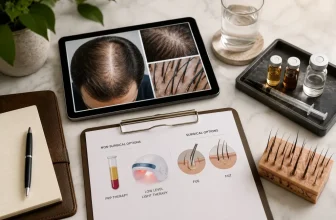
Hair Loss Treatment Options: Medication, PRP, Laser Therapy, and Transplants Compared

Key takeaways
- The right hair loss treatment depends on the cause. Hereditary thinning, stress-related shedding, and alopecia areata are treated very differently.
- FDA-approved medications, such as topical minoxidil and oral finasteride for men, are often the foundation of treatment for pattern hair loss.
- PRP and laser or light therapies are non-surgical options that some patients add. Their regulatory status and evidence vary, so realistic expectations matter.
- A hair transplant moves your own follicles to thinning areas. Candidacy depends on your donor hair and pattern of loss.
- Many plans combine approaches, and most plans for hereditary hair loss include ongoing maintenance.
There is no single best hair loss treatment. There is the right option for your diagnosis, the stage of your hair loss, and your goals. For hereditary thinning, the main paths are medication, non-surgical in-office treatments such as PRP and laser therapy, and hair transplant surgery, often in combination. For other causes, such as a thyroid problem or alopecia areata, treatment targets that condition instead.
Here is how the options compare, including what each one does, who it tends to suit, and what to realistically expect.
First, the diagnosis
According to the American Academy of Dermatology, effective treatment for hair loss begins with finding the cause. That’s because the options below mostly apply to hereditary pattern hair loss (androgenetic alopecia), the most common type. Other types need a different approach:
- Shedding after illness, surgery, childbirth, or major stress often improves on its own once the trigger passes.
- Medical causes, such as a thyroid problem or low iron, are treated at the source.
- Alopecia areata, an autoimmune condition, has its own treatments. See our alopecia areata page.
If you haven’t been evaluated yet, start with our guide to what to expect at a hair restoration consultation.
The options at a glance
| Option | What it is | Surgery? | Often considered for | Commitment |
|---|---|---|---|---|
| Medical management | Prescription and topical medications | No | Early to moderate pattern hair loss; the foundation of many plans | Ongoing daily use; results take months |
| PRP therapy | Injections of a concentrate of your own platelets | No | Early to moderate thinning, often alongside other treatments | A series of sessions plus maintenance |
| Laser and light therapy | In-office lasers or a light-therapy cap | No | Early to moderate thinning | A series of sessions or regular use |
| ARTAS® robotic hair transplant | Robotic-assisted transfer of your own follicles | Yes, minimally invasive | Established thinning or recession with adequate donor hair | One or more procedures, with medical treatment to protect remaining hair |
Medical management
For many patients with pattern hair loss, medication is the starting point. Two treatments are FDA-approved for androgenetic alopecia: topical minoxidil and oral finasteride. Finasteride is approved for men. Other prescription options are sometimes used off-label, depending on your sex, health history, and goals.
What to expect: medication works slowly. A peer-reviewed review notes that topical minoxidil typically takes four to six months to show a visible improvement, and benefits generally last only as long as treatment continues. Every medication has potential side effects, which your provider will review with you.
At Gold Skin Care Center, medical management for hair loss is a physician-supervised program built around your diagnosis, and it often supports other treatments.
PRP therapy
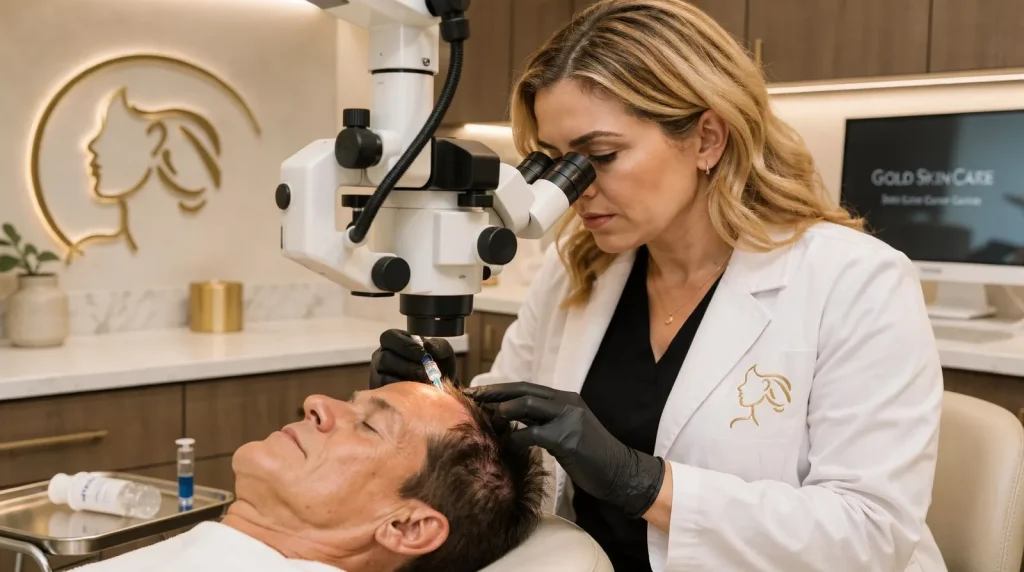
Platelet-rich plasma (PRP) therapy uses a small sample of your own blood, processed to concentrate the platelets, which is then injected into thinning areas of the scalp.
What to expect: PRP has shown benefit for some people with pattern hair loss in clinical studies, but it is not FDA-approved for hair loss, and a 2023 systematic review found that most of the evidence is low quality. Protocols vary, and PRP is often used alongside medication rather than on its own. Learn more about PRP hair therapy at the practice.
Laser and light therapy
The Global Center for Hair Restoration offers several light- and laser-based options:
What to expect: these treatments are generally done as a series or used regularly over time, and they’re typically considered for early to moderate thinning rather than advanced baldness. Your provider can explain the evidence and candidacy for each.
ARTAS® robotic hair transplant
A hair transplant moves your own hair follicles from a donor area, usually the back and sides of the scalp, to thinning or balding areas. ARTAS® robotic hair transplant is a robotic-assisted form of follicular unit extraction (FUE), in which individual follicles are harvested and implanted.
What to expect: candidacy depends on how much healthy donor hair you have and your pattern of loss. Because a transplant doesn’t stop hereditary hair loss from continuing in untreated areas, many patients also use medical treatment to protect the hair they have. Every procedure carries risks, and your provider will explain recovery and what results are realistic for you.
Combining treatments
Many patients do best with more than one approach. For example, medication may be paired with PRP or laser therapy, or used after a transplant to protect existing hair. A good plan explains what each part is meant to do and how long before you can judge whether it’s working.
Hair restoration at Gold Skin Care Center
Board-certified dermatologist Dr. Michael H. Gold founded Gold Skin Care Center in 1990, and the practice’s Global Center for Hair Restoration provides care under his supervision. Dr. Gold also leads the Tennessee Clinical Research Center, which has conducted clinical studies on hair loss among many other conditions. Research participation is voluntary, depends on eligibility, and is separate from routine care. For help weighing providers, see how to choose a hair restoration dermatologist.
What to do next
The best way to narrow these options is an evaluation that identifies the cause of your hair loss. Request an appointment and select “Hair Restoration” as your service of interest, or call (615) 383-2400.
Frequently asked questions
What is the most effective treatment for hair loss?
It depends on the cause and stage. For hereditary pattern hair loss, FDA-approved medications are often the foundation, and a hair transplant can restore coverage for suitable candidates. Other causes, such as thyroid problems or alopecia areata, need their own treatment.
Can hair loss be treated without surgery?
Often, yes, especially in earlier stages. Medication, PRP, and laser or light therapy are all non-surgical. They tend to work best at slowing loss and improving thinning rather than restoring areas that are already bald.
Is PRP better than a hair transplant?
They do different things. PRP is a non-surgical treatment that may help some people with thinning hair. A transplant moves your own follicles to fill in areas of loss. Some patients use both, and the right choice depends on your diagnosis and donor hair.
This article is for general education and is not medical advice. Results vary, and every treatment carries risks. An appointment with a board-certified dermatologist or qualified dermatology provider is the best way to learn which options are right for you.