Please provide your email address to receive an email when new articles are posted on .
We were unable to process your request. Please try again later. If you continue to have this issue please contact [email protected].
Key takeaways:
Nearly 70% of survey respondents reported daily/near daily marijuana use for symptom control.
Use was tied to patient-reported relief of anxiety, joint pain and nausea/vomiting, and better quality of life.
Patients with inflammatory bowel disease who used marijuana reported symptom relief, improved daily functioning and reduced opioid analgesic use, survey results showed.
Prior research indicates some patients with IBD use marijuana to manage disease symptoms or treatment-related adverse events.
Data derived from Daneshmand A, et al. Med Cannabis Cannabinoids. 2026;doi:10.1159/000553354.
Naueen A. Chaudhry
“Marijuana use is prevalent for symptom control among patients with IBD and is rising with legalization; however, it is often not discussed in clinic visits,” Naueen A. Chaudhry, MD, assistant professor of gastroenterology at University of Florida, told Healio. “Physicians managing IBD do not have extensive data on the patient experience and symptom response to marijuana use.”
IBD and marijuana use
The number of U.S. states in which marijuana use currently is legal — 38 states for medicinal use and 24 for recreational — continues to expand. Medical marijuana use is legal in Florida, where this study took place, and Crohn’s disease is an approved indication.
Chaudhry and colleagues administered a 39-question survey to 108 patients at the University of Florida’s IBD clinic who were diagnosed with CD or ulcerative colitis (51.9% women; 50% aged 26 to 45 years; 79.6% CD) and reported using marijuana.
“Our goal was to gain a better understanding of our patients, including their patterns of use, experiences and perceptions of marijuana use in the context of disease-related symptoms,” Chaudhry said.
The majority (82.4%) of patients were on pharmacotherapy for IBD, with more than half (56.5%) reporting current biologic use.
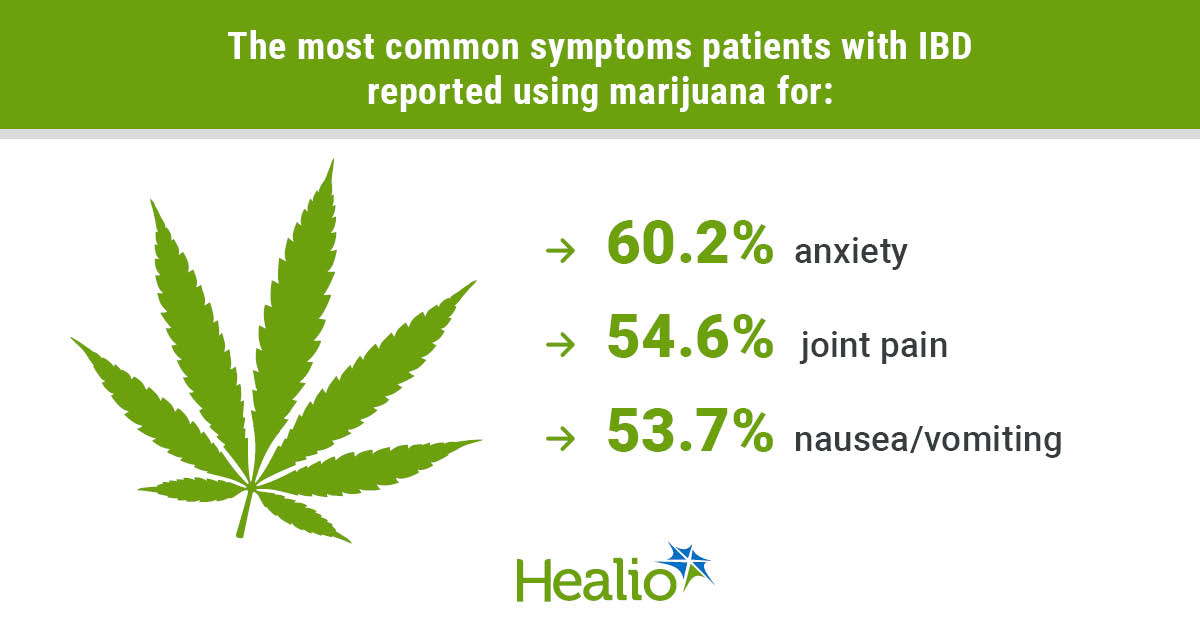
Participants most often used marijuana for anxiety (60.2%), joint pain (54.6%), and nausea and vomiting (53.7%).
Most respondents reported daily or almost daily use (68.3%), and many reported medical marijuana use (61.9%), rather than recreational or combination use.
A total of 87.6% of patients reported improved quality of life with marijuana use, and 59.3% thought marijuana reduced their use of other analgesics.
“Many patients relied on marijuana use to reduce their reliance on opioid pain medications,” Chaudhry said. “This was an interesting insight demonstrating a more judicious approach in this patient population to avoid potential opioid dependence and addiction.”
Those who used marijuana daily or almost daily reported improved ability to live independently (P = 0.0075) and were more likely to be employed (P = 0.04). This frequency of use also was linked to patient-reported relief of nausea and vomiting, joint pain and insomnia.
Chaudhry and colleagues noted that use patterns shifted with age and gender.
Younger respondents (P = 0.0074) and patients with more recent IBD diagnoses (P = 0.006) favored recreational use. Medical use was more common among middle-aged adults and patients with a longer duration of disease.
According to the researchers, women were most likely to use oral non-edibles and men were most likely to smoke marijuana (P = 0.011).
Patient knowledge
Almost all patients (97.9%) indicated they were comfortable informing their physicians about their marijuana use.
“This may reflect a positive trend in destigmatization by the medical field regarding marijuana, which allows patients to be more transparent about their health practices,” Chaudhry and colleagues wrote.
However, only a quarter (24.5%) of patients reported they had been counseled on how marijuana use may interact with other medications.
“Patients are not aware of the potential for drug interactions between marijuana formulations and their prescription medications,” Chaudhry said. “Hence, they may not realize the importance of disclosure of use to their clinical care teams in this context.
“Organized efforts to educate patients on this front are also lacking from the clinical and pharmaceutical perspective,” she continued.
Respondents demonstrated an understanding of marijuana’s impact on disease course, with 67.6% reporting that it did not contribute to improvement in gut inflammation.
Chaudhry and colleagues acknowledged study limitations, including generalizability due to the single-center design, sample size and psychiatric comorbidity burden. Among survey participants, 61.1% reported a formal depression or anxiety diagnosis, and an equal percentage (19.4%) reported having either PTSD or ADD/ADHD.
Most importantly, Chaudhry added, there is potential for bias, as survey respondents were active marijuana users, likely due to having a beneficial response as opposed to experiencing adverse events or poor response.
“Future studies, including patients who chose to avoid marijuana use because of poor response or side effects, will provide a broader insight into the patient experience of marijuana use for IBD-related symptoms,” she said. “Data are also lacking on effective doses and formulations recommended for symptom control, largely because the regulatory framework governing medical cannabis remains fragmented and underdeveloped.”