Please provide your email address to receive an email when new articles are posted on .
We were unable to process your request. Please try again later. If you continue to have this issue please contact [email protected].
Key takeaways:
Although most infants are colonized with C. difficile within their first 2 years of life, they rarely exhibit symptoms.
Emerging research suggests that colonization early in life may have long-term consequences.
Although it does not produce symptoms typically seen in adults, emerging research suggests that Clostridioides difficile does have an impact on infants’ microbiome.
An estimated 40% to 70% of infants are colonized with C. difficile within the first 2 years of life, but they are usually asymptomatic. Researchers have been trying to understand why.
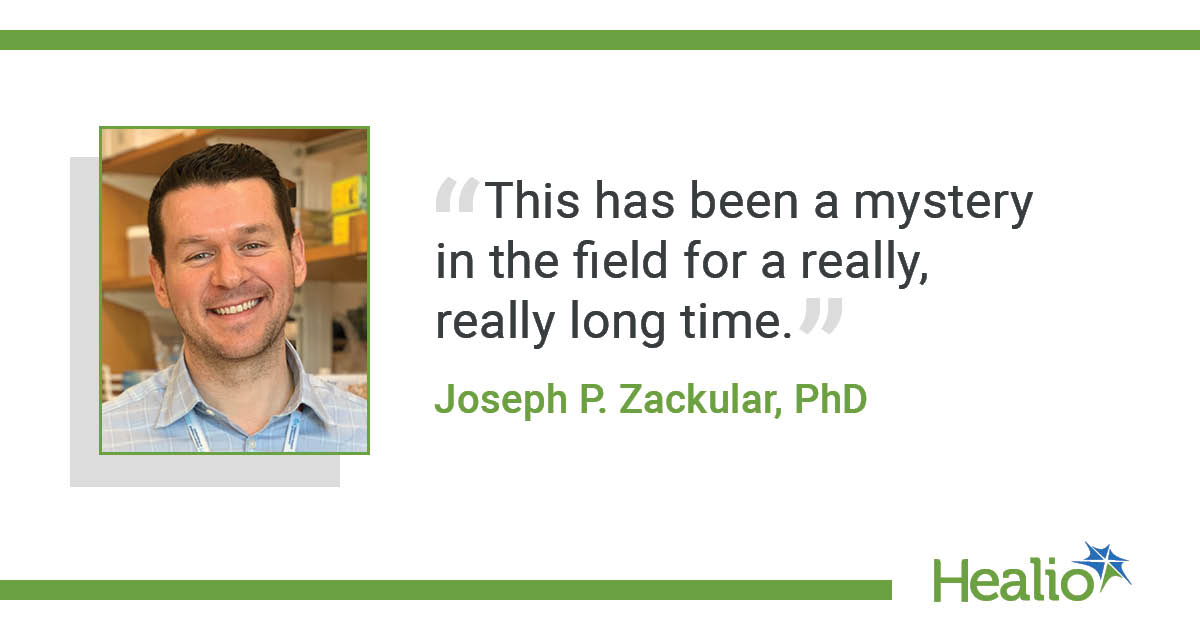
“This has been a mystery in the field for a really, really long time,” Joseph P. Zackular, PhD, codirector of the Center for Microbial Medicine at Children’s Hospital of Philadelphia, told Healio.
Zackular and colleagues at CHOP and the University of Pennsylvania investigated whether C. difficile colonization affects infants and their developing microbiome. In a study published in Science, the researchers learned through mouse models, stem cell organoids and biopsies from human infants that despite there being no observable symptoms, C. diff toxins can cause intestinal damage in neonates.
Zackular said maternal vaccination or monoclonal antibodies could mitigate this damage.
Healio spoke with Zackular about the findings and how it will impact future C. diff research.
Healio: What are the theories for why infants are colonized with C. diff but do not display symptoms?
Zackular: When we are born, we are being rapidly colonized by countless microorganisms. We don’t want to be hyper-responsive to all of these new visitors, so by design, our immune systems are quite tolerant early in life. Also, our epithelium is still developing, our enteric nervous system is underdeveloped, and we think that this leads to a scenario where C. difficile is able to colonize babies under the radar.
Our leading thought is that the C. difficile toxins, which are potent exotoxins that target the epithelium and cause severe disease in adults, are doing what they do and causing damage, but infants lack the classical strong inflammatory immune response that we see in adults. But a lot more work is needed to understand this fascinating phenomenon in babies.
Healio: Can you explain the experiments in your paper and how mouse and organoid models translate to human infants?
Zackular: It can be hard to ask some of these questions, because we are talking about infants, and we can’t do natural experiments in humans.
A mouse model does a nice job of replicating what you see in human infants — if you give baby mice C. diff, it colonizes, it produces toxins and eventually it is cleared as the mouse and the gut microbiome mature, just like we see in human babies. Importantly, they are also asymptomatic, so you can’t tell they are colonized, just like human babies. So, this gives us a really powerful model because we can ask questions about how this pathogen is impacting the developing epithelium, the immune system, and the microbiome. This allowed us to take that holistic view of a C. diff in this asymptomatic environment.
We also used organoid models, which are in vitro systems of grown stem cells that mimic an intestine, and this allowed us to more thoroughly test what was occurring in the mouse. That’s where we were able to show that having been exposed to C. difficile dramatically changes that behavior and function of these stem cells, showing that C. diff being there — even though it is not causing disease — was rewiring that critical stem cell compartment that is important for developing the epithelium.
What is important is that this is just a model system. Even though it is a powerful model, it is important to understand what is happening in humans. At CHOP, we were able to access biopsies and organoids from babies through a collaboration with our colleagues in the Gastrointestinal Epithelial Modeling Program. Even though we weren’t able to acquire a large number of samples, because they are quite rare, we found that healthy babies who were colonized with C. diff, compared with healthy babies without C. diff, did show differences in the behavior of their epithelium that correlated with what we were seeing in the animals.
Healio: You tested a C. diffvaccine in your paper, as well. How did you develop it, and what did you learn?
Zackular: There is currently no C. diff vaccine, but there is a lot of energy and a lot of potential in that space. Two years ago, in collaboration with Drew Weissman, MD, PhD, and Mohamed-Gabriel Alameh, PhD, we developed the first multivalent mRNA lipid nanoparticle vaccine for C. diff. This mRNA vaccine is targeting the toxins, as well as aspects of the spore and the cell itself. We are in the process of bringing that to clinical trials, but it is still early.
With this vaccine in hand, we asked: “Are we able to introduce antibodies into the babies to try to prevent or mitigate the effects we are seeing early in life?” We were thinking about the best ways to deliver antibodies to babies, because we couldn’t vaccinate them directly. We want to get the antibody response up quickly, so that’s where we were excited about a maternal vaccine strategy. If we can get antibodies into their mothers, then they would transfer these antibodies to the baby through breast milk or placental transfer. What we were able to show is that by providing mRNA vaccines to the [mouse] mothers, this mitigated all of the effects that we could see.
An important aspect is that early in life, the microbiome is critical for that developmental window. If you perturb that, it can dramatically impact health long term, because those microbes are important for shaping the immune system. We know that antibiotics are associated with increased risk for diseases like allergy and autoimmunity, so we don’t want to give a baby with C. diff antibiotics. But if we can do something that is more precise, like a vaccine that just targets the toxins themselves and doesn’t impact that ecology and development of the microbiome, that would be really promising. Our work shows that all we really need to do to mitigate the effect of the toxins to prevent the effects of early life C. diff colonization, and we think maternal vaccines or monoclonal antibodies show real promise.
Healio: What is the main takeaway for pediatricians?
Zackular: We want to be careful here because so many babies are exposed to C. diff, and all these babies ultimately grow up healthy. We don’t want to be too alarmist. However, early life is a critical development window, and we are exposed to a large number of organisms following birth. Many of them may be pathogens. Our main takeaway is just because pathogens may not always cause overt disease or overt symptoms does not mean that they are not having a potentially profound impact on the baby or on development.
Healio: What are the next steps in the research?
Zackular: One of the most important takeaways is that these effects are happening early in life, but they are long lived. Long after C. diff has been cleared by these baby mice, we see those effects. We think it is profoundly impactful to the long-term health of the animal and potentially humans. Is it impacting the risk for allergy, inflammation or infection? We are focused on understanding the long-term effect on health.
We are also very interested in understanding why this is happening, what is happening and is there any way to potentially reverse the effects? In order to think about treatment and prevention, we need to understand the nitty gritty: Why? Which toxin is it? Which cell types are targeted? What long-term effects does it have on the immune system?
The final question is that a lot of babies have C. difficile, so is every strain doing the same thing? Does the dose or type of toxin matter? There is a lot of follow-up work to do.
For more information:
Joseph P. Zackular, PhD, is associate professor of pathology and laboratory medicine and associate professor of microbiology at Perelman School of Medicine at the University of Pennsylvania and codirector of the Center for Microbial Medicine at Children’s Hospital of Philadelphia. He can be reached at [email protected].