
A Practical Guide To Earned Media Strategy
A company can buy advertising space or publish an article on its website. Earning a place in someone else’s coverage requires a different approach. A journalist, editor, podcast host, or customer needs a reason to consider the company worth discussing.
For B2B brands, that reason might be original research, a useful explanation, a customer’s experience, or an executive’s perspective. These contributions give other people something to quote, question, recommend, or share beyond the company’s own channels.
An earned media strategy connects those opportunities rather than treating each mention as an isolated PR win. It starts with what your company knows and can demonstrate, then identifies who would find that information useful.
An earned media strategy is a structured plan for generating unpaid third-party exposure through coverage, expert mentions, reviews, recommendations, backlinks, interviews, podcast appearances, and citations. The aim is to build relevant visibility through contributions others choose to recognize.
Key Takeaways
A useful earned media plan should reflect four priorities:
- Create expertise, evidence, and stories worth covering before asking for attention.
- Match each contribution to the right audience, publication, or conversation.
- Combine earned visibility with owned, shared, and paid activity without confusing them.
- Measure coverage quality, audience response, and business influence, not just mention counts.
Want to achieve data-driven growth and brand visibility?
Talk to our team about being featured in our AI-optimized editorial content or directories.
In This Article, We Cover…
What Is Earned Media?
Earned media is exposure generated by third parties rather than directly purchased or fully controlled by your company. Examples include a journalist citing your research, a customer recommending your platform, an editor quoting an executive, or a podcast host inviting your specialist to discuss an industry problem.
Other earned media examples include independent reviews, organic backlinks, research citations, and editorial recognition. However, appearing outside your website does not automatically make something earned. Sponsored content is paid media, even when it looks similar to an editorial article.
The distinction comes down to how the exposure was obtained. Paying people to develop research or manage outreach does not make subsequent independent coverage a paid placement. “Earned” describes the exposure, not an absence of investment in the work behind it.
Earned Vs. Paid Vs. Owned Vs. Shared Media
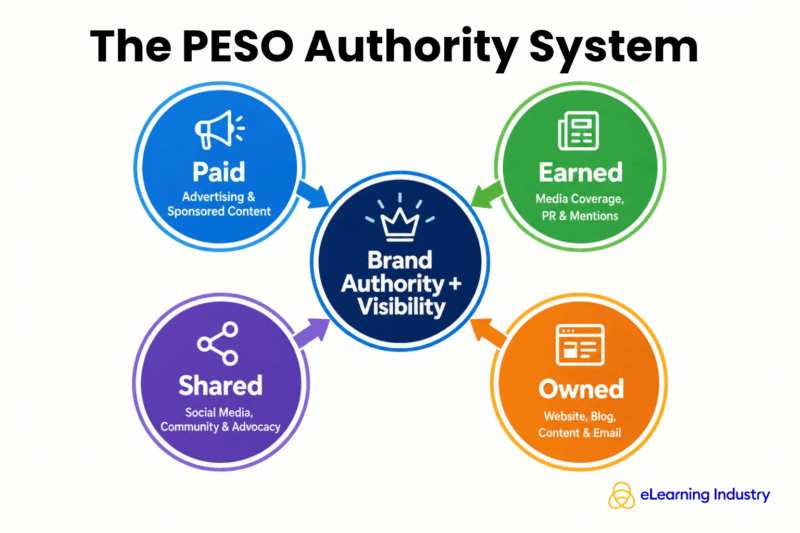
Owned media includes your website, blog, and newsletter. These channels give you substantial control over what you publish and help you build a place where audiences can explore your expertise.
Paid media includes advertisements, sponsorships, and purchased placements. You pay for distribution or exposure, while earned media depends on someone else choosing to cover, quote, or recommend you. Shared media covers social conversations and distribution, where your contribution becomes part of an exchange you do not fully control.
These categories can overlap. An unsolicited customer recommendation is earned recognition, for example, while the social discussion around it also belongs to shared media. The distinction is useful for planning, but it should not lead to counting the same result twice.
Together, paid, earned, shared, and owned form the PESO media ecosystem. You might publish research on your website, earn a journalist’s citation, discuss the findings socially, and use paid promotion to extend their reach. Each activity supports the others, but buying additional distribution does not turn that distribution into earned coverage.
Why Earned Media Matters More In B2B
For SaaS, HR technology, and learning technology companies, visibility needs to be connected to credibility. A company can describe its own expertise, but a relevant publication choosing to quote its specialist provides a different kind of recognition.
That exposure can introduce the business to audiences it does not already reach. It also lets buyers encounter third-party perspectives alongside company-created marketing when researching a vendor, its category, or the problems it addresses.
Executive visibility adds another dimension. An interview or podcast gives people an opportunity to assess how a leader explains decisions and responds to questions. However, publication of that perspective is not an independent endorsement of the company’s products.
Earned coverage can also create referral paths, editorial links, and associations between a brand and a subject. Those references add to the wider information available about the business, including information that AI systems may encounter. The practical value is a broader body of relevant evidence, not a promise of higher rankings or automatic inclusion in AI answers.
What Makes A Brand Earn Media Attention?
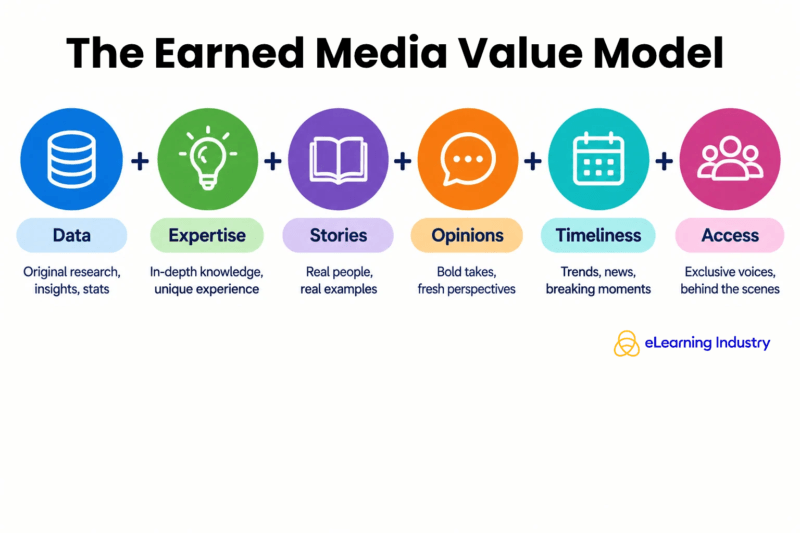
Before asking how to get journalists to mention your brand, ask what you have that is worth their attention. A feature announcement may matter internally, but an outside audience needs a reason to care beyond the fact that your team completed the work. Six types of assets can help you find that reason.
Data and expertise provide evidence and interpretation. Surveys, proprietary datasets, and benchmarks can reveal a useful pattern, while executives and subject-matter experts can explain its significance. The strongest combination gives readers both a finding and a credible account of what it means.
Stories and opinions bring decisions into focus. Customer transformations, implementation setbacks, and lessons learned show what happened in practice. A defensible opinion then helps others reconsider an assumption or understand a trade-off rather than simply repeating familiar advice.
Timeliness and access make a contribution relevant and usable. An industry development may create demand for explanation, while access to customers, specialists, or a distinctive community can make that explanation possible.
This earned media value model brings together data, expertise, stories, opinions, timeliness, and access. You do not need all six for every pitch, but you do need a clear answer to what someone else would gain by covering it.
Build Your Earned Media Strategy: A 6-Step Framework
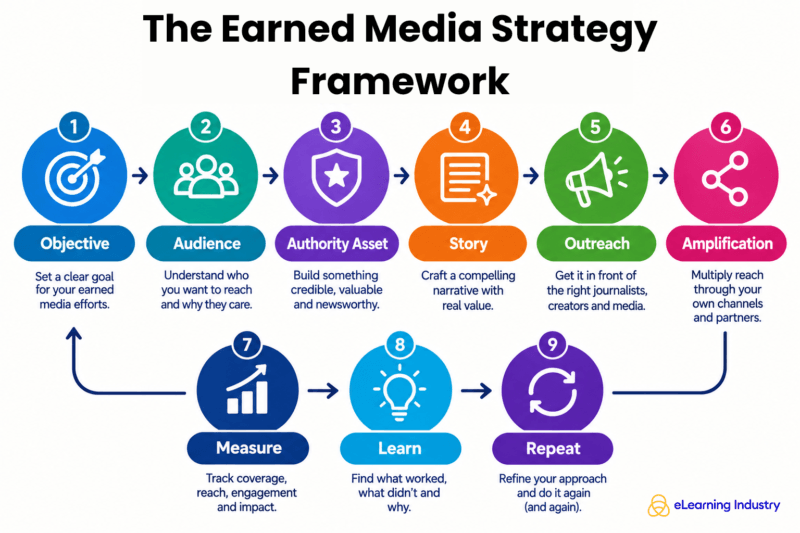
An earned media strategy for B2B should connect business priorities to specific editorial opportunities. The following framework uses a hypothetical learning technology company building authority around responsible AI adoption to show how the decisions fit together.
Step 1: Define The Business Objective
Choose the primary outcome before selecting tactics. Brand awareness, category authority, executive visibility, product credibility, reputation, market entry, and demand generation are related goals, but they do not require identical plans.
For our example company, the objective could be to become a recognized source on practical AI adoption among enterprise learning leaders. That is more useful than asking for general publicity because it defines both the audience and the expertise to demonstrate.
Set expectations for what progress would look like. Relevant citations and invitations to explain the research may be stronger early indicators than an immediate increase in sales enquiries.
Step 2: Define Who You Need To Influence
Separate the people whose decisions matter from the people who help inform those decisions. Learning leaders may be the intended buyers, while journalists, editors, analysts, podcast hosts, and industry communities provide routes to reach them.
Investigate where those audiences already get information. Review publication coverage, podcast topics, contributor backgrounds, and community discussions rather than building a contact list around impressive names.
For the example company, an interview about training governance may fit a specialist learning podcast better than a broad technology show. Select opportunities according to the conversation you need to join, not simply the largest potential audience.
Step 3: Build Your Authority Assets
Next, prepare material that supports the position you want to establish. For the learning technology company, that might include a survey, a customer implementation story, and a practical assessment framework.
Each asset needs enough substance for another person to use it responsibly. Research should explain the sample and limitations, while a customer story should distinguish documented outcomes from interpretation.
Prepare the supporting material before outreach begins. Keep the findings, methodology, approved examples, and expert availability together so your team can answer questions without starting another internal search. A promising pitch loses practical value when the evidence or spokesperson is unavailable.
Step 4: Develop Your Story Angles
An asset is not yet a story. Decide what the information reveals and why that matters to a particular audience.
For example, “We launched an AI feature” describes company activity. A hypothetical alternative, supported by actual research, could be: “Learning teams are struggling to assign responsibility for reviewing AI-generated training.” That angle identifies a problem people can discuss.
The same research might support different stories about leadership, procurement, or instructional design. Adapt the interpretation to each audience without changing the underlying findings. Your strongest angle should come from what the evidence supports, not what would make the most dramatic subject line.
Step 5: Match The Story To The Right Channel
Choose the format after developing the angle. Research findings may suit journalists and industry publications, while executive experience may work better in interviews or podcasts. A practical framework can become a contributed article, and a customer transformation may support a case study.
For our example company, the research lead could discuss findings with an editor while an implementation specialist prepares a podcast conversation about the decisions behind them.
Keep an outreach record showing the recipient, proposed angle, supporting asset, next action, and responsible team member. This helps the team coordinate relationships without treating every contact as another name in a mailing list.
Step 6: Amplify And Compound The Win
Plan what happens after publication. Share relevant coverage through newsletters and social channels, add it to appropriate website pages, and help sales colleagues understand when it would be useful in a conversation.
Avoid turning every placement into a generic announcement that says little beyond “we were featured.” Explain the question discussed and what readers or listeners can learn. Use quotations and excerpts accurately, within the publication’s permissions.
Then review what the opportunity revealed. A journalist’s questions may suggest further research, while a podcast discussion may uncover a useful follow-up article. The cycle is objective, audience, asset, story, outreach, and amplification, followed by measurement, learning, and repetition.
The Best Earned Media Tactics For B2B Brands
The most useful earned media tactics depend on what your company can contribute consistently. Choose a combination your experts and communications team can support rather than attempting every format at once.
- Original research. Surveys and proprietary analysis give others new information to reference. Start with a genuine audience question rather than designing a study to confirm a sales message. For companies developing this asset, eLearning Industry’s SurveyWorks provides a route to audience research. Commissioning research creates material for outreach; independent coverage still has to be earned.
- Expert commentary. Make specialists available to explain developments within their expertise. Prepare relevant examples and establish who can respond, so a promising opportunity does not depend on finding an available spokesperson at the last minute.
- Thought leadership. Develop a perspective that helps readers understand a problem or make a decision. Unpaid editorial contributions can support earned visibility, while sponsored articles provide a separate paid route. Both may belong in the wider plan, but they should be classified accurately.
- Media outreach. Approach journalists and editors with relevant stories, evidence, and access. Our guide to Media Outreach explains how relationship-building supports this work beyond an individual pitch.
- Article pitching. Offer an expert-written contribution that fits a publication’s audience and requirements. The Article Pitch Examples guide explores different approaches, including original research, practical frameworks, executive experience, and lessons learned.
- Podcast guesting. A well-matched conversation gives an executive room to explain decisions, discuss mistakes, and respond to questions. Prepare stories about leadership, growth, AI adoption, or customer problems rather than a spoken product presentation. Review Why Be a Podcast Guest? when planning the approach, and explore eLearning Industry’s podcasts to understand relevant conversations. Check the arrangement: an independent invitation and a purchased appearance are not the same.
- Reviews and recommendations. Make it straightforward for customers to share genuine experiences, including limitations and disappointments. Their independent assessment provides a different perspective from a testimonial your marketing team selects and publishes.
- Awards and industry recognition. Evaluate the relevance and selection criteria behind an award before pursuing it. Resources such as eLearning Industry’s Top Lists can help identify category-specific opportunities. Distinguish editorial recognition from anything purchased, and describe the recognition precisely.
- Customer stories. Build the story around the customer’s challenge, decisions, and outcomes rather than your product alone. The material may support case studies or a discussion in expert interviews. It may also become the basis of a webinar. These formats create useful material, but only independently selected coverage or recommendations should be counted as earned exposure.
How To Pitch Journalists, Editors, And Podcast Hosts
A good pitch answers four questions: Why this subject? Why now? Why this audience? And why is your expert qualified to contribute? For podcasts, add a fifth: what would make this an interesting conversation?
Instead of saying your CEO would love an interview, explain the experience they can discuss. A hypothetical pitch might offer an executive who can describe the adoption mistakes encountered during several enterprise AI projects, supported by approved examples.
The difference is the offer. One asks for visibility; the other gives the host a subject worth exploring. Pitch the insight, not the person, while making the contributor’s relevant experience clear.
Keep the request specific, follow submission preferences, and provide the evidence or access promised. Any follow-up should help the recipient assess the idea rather than pressure them to respond.
Turn Executives Into Earned Media Assets
Corporate announcements are only one source of visibility. Develop recognizable experts whose contributions connect to real responsibilities and experience.
A CEO might address market direction and leadership, while a CMO discusses growth, brand, and buyer behavior. A CTO can explain technology and security decisions, a learning leader can discuss workforce development, and a product leader can examine category changes.
Give each person a clear area of expertise, supported by evidence, stories, and points of view they can defend. Prepare them to explain trade-offs and acknowledge uncertainty rather than steering every answer toward company messaging.
Speaking confidence and availability matter alongside knowledge. Agree on the topics each expert can address and provide opportunities to practise through interviews, webinars, panels, or internal conversations. Over time, relevant articles, podcasts, and expert quotes can connect personal expertise with the corporate brand without making every appearance promotional.
Earned Media, Backlinks, And SEO
Earned media can create editorial backlinks, referral traffic, brand searches, and associations between a business and a subject. An unlinked mention can also introduce the brand to relevant readers, although it should not be treated as equivalent to a backlink.
The strongest approach is to create information others have a reason to reference. An original dataset may lead a journalist to cite a finding and link to its source. That is a clearer editorial relationship than asking for a keyword-heavy link in an unrelated article.
Make the source material useful when people arrive. Readers should be able to understand the finding, its context, and any important limitations rather than landing on a sales page that cannot substantiate the coverage.
Evaluate search visibility alongside referrals and audience relevance. Our Share of Voice SEO guide explores the competitive perspective. Keep that search measure distinct from media Share of Voice, and avoid assuming that a placement caused every subsequent change in rankings or traffic.
Earned Media And AI Visibility: The GEO Opportunity
For brands considering generative engine optimization, or GEO, the question extends beyond what appears on their own website. Consider whether credible external sources connect the company with the topics it wants to be known for.
Industry articles, podcasts, reviews, research, directories, and customer stories can contribute to that wider information footprint. However, repeated claims do not automatically become independent confirmation, and a large number of mentions does not establish that those mentions are accurate or useful.
Focus on citation-worthy assets: original statistics, clear definitions, practical frameworks, benchmarks, datasets, and expert analysis. Make it possible for someone to understand where a claim came from and what it does—and does not—show.
Earned media does not guarantee inclusion in AI-generated answers. It can expand the credible third-party evidence associated with your brand, but you do not control whether a system retrieves or cites a particular page.
The goal is therefore to become a useful source and a company credible sources have reason to discuss. That is a more defensible direction than treating earned mentions as a formula for manipulating AI recommendations.
How To Measure Earned Media Performance
Start with the business objective, then measure visibility, authority, engagement, and business impact. Advertising value equivalency, which estimates what comparable advertising space would cost, does not establish what the coverage achieved.
Visibility
Track relevant mentions, coverage, podcast appearances, and media Share of Voice. Define the competitors, topics, channels, and reporting period consistently. Treat potential reach as context rather than proof that every person in an outlet’s audience encountered your contribution.
Authority
Assess publication relevance, research citations, expert quotations, editorial backlinks, and executive mentions. Review the substance: a passing reference, a detailed interview, and a critical mention are different outcomes. Also distinguish original coverage from repetitions of the same story.
Engagement
Look at referral visits, branded search, social responses, and consumption of the underlying research or content. Consider what people did after encountering the coverage, while recognizing that other marketing activity can influence the same measures.
Business Impact
Work with sales to record relevant conversations, target-account engagement, leads, partnerships, and influenced pipeline. Speaking invitations and requests for further expert input can also indicate that the work reached people who found it useful.
Avoid assigning an entire opportunity to one article merely because it appeared somewhere in the buyer’s journey. Combine observable activity with what prospects and sales colleagues can actually confirm.
Review the findings together rather than choosing one flattering total. A single mention in a publication your buyers trust can be more useful than dozens on unrelated websites. Use the results to decide which assets, experts, and relationships deserve further attention.
Common Earned Media Strategy Mistakes
Most mistakes begin with treating attention as something the company is owed. Product-only pitches, generic commentary, and mass emails ask the recipient to find relevance that the sender has not established.
Watch for three recurring problems:
- Weak preparation: No original insight, limited audience research, or unavailable experts.
- Poor outreach: Identical pitches, backlink demands, promotional interview requests, or excessive follow-ups.
- Incomplete follow-through: Ignored customer stories, unused coverage, and measurement based only on volume.
- Another mistake is treating earned media as a single campaign. Relationships and expertise need attention between announcements, not only when the business wants publicity.
Conclusion
An earned media strategy starts with what your company can contribute, not the number of contacts in a press list. Research, expertise, customer experiences, and thoughtful perspectives create reasons for other people to cover, quote, or discuss the business.
Build those assets around a clear objective, match them to relevant audiences, and prepare your experts to be useful. Then make each earned opportunity part of the wider marketing effort through sensible amplification and measurement.
You cannot control every editorial decision, but you can control the quality and reliability of your contribution. That is the foundation of an approach that builds authority beyond occasional publicity.
FAQ
An earned media strategy is a structured plan for gaining unpaid third-party visibility through media coverage, expert mentions, reviews, podcast appearances, backlinks, interviews, recommendations, and other independent references. Instead of relying on occasional PR outreach, it gives a company a repeatable way to turn its expertise, research, customer stories, and executive perspectives into opportunities for relevant coverage.
Earned media can include news coverage, journalist mentions, expert quotes, podcast invitations, interviews, organic backlinks, customer reviews, industry awards, research citations, and unsolicited recommendations. Organic social mentions and references in industry articles can also count. The main distinction is that the company does not directly purchase or fully control the exposure.
Earned media comes from third parties choosing to mention, quote, review, or cover a company. Paid media includes advertising, sponsorships, and other exposure a company purchases. Owned media covers channels the business controls, such as its website, blog, and newsletter. These channels often work together. For example, a company might publish original research on its website, earn media coverage based on the findings, and then use paid promotion to extend the reach of that coverage.
Start by creating something that journalists, editors, podcast hosts, or industry experts would genuinely find useful. That might be original research, proprietary data, expert commentary, a customer story, or a timely perspective on an industry change. Then match the idea to the right publication or channel and explain why it matters to that specific audience. Strong earned media outreach focuses on the value of the story or insight, rather than simply asking for brand exposure.
Earned media should be measured across visibility, authority, engagement, and business impact. Useful metrics can include media mentions, relevant coverage, podcast appearances, Share of Voice, editorial backlinks, research citations, referral traffic, branded search, leads, target-account engagement, and influenced sales conversations. Quality matters as much as volume, so one strong mention in a publication your buyers trust may be more valuable than many mentions on unrelated websites.
Earned media can support SEO by generating relevant backlinks, referral traffic, brand mentions, and stronger associations between a company and the topics it is known for. It may also contribute to a broader third-party information footprint that AI systems can encounter when generating answers. However, earned coverage does not guarantee higher rankings, AI citations, or inclusion in AI-generated responses. The stronger approach is to build a consistent body of credible, relevant information that other trusted sources have a reason to reference.