Published by:


Ask a clinical question and tap into Healio AI’s knowledge base.
- PubMed, enrolling/recruiting trials, guidelines
- Clinical Guidance, Healio CME, FDA news
- Healio’s exclusive daily news coverage of clinical data
September 22, 2026
2 min read
Bariatric surgery decreased nearly 65% among Medicare beneficiaries between 2014 and 2024, with the trend beginning prior to the COVID-19 pandemic and increased use of GLP-1s for weight loss, according to a research letter.
“Bariatric surgery is … a very resource-intensive service line, so below a certain threshold, hospitals may simply stop offering it,” Ryan Howard, MD, MS, DABOM, of the University of Michigan, told Healio, adding that several bariatric surgery programs have recently closed.
To identify shifts in bariatric surgery utilization, Howard and colleagues conducted a national interrupted time-series analysis from 2014 to 2024 of the annual rates of primary bariatric surgeries performed per 100,000 fee-for-service Medicare beneficiaries.
The researchers determined two periods of interruption in their analysis: 2020, reflecting the COVID-19 pandemic’s impact on surgery utilization, and 2022, representing Medicare’s coverage of tirzepatide (Mounjaro/Zepbound, Eli Lilly & Co.) for type 2 diabetes and increased GLP-1 receptor agonist prescriptions.
Overall, Howard and colleagues observed a 64.8% decrease in bariatric surgery during the 10-year analysis period, falling from 47.1 procedures to 16.6 procedures per 100,000 beneficiaries.
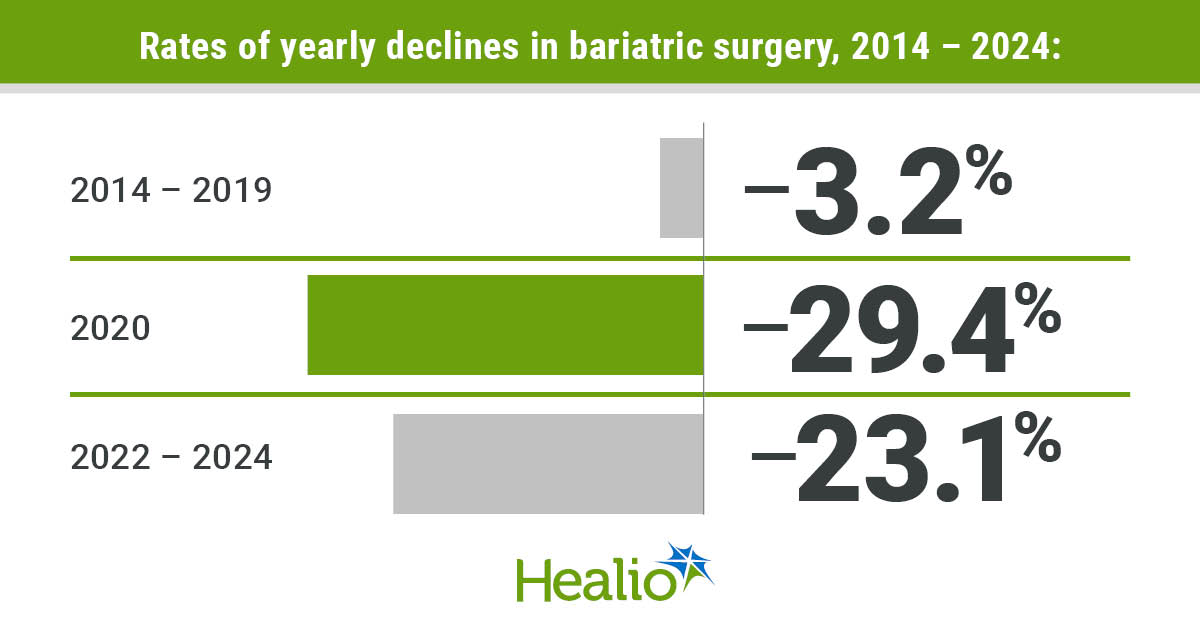
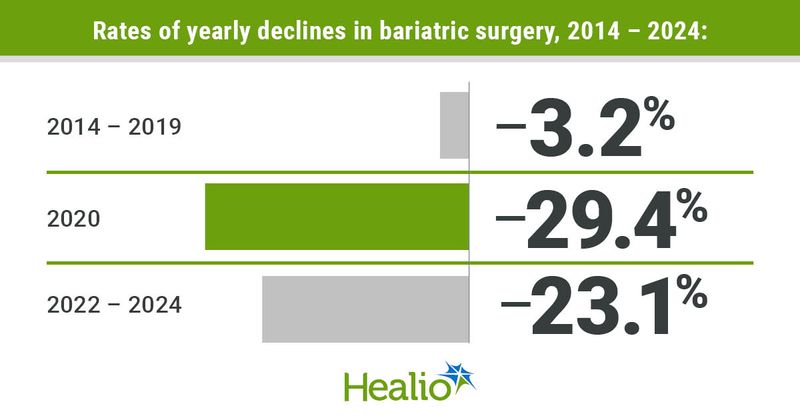
Specifically, declines in surgery utilization were most prominent during three separate periods:
The researchers noted that the actual rate of bariatric surgeries performed between 2020 and 2024 — 21,671 — was 33% lower than the rate projected in the years observed before the COVID-19 pandemic.
Although the rate fell in 2020 and remained below the levels observed prior to the pandemic, Howard told Healio that “utilization was already falling about 3% per year before 2020, [which] reflects long-standing barriers in this population.”
Notably, limited referrals from primary care physicians, complications to completing the workup and lowered Medicare reimbursement rates for bariatric surgery contextualize the overall decline observed among fee-for-service beneficiaries, Howard said.
Howard and colleagues noted several limitations, including a reduced ability to examine patient-level factors, such as comorbidities and treatment eligibility.
“The pandemic exposed how fragile access was — deferred cases in Medicare became permanent cancellations rather than a backlog waiting to be cleared, and the population that lost access is older and sicker than other payers,” Howard said.
However, bariatric surgery remains a steadfast, safe approach for patients with obesity, the authors wrote.
“As Medicare expands GLP-1 coverage, we need to make sure surgery is preserved as an available option, and that the choice between medication and surgery is an informed one made with patients rather than one dictated by whichever treatment is easiest to access,” Howard told Healio.
Ryan Howard, MD, MS, DABOM, assistant professor of surgery and associate director of the adult bariatric program at the University of Michigan, can be reached at [email protected].
Ask a clinical question and tap into Healio AI’s knowledge base.