Subscribe to our ▶️ YouTube channel 🔴 for the latest videos, updates, and tips.
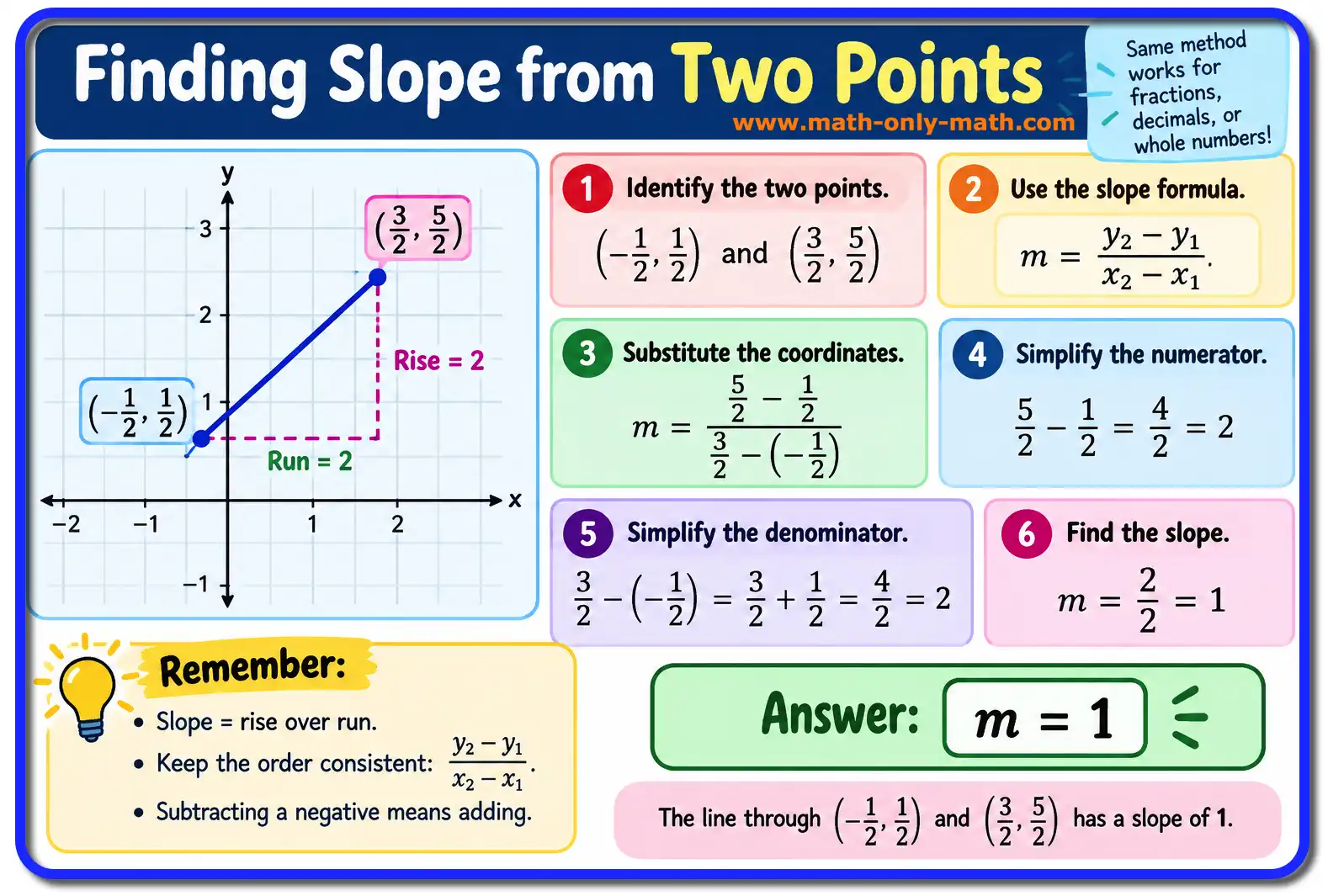
Learning how to find slope from two points with fractions is an important Grade 8 math skill. Slope describes how much a line rises or falls as the x-value changes, and it is often written as a fraction. To find the slope between two points, use the slope formula and carefully subtract the y-coordinates and x-coordinates. When the coordinates contain fractions, students also need to know how to subtract fractions, work with negative numbers, and simplify the final answer. In this lesson, you will learn how to find the slope from two points step by step, including examples with positive and negative fractions. You will also learn how to recognize positive, negative, zero, and undefined slopes, avoid common mistakes, and practice finding fractional slopes. These skills are useful when working with graphs, linear equations, rates of change, and real-world problems.
What Is Slope?
Slope tells us how steep a line is. It compares the change in the y-values with the change in the x-values.
Where:
- m = slope
- y₂ − y₁ = change in y
- x₂ − x₁ = change in x
Slope = rise ÷ run
How to Find Slope from Two Points
Follow these 4 simple steps to find the slope between two points with fractions.
1
Identify the two points
Suppose the two points are:
(
1
2
,
3
4
)
and
(
5
2
,
7
4
)
2
Use the slope formula
m
=
y2 − y1
x2 − x1
3
Substitute the coordinates
Put the y-values in the numerator and the x-values in the denominator.
m
=
7
4
−
3
4
5
2
−
1
2
4
Simplify
Numerator:
7
4
−
3
4
=
4
4
= 1
Denominator:
5
2
−
1
2
=
4
2
= 2
Therefore,
m
=
1
2
✓
Answer:
The slope is
1
2
.
Note:
Keep the subtraction order the same.
If you use
y₂ − y₁,
you must also use
x₂ − x₁.
Finding Slope When Both Coordinates Are Fractions:
When both points contain fractions, use the slope formula and simplify
the numerator and denominator carefully.
Example
Find the slope between:
(
−2
3
,
1
2
)
and
(
4
3
,
5
2
)
1
Use the slope formula
m
=
y2 − y1
x2 − x1
2
Substitute the coordinates
m
=
5
2
−
1
2
4
3
−
(
−2
3
)
4
Simplify the denominator
4
3
−
(
−2
3
)
=
4
3
+
2
3
=
6
3
=
2
Therefore,
m
=
2
2
=
1
✓
Answer:
The slope is m = 1.
💡
When subtracting a negative number, remember:
Subtracting a negative = adding.
4/3
− (−2/3)
=
4/3
+ 2/3
Finding Slope from Two Points Step by Step:
Follow these steps to find the slope between two points, including
points with fractional coordinates.
| Step | What to Do |
|---|---|
| 1 |
Identify (x1, y1) and (x2, y2) . |
| 2 |
Write the slope formula: m = (y2 − y1) / (x2 − x1) |
| 3 | Substitute the coordinates carefully into the formula. |
| 4 |
Subtract the y-values to find the change in y. |
| 5 |
Subtract the x-values to find the change in x. |
| 6 | Simplify the resulting fraction. |
| 7 |
Check the sign of the slope. A positive slope rises from left to right, while a negative slope falls from left to right. |
💡
Important Reminder
Keep the order consistent.
If you calculate:
y2 − y1
then the denominator must be:
x2 − x1
Don’t use
y2 − y1
and
x1 − x2,
because that changes the sign of the slope.
Worked Examples:
Finding Slope from Two Points: Solved Examples
Learn how to find the slope between two points with these
step-by-step examples. The examples include fractions,
negative numbers, and integer coordinates.
Find the slope between the following two points:
(
1
2
,
1
4
)
and
(
5
2
,
5
4
)
Step 1: Use the slope formula
m
=
y2 − y1
x2 − x1
Step 2: Substitute the coordinates
m
=
5
4
−
1
4
5
2
−
1
2
Step 3: Simplify the numerator
Step 4: Simplify the denominator
✓
Answer:
m = 12
Find the slope between:
(−
1
2
,
3
4
)
and
(
3
2
, −
5
4
)
Step 1: Substitute into the slope formula
m
=
−
5
4
−
3
4
3
2
−
(−
1
2
)
Step 2: Simplify the numerator
−
5
4
−
3
4
=
−
8
4
= −2
Step 3: Simplify the denominator
3
2
− (−
1
2
)
=
3
2
+
1
2
= 2
Step 4: Divide
m
=
−2
2
= −1
✓
Answer: m = −1
Find the slope between (2, 3) and (6, 11).
Step 1: Use the slope formula
m
=
11 − 3
6 − 2
Step 2: Subtract the y-values
Step 3: Subtract the x-values
Step 4: Divide
m
=
8
4
= 2
✓
Answer: m = 2
Find the slope between (−2, −1) and (4, 2).
Step 1: Substitute into the formula
m
=
2 − (−1)
4 − (−2)
Step 2: Simplify the numerator
Step 3: Simplify the denominator
Step 4: Simplify the fraction
m
=
3
6
=
1
2
✓
Answer: m = 1/2
Find the slope between:
(
1
2
,
2
3
)
and
(
5
2
,
5
3
)
Step 1: Substitute the coordinates
m
=
5
3
−
2
3
5
2
−
1
2
Step 2: Simplify the numerator
Step 3: Simplify the denominator
✓
Answer: m = 1/2
Note:
The x-values use denominator 2 and the y-values use denominator 3.
Each subtraction can be simplified directly because the two
fractions being subtracted have the same denominator.
Find the slope between:
(−
3
4
, −
1
2
)
and
(
5
4
,
3
2
)
Step 1: Substitute into the slope formula
m
=
3
2
− (−
1
2
)
5
4
− (−
3
4
)
Step 2: Change subtraction of a negative to addition
3
2
− (−
1
2
)
=
3
2
+
1
2
= 2
5
4
− (−
3
4
)
=
5
4
+
3
4
= 2
Step 3: Divide
m
=
2
2
= 1
✓
Answer: m = 1
Remember:
Subtracting a negative number is the same as adding the positive
number.
Quick Review
- Use the slope formula:
m = (y2 − y1) /
(x2 − x1). - Keep the order of the coordinates consistent.
- When subtracting a negative, change subtraction to addition.
- Simplify the final fraction whenever possible.
- A positive slope rises from left to right, while a negative slope
falls from left to right.
Types of Slope:
Finding slope from two points is easier when you follow the same steps every time.
When fractions and negative numbers are involved, a small sign or order mistake
can change the answer. Here are four common mistakes to watch for.
Mistake 1: Mixing Up x and y
Students sometimes put the change in the x-values on top and the change
in the y-values on the bottom.
❌ Incorrect
x2 − x1
y2 − y1
✓ Correct
y2 − y1
x2 − x1
Remember: Slope is rise over run.
The change in y goes in the numerator and the change in x goes in the denominator.
Mistake 2: Forgetting Parentheses Around Negative Numbers
When subtracting a negative fraction, use parentheses so the signs are clear.
2
3
−
(
−
1
3
)
=
2
3
+
1
3
Subtracting a negative changes the operation to addition:
−(−) = +.
Mistake 3: Changing the Order Only Once
You may reverse the order of the two points, but you must reverse the
order in both the numerator and denominator.
Original order
y2 − y1
x2 − x1
Both reversed
y1 − y2
x1 − x2
Both the numerator and denominator change signs, so the two negative
signs cancel. The slope stays the same.
Remember: If you switch the order of the points,
switch it everywhere.
Mistake 4: Not Simplifying the Final Fraction
After calculating the slope, always check whether the fraction can be simplified.
Before simplifying
4
6
Simplified answer
2
3
Since 4 and 6 have a common factor of 2:
4 ÷ 2 = 2 and 6 ÷ 2 = 3.
Therefore, 4/6 = 2/3.
Quick Slope Checklist
- Use rise over run: change in y ÷ change in x.
- Put parentheses around negative coordinates and fractions.
- Keep the order of the points consistent in both numerator and denominator.
- Simplify the final fraction whenever possible.
Common Mistakes When Finding Slope with Fractions:
Finding slope from two points is easier when you follow the same steps every time.
When fractions and negative numbers are involved, a small sign or order mistake
can change the answer. Here are four common mistakes to watch for.
Mistake 1: Mixing Up x and y
Students sometimes put the change in the x-values on top and the change
in the y-values on the bottom.
❌ Incorrect
x2 − x1
y2 − y1
✓ Correct
y2 − y1
x2 − x1
Remember: Slope is rise over run.
The change in y goes in the numerator and the change in x goes in the denominator.
Mistake 2: Forgetting Parentheses Around Negative Numbers
When subtracting a negative fraction, use parentheses so the signs are clear.
2
3
−
(
−
1
3
)
=
2
3
+
1
3
Subtracting a negative changes the operation to addition:
−(−) = +.
Mistake 3: Changing the Order Only Once
You may reverse the order of the two points, but you must reverse the
order in both the numerator and denominator.
Original order
y2 − y1
x2 − x1
Both reversed
y1 − y2
x1 − x2
Both the numerator and denominator change signs, so the two negative
signs cancel. The slope stays the same.
Remember: If you switch the order of the points,
switch it everywhere.
Mistake 4: Not Simplifying the Final Fraction
After calculating the slope, always check whether the fraction can be simplified.
Before simplifying
4
6
Simplified answer
2
3
Since 4 and 6 have a common factor of 2:
4 ÷ 2 = 2 and 6 ÷ 2 = 3.
Therefore, 4/6 = 2/3.
Quick Slope Checklist
- Use rise over run: change in y ÷ change in x.
- Put parentheses around negative coordinates and fractions.
- Keep the order of the points consistent in both numerator and denominator.
- Simplify the final fraction whenever possible.
Practice Problems:
Find the slope between each pair of points. Choose your answer to get
immediate feedback. Your final score will appear after all 12 problems are completed.
Slope formula:
m =
y2 − y1
x2 − x1
— remember: rise over run.
Tip: Keep the subtraction order consistent in both the numerator
and denominator, and simplify your final fraction.
Interactive Quiz:
Finding Slope with Fractions
Answer one question at a time. Use the hint when you need help. At the end, review every answer and your final score.
Answer Review
| # | Question | Your Answer | Correct Answer | Result |
|---|
Real-Life Example of Slope with Fractions:
Slope is not only used on graphs. It can also describe how quickly something
rises, falls, or changes in real life.
A hiking trail rises
3
4
mile while the horizontal distance increases by
3
2
miles.
Step 1: Write the slope as rise over run.
m =
3
4
3
2
Step 2: Divide by a fraction by multiplying by its reciprocal.
m =
3
4
×
2
3
Step 3: Multiply and simplify.
m =
6
12
=
1
2
So, the slope of the hiking trail is
1
2
.
Why this matters:
The slope tells us the trail’s rate of change. A slope of
1
2
means the trail rises 1 mile for every 2 miles of horizontal distance.
Frequently Asked Questions about Finding Slope from Two Points with Fractions:
Answer:
The formula is m = \( \frac{y_{2}-y_{1}}{x_{2}-x_{1}}\), where the two points are (x1,y1) and (x2, y2).
Answer:
Substitute the fractional coordinates into the slope formula, subtract the y-values, subtract the x-values, and simplify the resulting fraction.
Answer:
Find a common denominator when necessary, subtract the numerators, and simplify the result.
Answer:
Yes. A slope can be a positive or negative fraction, such as \(\frac{2}{3}\) or -\(\frac{4}{5}\).
Answer:
A negative slope means that the line decreases as you move from left to right.
Answer:
The slope is undefined because division by zero is not possible.
About Author

Written by Priyanka Ghosh
Mathematics Educator | Founder of Math Only Math
Priyanka Ghosh has been teaching elementary and middle-school mathematics for over 12 years and specializes in creating simple, child-friendly math lessons and worksheets.
Related Resources:
Didn’t find what you were looking for? Or want to know more information
about Math Only Math.
Use this Google Search to find what you need.