Please provide your email address to receive an email when new articles are posted on .
We were unable to process your request. Please try again later. If you continue to have this issue please contact [email protected].
Key takeaways:
Consider your motivations when making a big career change.
Finding a trusted mentor or coach can be valuable to making a career change.
The first step in making a big career change is recognizing your “early symptoms,” according to an expert.
At the 2026 Women in Nephrology Annual Leadership Conference, Nuria Maria Pastor-Soler, MD, PhD, associate professor of medicine at University of Vermont, will speak to women in medicine considering a career change and how to navigate the complex emotions and practical concerns that come with making a career shift.
“I want to talk about what it takes to start thinking about a career pivot and how to identify those ‘early symptoms’ of wanting to pivot,” Pastor-Soler told Healio.
Healio spoke with Pastor-Soler ahead of the meeting to learn more about the first steps of making a career change.
Healio: What was your career trajectory like?Have you always known what you wanted to do?
Pastor-Soler: Originally, I did not know that I wanted to become a kidney doctor. When I was very young, I thought I could not be a physician because all the role models I had were male doctors. My father told me, no, you can be a doctor and there are women in medicine who are doctors.
When I graduated with an MD-PhD and became an internal medicine resident, I decided I wanted to do another specialty. I met two remarkable women who were nephrologists, and they encouraged me to pursue a career in the field. From there, I applied for a research-based nephrology fellowship.
Healio:What will your session at the Women in Nephrology Conference cover?
Pastor-Soler:I’m going to talk about career pivots, and I define these as intentional changes in your career direction. Many experts determine the genesis of a pivot as a feeling of dissatisfaction about where we are in our career. I want to reframe the idea more positively as a feeling that your potential as someone in the kidney health field could be fulfilled beyond your current position.
In my own experience, I have moved within the academic world. However, I have seen mentees who transitioned to a completely different field, such as academia to industry or academia to policy. That takes a lot of courage. We often bring women who have successfully made it to the top of the ladder in industry or government to leadership conferences. However, there are a lot of other women who don’t necessarily go into leadership roles but still have fulfilling lives in new positions.
Healio: What pros and cons should clinicians weigh before considering abig career change?
Pastor-Soler:The first thing you can do when thinking about a pivot is to name it. Sometimes, the first feeling you have may be negative, but naming it can help dispel those negative feelings. The feeling can also be positive, for example, if you see a colleague and think, “I really like what she or he is doing.” Remove all feelings of guilt or shame and find somebody who can help with the transition, like a trusted mentor or coach.
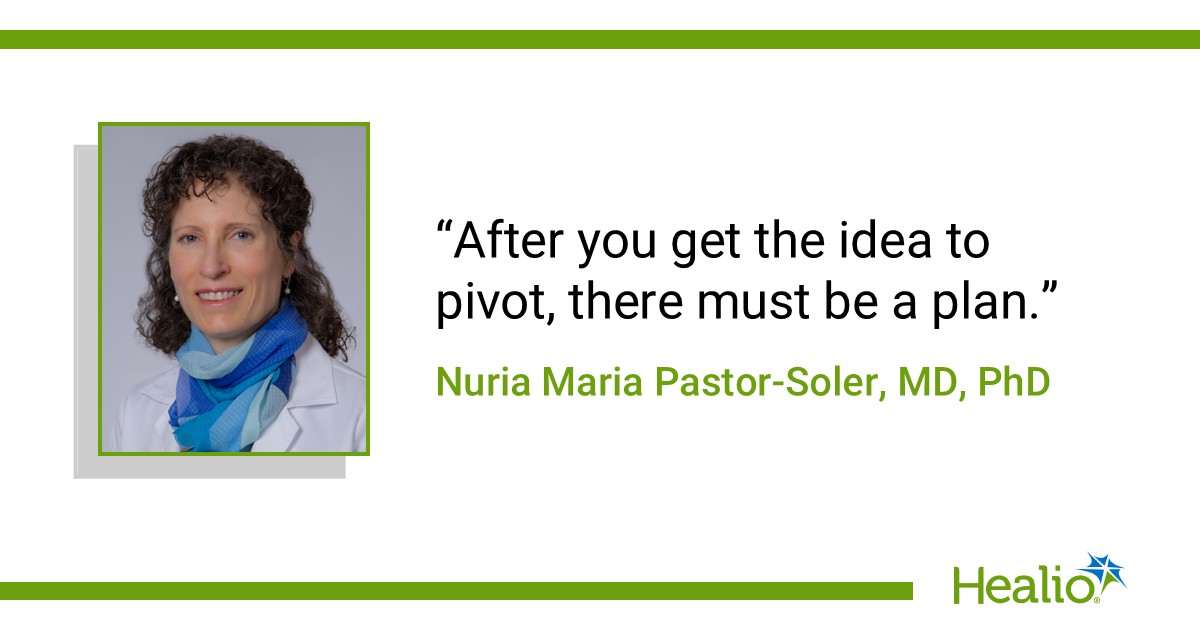
After you get the idea to pivot, there must be a plan. You may realize you’ll have to take a pay cut or move to a new location to make this plan happen.
There is also, as we call it in science, this activation energy describing the energy we put into something to make a change happen. To gather that activation energy involves a lot of searching for one’s own identity and available resources, including personal, community-related and material resources. If the current environment is not toxic, then you have more time to create the best possible plan. For example, if you are a healthcare provider and you want to become a public health practitioner, you need to think about whether you can work with less resources while you obtain the right credentials or make sure your schedule for your full time job allows you to dedicate enough time to learn about the field that you want to move into.
It’s also normal to disappoint certain people in your circle. For example, your current boss may be depending on you to remain in your current position, or your current research team is hoping that you will continue your research in a certain direction. It’s important to be able to take comments from disappointed team members without resentment and say, “OK, I was not expecting that negative response, but I understand where they are coming from.” At the same time, you must also protect yourself from manipulation. If your employer tells you that you’ll get a small raise for staying in a current job that is not fulfilling, that raise may tempt you to stay in your current position, especially if you were about to take a pay cut in the new, more fulfilling position.
Healio: How might career decisions differ based on the stage of your career or your skillset?
Pastor-Soler:Many pivots that happen early in one’s career have to do with lifestyle and finances. Later on, I have witnessed more pivots that have to do with being true to one’s values. For example, if you have three kids that you want to put through private school, you may need a strong financial pool to do so. If your value is to give your children this kind of education, you will likely need to make a career decision that makes sense financially.
Healio: What is a key piece of advice you’d give to clinicians considering a big career change?
Pastor-Soler:The most important things to think about are your motivations and how to plan. Most medical students follow this straightforward path: Get good grades, pass the boards, apply for the match. We’re good at following landmarks on this path. Then, later on, when one starts a career, there might be a sign pointing toward physician-scientist, one pointing toward clinician-educator or another toward industry. Once you are approaching your unique professional and lifestyle destination, you’re on your own ship in an open sea. You have the coordinates or description of where you want to go, just as your role model did, but the sea that you are navigating is different than that of your predecessors and your ship is different, so you need to know yourself and what you can handle when sailing to your destination.
Healio: Do you have anything else to add?
Pastor-Soler: We are encountering a time where mentoring is difficult because the changes in the workplace are moving exponentially fast. The best way you can prepare is to take care of yourself as a person so that you are mentally prepared to uncover your true path and take on changes and opportunities. This type of preparation takes a lot of reflective work, and many of us in healthcare are not used to that type of self-care.
The word “pivot” is going to be increasingly part of our vocabulary as the workforce changes with the advent of technologies like artificial intelligence and personalized health. It’s not about how you pivot, necessarily, but how you prepare yourself so that, when the circumstances are right to start a transition, you’re being authentic to yourself.
For more information:
Nuria Maria Pastor-Soler, MD, PhD, can be reached at [email protected].